
⌕ Search
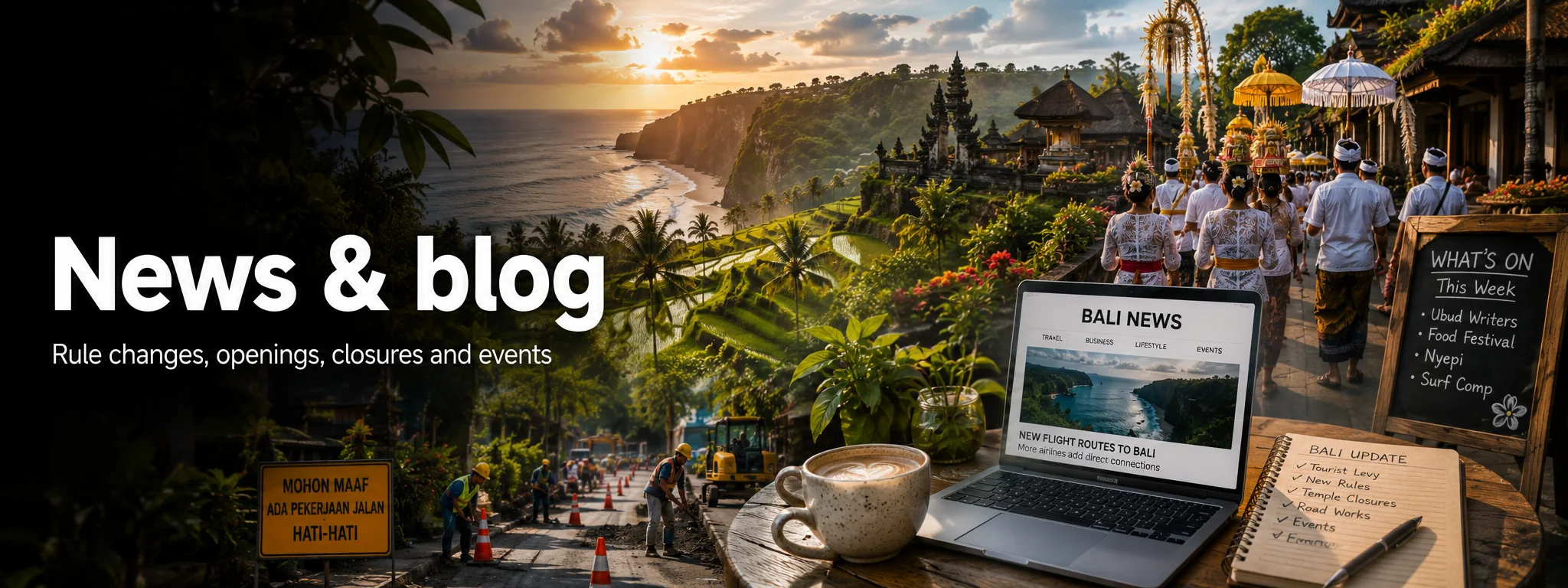
The changes that can alter a Bali trip: entry rules, visitor levies, transport, flights, infrastructure, public-health notices and tourism policy.
Checked and updated for travellers
A useful Bali news page should not be a diary of website updates. It should answer a harder question: what has changed that could affect an actual trip? We track entry requirements, visitor charges, transport, flights, public-health notices, major infrastructure and tourism policy, then link the news back to practical planning guides.
Bali's arrival process now combines several separate requirements. Check your visa or visa-free eligibility, complete the All Indonesia arrival declaration, and deal with Bali's foreign tourist levy separately. Our entry guide explains which step is which.
Health advice can change faster than a normal travel article. Our safety guide carries the current traveller notices at the top — including mosquito-borne disease alerts — and links back to primary health authorities.
Old Bali advice often says public buses are effectively nonexistent. That is no longer a safe assumption: Trans Metro Dewata is operating again, alongside taxis, ride-hailing and private drivers.
Bali's biggest practical story is often not a new attraction but movement: a new direct route can change how easy the island is to reach, while roadworks, airport changes or public-transport decisions can change how long a day trip takes. We separate confirmed developments from proposals and political announcements.
Visitor statistics are useful when they are treated as statistics, not as evidence that Bali is either “dead” or “overrun”. Bali's statistics office recorded 605,013 direct foreign tourist arrivals in June 2026, up 4.63% from May; Australian passport holders accounted for 25.90% of the June total. The more useful takeaway for a traveller is that overall demand remains high, but crowding is extremely uneven by season, district and time of day.
For raw numbers we prefer BPS Bali's official tourism releases rather than recycled social-media claims.
Season labels are only a starting point in Bali. In 2026, BMKG guidance has pointed to an earlier and comparatively drier dry season in many areas, while local conditions still vary sharply between the Bukit Peninsula, the south coast, Ubud and mountain districts. Check the planning guide rather than treating a generic weather app as an island-wide forecast.
Bali is also pushing lower-emission tourism areas in Nusa Dua, Kuta, Ubud, Sanur and Nusa Penida, alongside existing restrictions on certain single-use plastics. Those are policy directions worth watching because they can affect transport, hotels, restaurants and visitor behaviour over time. Bali Provincial Government announcement →
Month-by-month rainfall, crowds, Nyepi, surf and 2026 season context.
What Bali's Day of Silence means for flights, roads, hotels and visitors.
Practical etiquette, temple behaviour and ways to be a better guest in Bali.
We include a development when it can materially affect travellers, residents working in tourism, or the experience of visiting Bali. That includes a rule change, confirmed transport service, significant route launch, airport procedure, public-health notice, closure, major attraction opening, environmental policy or reliable tourism data. We do not pad this section with stories about Totally Bali itself.
Announcements are labelled carefully. A proposed railway, road, attraction or regulation is not treated as operational until there is evidence it has actually started. For fast-changing subjects, use the linked official source as the final check immediately before travel.