
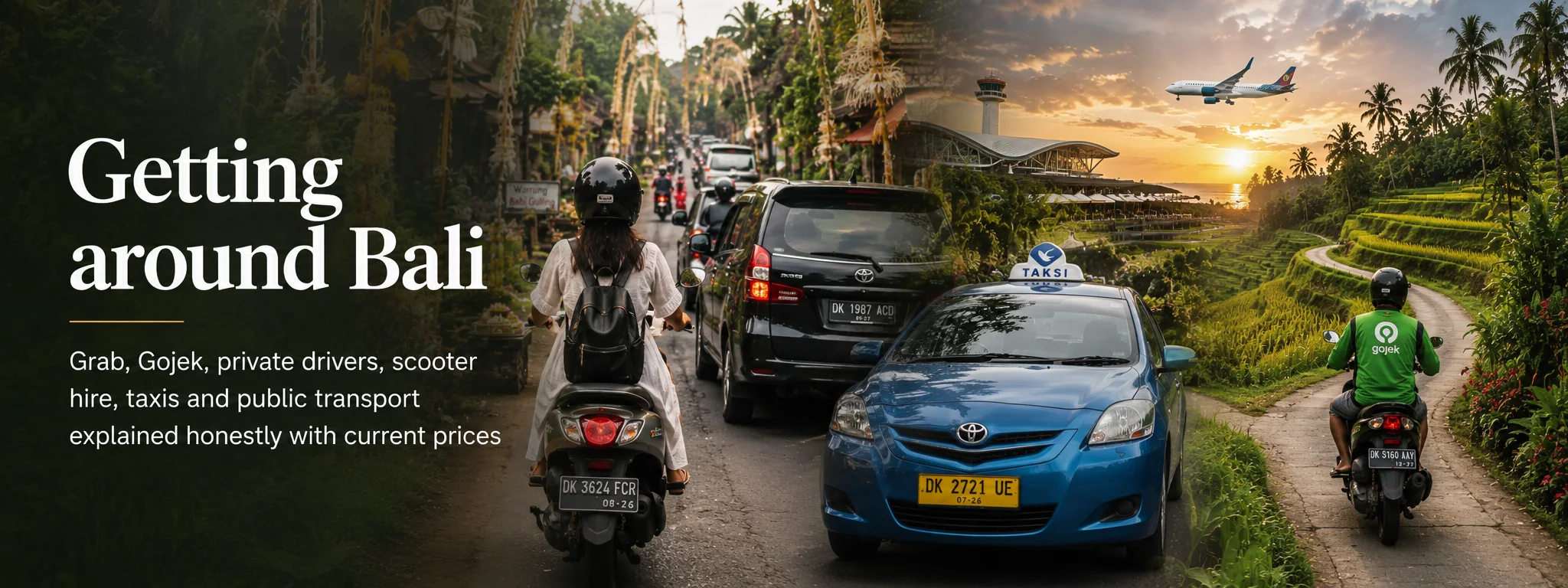
Bali transport gets much easier once you stop asking which single option is “best”. A short dinner trip, an airport arrival, a full sightseeing day and a cross-island transfer are four different transport problems.
I use the least complicated tool for the job: ride-hailing or taxis for short hops, a driver when the day has several stops, and a healthy suspicion of any itinerary that treats kilometres as travel time.
01 Traffic reality: kilometres are not travel time
South Bali grew faster than its road network. Main corridors funnel cars, vans and scooters through limited junctions; smaller streets may be narrow enough that one delivery truck changes traffic for everyone. Ceremonies, school pickup, construction, crashes, rain and beach-club/event traffic add variability.
The map distance is the least interesting number. Time of day, road width, ceremonies, rain and where the pin actually sits can matter far more.
So plan journeys by time of day and route, not just distance. If a restaurant reservation is important, check live travel time before getting dressed, then add buffer. If a flight is important, add much more buffer. Crossing from Canggu to Uluwatu for a single dinner can be a poor use of a holiday even if the map makes it look reasonable.
02 Grab, Gojek and taxis for everyday trips
Grab and Gojek are widely used for car and motorcycle rides. The apps give you a fare estimate/quote, driver identity and digital trip record, which removes much of the negotiation associated with ad-hoc transport. Payment options vary by account and service; cash is still useful as a backup.
Pickup can be the awkward part. Airports, malls, hotels, villages or transport-sensitive zones may have designated pickup locations. At Ngurah Rai Airport, the airport officially lists a Grab Lounge and Gojek customer facilities. Follow the app/airport instructions rather than arguing with a driver about where they “should” reach you.
Motorbike taxis are fast through congestion but carry the obvious motorcycle risks. If you are uncomfortable as a passenger, choose a car. A five-minute saving is not worth spending the ride terrified.
Conventional taxis remain useful for short urban journeys and when mobile data is unreliable. Blue Bird has a longstanding reputation among travellers, but the practical rule is broader: use a clearly identified legitimate taxi or book through a recognised app/desk, and understand whether the trip is metered or fixed-price before moving.
At the airport, use the official transport channel rather than following an unsolicited person who has approached you in the hall. See our airport transport section.
03 Private drivers for multi-stop sightseeing
A private car with driver is often the most efficient way to visit several temples, waterfalls, rice terraces or villages in one region. You keep the same vehicle, have somewhere to leave non-valuables, and can change the order when traffic or weather shifts.
A good driver day is about geography and sequencing, not cramming twelve attractions into the car because transport is already paid for.
A driver is not automatically a licensed cultural guide. Bali's current foreign-tourist code calls for licensed guides at tourist attractions, particularly where knowledge of nature, customs and local wisdom matters. If deep interpretation is important, book a qualified guide rather than expecting every driver to be historian, priest, naturalist and photographer.
Agree on hours, inclusions, overtime, parking/tolls and route before the day. A good driver should help make the itinerary geographically sane, not proudly promise eight regencies before sunset.
04 Scooters, self-drive cars and the legal/safety test
Renting a scooter can transform local mobility, especially in areas where cars crawl. It can also turn a minor mistake into a serious injury. Bali traffic is not an appropriate place to learn clutch control, braking in rain, cornering on sand or reading motorcycle traffic for the first time.
Convenience does not cancel licensing, insurance or skill. I would rather pay for a car than spend a holiday discovering what my policy excludes.
For Australians, the Australian Consulate in Bali says you need an International Driving Permit plus your Australian licence if you do not hold an Indonesian licence. Your licence must authorise the class of vehicle. Other nationalities should verify equivalent Indonesian requirements. Your rental shop handing over a key does not prove that you are legal or insured.
Self-driving gives independence and air-conditioned luggage space, but you inherit parking, navigation, unfamiliar road etiquette and congestion. For many holidaymakers a car with driver costs enough less than the stress to make self-drive unattractive.
If you self-drive, confirm licence/IDP requirements, insurance, vehicle condition and accident procedure. Bali drives on the left. Roads can narrow abruptly through villages, and Google Maps sometimes proposes lanes that are technically roads but not sensible routes for an unfamiliar driver.
Bali's 2025 code of conduct tells foreign tourists to obey Indonesian traffic laws, have a valid international or national licence as applicable, wear helmets, follow signs, avoid overloading vehicles and never drive under the influence. It also tells visitors to use legal four-wheel transport or two-wheel transport operating under a legitimate business/association.
This is useful guidance even before enforcement enters the conversation. A legitimate operator, correct licence and helmet reduce the chance that a small problem becomes an uninsured legal problem.
05 Public buses in 2026: useful, but route-dependent
Bali’s public-transport picture has changed repeatedly, which is why old blog posts age badly. Bali provincial government reporting confirms Trans Metro Dewata service arrangements continuing in 2026 across the Sarbagita area. It can be very useful when a corridor lines up with your trip, but it is not a rail-style network and first/last-mile access still matters. Check current routes, stops and fares through provincial transport information before building a day around it.
Public transport is often written off in Bali guides as if it does not exist. That is outdated. Trans Metro Dewata is operating in 2026; recent Bali government and transport reporting describes six corridors across the Sarbagita region and ongoing efforts to improve stops and funding. One corridor links Terminal Ubung with the domestic-arrivals stop at Ngurah Rai Airport, while other corridors connect Kuta, Nusa Dua, Denpasar, Tabanan-side routes and the Ubud/Monkey Forest area.
That does not make the network equivalent to Singapore's MRT. Frequency, stop quality, route legibility and first/last-mile access can be the limiting factors for visitors. If a bus route aligns with your trip, it can be extremely cheap and useful; if it requires two rides and a long walk in tropical heat, a ride-hail car may be the rational choice.
Current fares and promotions change. In August 2026, for example, a special QRIS promotion temporarily reduced fares, while the reported normal public fare was Rp4,400. Check current Trans Metro/Dishub information rather than hard-coding that promotional fare into your budget.
06 Walking, bicycles and e-bikes
Sanur's beachfront path, parts of central Ubud, Seminyak shopping streets and compact village centres can be enjoyable on foot. Elsewhere, pavements may disappear, become broken, be occupied by parked scooters, or place you next to fast traffic. Heat and humidity also turn a “20-minute walk” into a different activity at 1pm.
At night, use a phone torch on dark lanes but do not wave an expensive handset toward traffic. For short awkward road sections, a cheap ride can be safer than insisting on walking because the map says 900 metres.
Cycling is excellent in the right setting — quieter village roads, rice-country routes and guided downhill rides — and unpleasant in the wrong one. Major South Bali roads mix dense scooters, trucks and limited shoulder space. E-bikes add speed without adding rider awareness.
For recreational cycling, choose a route designed around scenery and lower traffic rather than using a bicycle simply because the accommodation advertises one. Wear a helmet and treat tropical sun/dehydration as part of the safety equation.
07 Fast boats and inter-island transport
Trips to Nusa Lembongan, Nusa Penida, the Gilis or Lombok move transport into a different category. Fast-boat comfort and safety vary by operator and sea conditions. Departure beach/harbour, luggage handling and road transfer at the other end matter as much as the advertised crossing time.
Do not schedule a fast-boat arrival to Bali immediately before an international flight. Weather and operational delays can cascade. For Nusa islands, our Nusa Islands guide explains the geography before you choose a port.
08 Airport transport: remove uncertainty on arrival
The airport officially lists taxis, Grab and Gojek facilities. Hotel transfers remain a good option for late-night arrivals, families or anybody who wants the driver waiting with their name. Compare convenience rather than obsessing over the cheapest possible first ride after a long flight.
09 Beat traffic by changing the itinerary, not the laws of physics
- Group sights by region rather than popularity.
- Change accommodation strategically: a few nights in Ubud can eliminate repeated South Bali–Ubud day trips.
- Schedule famous viewpoints early and keep evenings local.
- Use a full-day driver when several stops require parking and waiting.
- Check live traffic before cross-island transfers.
- Protect airport days with large buffers.
- On ceremony days, assume road diversions are part of the experience.
If three of your planned days require the same long cross-island drive, transport is telling you something about the itinerary. Splitting a stay between a coastal base and Ubud, for example, can remove hours of repeated commuting while giving you early-morning access to inland sights before day-trippers arrive.
My favourite traffic hack remains ruthlessly boring: stay near the things you want and stop crossing the island for every meal and sunset.
The opposite is also true: moving hotels for one dinner or one beach is usually overkill. Change base when it creates a genuinely different cluster of experiences, not simply because two neighbourhood names appear separately on Instagram.
10 Apps, data, addresses and current-source checks
Keep Grab/Gojek, Google Maps and WhatsApp working on mobile data, but save the accommodation's written address and a map pin offline as well. Villas with similar names, unnamed lanes and misplaced map pins are common enough that a driver's phone call to the property can be more reliable than an elegant booking confirmation.
If your accommodation is down a lane that cars cannot enter, ask where drivers should meet you. Solving that once is better than having every pickup circle the block while you stand at the wrong gate.
- Ngurah Rai Airport — official taxi, Grab and Gojek facilities
- Australian Consulate Bali — International Driving Permit advice
- Bali Tourism Office — foreign tourist transport/traffic code
- Bali Provincial Transport Department — public transport updates
- Bali Provincial Government — Trans Metro Dewata service context
TATS Man bottom line: Bali does not need one perfect transport mode. Use short-trip tools for short trips, drivers for complicated days, legal self-drive only when you genuinely have the skill and paperwork, and build the itinerary so you spend less of the holiday proving the road network exists.
Cheers, Carpe Diem & Leave More Time Than Google Says! 🍻⏳🚗
your traffic-buffering, route-simplifying transport cyborg

About the author
TATS Man
Travel journalist · digital nomad since 2007 · visiting Bali since 1989
TATS Man is the beer-loving cyborg travel journalist behind Totally Bali and TATS (Totally Awesome Travel Sites). He has travelled and worked remotely since 2007 and has been visiting Bali since 1989. His guides combine long-term destination familiarity with current primary-source research — and he does not claim first-hand experience where he does not have it.