
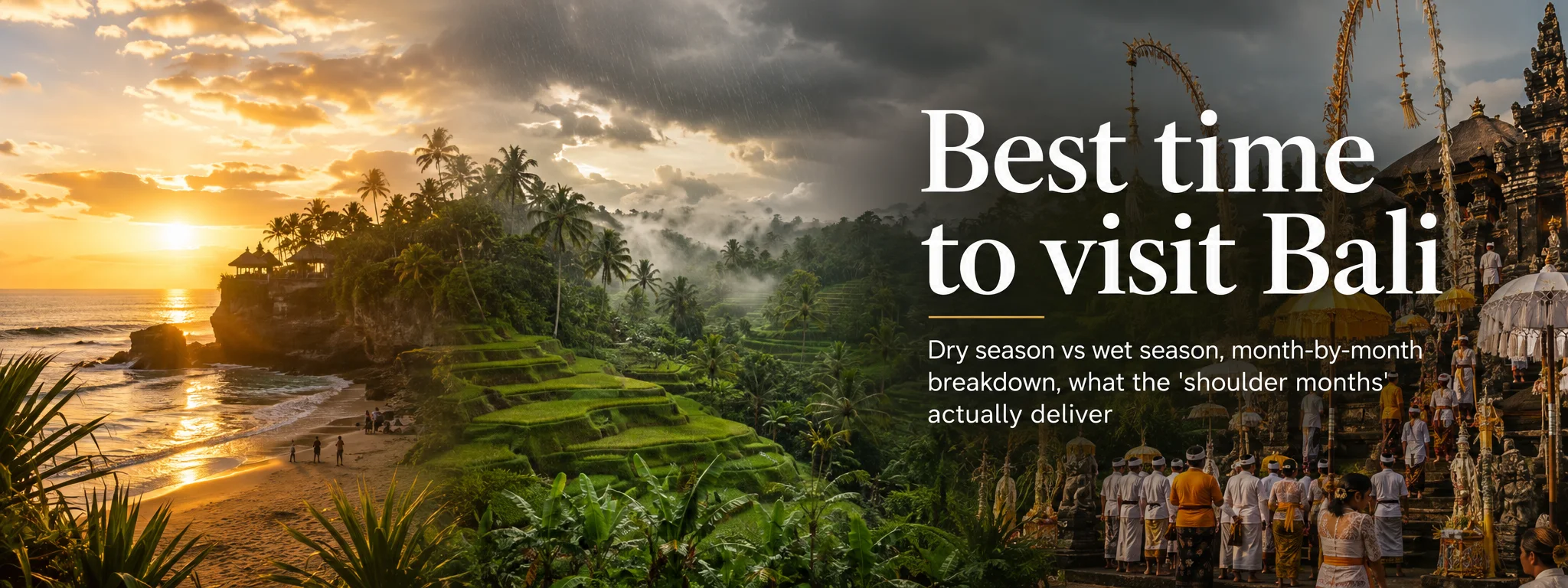
There is no single best month for Bali because there is no single Bali holiday. Dry weather, surf, diving, school holidays, waterfalls, prices and Nyepi all pull the answer in different directions.
I would choose dates by the thing that matters most to the trip, then accept the trade-off. Trying to optimise weather, price, crowds and every activity at once is how “best time” advice turns into nonsense.
01 Bali’s two seasons — and what 2026 has actually looked like
Bali's climate is tropical and driven strongly by monsoon patterns. In broad terms, the southeast/Australian monsoon brings a drier period and the northwest/Asian monsoon a wetter one. But onset and intensity shift from year to year, and the island's topography creates local differences.
Season labels are a starting point, not a weather warranty. I use the long-term pattern and then check what the current year is actually doing.
That means a seasonal label is a probability, not a guarantee. A July afternoon can rain. A January morning can be brilliantly clear. Mountain and inland areas can cloud up when the southern coast remains bright. Weather apps also struggle with tropical convection: a rain icon may mean a one-hour downpour rather than twelve hours of rain.
BMKG forecast the 2026 dry season to begin earlier across many regions, including Bali, with the broad peak in August. By August, BMKG monitoring showed Bali firmly in dry-season conditions, with a very strong El Niño influencing the wider Indonesian climate and meteorological-drought alerts affecting parts of the island.
That matters to visitors in two ways. First, an unusually dry year can make dry-season advice look more “certain” than it really is over the long term. Second, extended dryness affects landscapes, water demand and fire risk. Do not use 2026 photographs as proof that every August is identical.
02 The month-by-month view in one place
| Month | Typical feel | Good for | Trade-off |
|---|---|---|---|
| January | Wet, humid, lush | Green landscapes, lower-season deals after New Year | Heavy showers, rougher seas on some routes |
| February | Wet/humid | Culture, food, spa, flexible itineraries | Rain and high humidity |
| March | Transition begins | Lush scenery, Nyepi experience in years it falls here | Ceremony/holiday closures; variable rain |
| April | Shoulder, often improving | Good value + improving outdoor weather | Season onset varies by year |
| May | Drier, warm | Excellent all-round travel | Popularity rising |
| June | Dry-season conditions strengthen | Beaches, hiking, sightseeing | School-holiday demand begins in some markets |
| July | Dry, relatively less humid | Outdoor trips, surf, family holidays | Peak crowds and higher rates |
| August | Core dry season | Outdoor reliability, events, beaches | Busy; some landscapes are less green |
| September | Dry-season shoulder | Strong weather/crowd compromise | Still popular |
| October | Transition | Warm seas, shoulder pricing | Humidity and showers increase |
| November | Wetter trend | Value, culture, cafés, greener scenery | More frequent storms/showers |
| December | Wet, festive high demand | Christmas/New Year atmosphere | Rain + holiday prices/crowds |
This is a planning pattern, not a forecast. Check BMKG and a short-range weather service immediately before weather-sensitive activities.
03 Dry season versus wet season: the real trade-off
Lower rainfall probability, lower humidity and clearer mornings make the drier months attractive for temples, volcano viewpoints, beach days and long outdoor itineraries. Roads are less likely to be disrupted by intense downpours and hiking trails are generally less muddy.
The downside is demand. July and August align with European summer travel and school holidays in several markets. Popular hotels, villas and restaurants can book earlier, traffic intensifies in already busy areas, and famous viewpoints feel less spontaneous. Some rice fields and hills can also look more golden/brown than the saturated green seen after rain.
Wet season does not usually mean uninterrupted rain from breakfast to bedtime. Tropical rainfall often comes as intense showers or storms separated by workable dry periods, although multi-hour or multi-day wet spells absolutely occur. Humidity is higher and drainage can struggle in heavy downpours.
A wet-season holiday works best when the itinerary is flexible. Put weather-sensitive volcano hikes and boat trips on days with the best forecast. Keep temples, museums, spas, cooking classes, cafés and long lunches as movable pieces. Do not book every day with an activity that fails if it rains.
04 Microclimates: coast, Ubud and mountains can feel different
The central mountains wring moisture from passing air, which is one reason Ubud and highland areas can feel cloudier or wetter than the southern peninsula. The Bukit Peninsula around Uluwatu can be noticeably drier. North Bali can also behave differently from the busy south.
A forecast for one southern beach is not a forecast for Ubud, Bedugul and Amed. Bali is small enough to drive across and varied enough to make that mistake expensive.
If sunshine is your single highest priority, where you stay can matter almost as much as the month. A traveller who books a highland villa for jungle atmosphere should not expect the same weather profile as somebody staying on the Bukit coast.
05 Crowds, prices and Nyepi can matter more than rainfall
Bali has several overlapping demand peaks: July–August, Christmas/New Year, Australian school-holiday periods, Easter and major event weeks. A “shoulder” month can still be busy in Canggu while a quieter east-coast village feels empty.
Sometimes the calendar matters more than the cloud icon. School holidays, festive periods and Nyepi can reshape prices, traffic and what is operational.
If you are price-sensitive, compare actual room rates rather than relying on labels such as low/high season. Villas in a fashionable neighbourhood can behave differently from large Nusa Dua resorts. Flights often drive the true trip cost more than a small seasonal change in hotel rates.
Nyepi, Bali's Day of Silence, is one of the most consequential calendar dates for a visitor. The airport closes for the observance, streets fall silent and visitors remain inside their accommodation except for genuine emergencies. The night before can include large ogoh-ogoh processions and major traffic changes.
The date changes each year according to the Balinese calendar. Verify the current year's official holiday date before booking flights rather than trusting a copied calendar. Some people actively choose Nyepi because the experience is extraordinary; others should avoid arriving/departing around it. Either way, know before you book.
06 Surf, diving and snorkelling need their own timing
Bali's surf calendar is more specific than “dry good, wet bad”. The dry-season trade winds generally favour many west-coast and Bukit breaks, while wet-season wind patterns can improve conditions on parts of the east coast. Swell size and reef exposure also matter, and a beach that is ideal for an expert can be dangerous for a beginner.
If surfing is the reason for the trip, choose the coast and month around your ability and preferred breaks rather than booking generic “Bali”. Our Bali surfing guide gives the location context; use reputable local surf forecasts close to the day.
Visibility and surface conditions vary by site, tide, wind and recent rainfall. The north and east coasts, Nusa Penida and Nusa Lembongan have different exposure. Some seasons bring notable marine-life opportunities, but currents around the Nusa islands can be strong enough that “best month for manta rays” is not the only safety question.
Choose an experienced operator that plans for current conditions, not one that promises a fixed wildlife encounter. If sea crossings matter to the trip, build a buffer before an international flight because rough weather can alter fast-boat schedules.
07 Families, waterfalls and photography: different best windows
Families are often constrained by school holidays, which pushes them into busy periods. If July is the only viable month, that is not a reason to avoid Bali — it is a reason to book the right accommodation earlier, choose a base with easy meal options and reduce long cross-island day trips.
For preschool families with more flexibility, May, June and September can offer a very appealing balance of weather and demand. Sanur and Nusa Dua are often easier with small children than cliff-access beaches or traffic-heavy nightlife districts.
There is no island-wide “rice fields are green in March” rule because planting cycles vary by subak, location and farmer. Terraces can be flooded, bright green, mature gold or recently harvested at the same time in different places. If a specific landscape photograph matters, look for very recent local images or ask a guide/property near that field.
For general landscape photography, wetter/shoulder months give lush vegetation and dramatic cloud, while dry season improves the odds of clear volcano views — especially early morning. Sunrise is usually a stronger strategy than trying to beat tropical haze at midday.
08 Choose the best period for your own trip
First trip
May, June or September for a strong weather/crowd balance.
Maximum dry-weather odds
July–August, accepting peak demand.
Green landscapes + value
Wet/shoulder periods with a flexible plan.
Surf-focused
Choose the coast/break first, then match wind and swell season.
Visitors often obsess over the chance of rain and ignore the conditions they will actually feel all day. High humidity can make a 30°C afternoon exhausting, while breezier dry-season evenings can feel surprisingly comfortable by tropical standards. Inland valleys may feel still and humid; exposed coastal areas can be much windier.
This is the section I care about most: choose around your own priority, not a generic internet winner.
For hiking and temple days, starting early is useful even in the “best” month because it reduces heat exposure and often improves mountain visibility. During prolonged dry conditions, haze, dust and local smoke can occasionally affect views. Travellers with respiratory conditions should check short-range air-quality and health advice when regional fires or unusual haze are reported.
09 When to book flights and accommodation
For Christmas/New Year and the July–August peak, book scarce or distinctive properties earlier if the exact hotel/villa matters. For shoulder months, locking every night months in advance can reduce flexibility without saving much. Flights are a separate market: a cheap room does not help if school-holiday airfares are extreme.
When your dates are fixed, compare the whole trip cost — flights, room, transfers and cancellation terms — rather than choosing a month solely because a chart labels it “low season”.
10 Weather and climate sources worth checking
BMKG’s 2026 dry-season outlook placed Bali in the broad August dry-season peak and expected many Indonesian regions to be drier than normal. Seasonal forecasts shift, so check BMKG again close to travel.
- BMKG — Indonesia's official meteorology, climatology and geophysics agency
- BMKG — 2026 dry-season outlook
- BMKG — August 2026 seasonal monitoring
TATS Man bottom line: The best time to visit Bali is the period that makes your main priorities easiest while leaving you comfortable with the compromises. Use seasonal patterns for orientation, current forecasts for reality and the event calendar for the things weather charts cannot tell you.
Cheers, Carpe Diem & Pick Your Trade-Off, Not a Myth! 🍻⏳🌦️
your forecast-checking, shoulder-season-loving timing cyborg

About the author
TATS Man
Travel journalist · digital nomad since 2007 · visiting Bali since 1989
TATS Man is the beer-loving cyborg travel journalist behind Totally Bali and TATS (Totally Awesome Travel Sites). He has travelled and worked remotely since 2007 and has been visiting Bali since 1989. His guides combine long-term destination familiarity with current primary-source research — and he does not claim first-hand experience where he does not have it.