
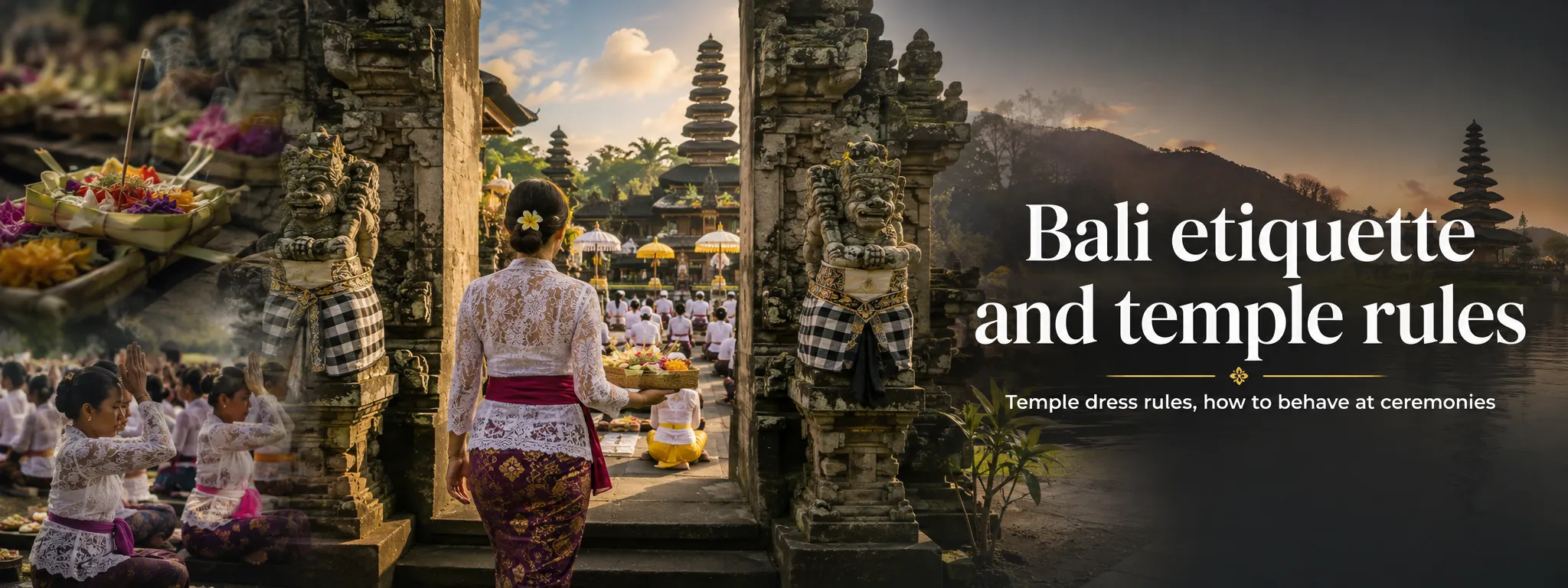
Bali etiquette is easier than the internet makes it sound. You do not need a pocket anthropology degree; you need to understand when you are in a sacred or ceremonial space, follow current local rules and avoid behaving like the island is a theme park built around your camera.
I prefer official guidance and the instructions of the people actually managing a temple or ceremony over folklore passed from travel blog to travel blog. When those disagree, the local rule wins.
01 Start with the official rules, not travel folklore
Bali etiquette is often presented online as a long list of quirky dos and don’ts. Some advice is useful, some is exaggerated, and some is simply outdated. The strongest starting point is Bali’s own current visitor policy.
I separate legal or formal visitor rules from nice-to-know manners. That keeps genuinely important conduct from disappearing inside a list of travel superstitions.
In 2025 the Bali Provincial Government issued Circular Letter No. 7 of 2025, updating its code of conduct for foreign tourists. It requires visitors to respect temples, sacred objects, customs, traditions, arts, culture and local wisdom; dress and behave appropriately; obey site rules; follow traffic and other Indonesian laws; and avoid behaviour that desecrates sacred places.
That means respect is not merely a matter of being “polite enough”. In sacred places and certain public contexts, there are formal expectations backed by local regulation and potential enforcement. The practical rules below focus on the parts most relevant to cultural visits.
02 At temples: access is more restricted than many old guides suggest
Old travel advice often says visitors can enter most temple courtyards as long as they wear a sarong. That is now too casual. The 2025 foreign-tourist code specifically prohibits foreign tourists from entering the Utamaning Mandala and Madyaning Mandala areas of sacred places unless they are worshippers wearing Balinese traditional dress and meeting the site’s religious requirements. For context on how sacred space is organised, see our Balinese temple architecture guide.
Temple access is not a negotiation. I dress for the place, follow signage and accept that some spaces are not for visitors.
In practice, visitor temples have different layouts, barriers and designated routes. Some allow tourists to view substantial parts of the complex; others keep worship areas clearly separate. Follow signs, staff and licensed guides rather than assuming an open gate means public access.
Dress requirements also vary. Major temples commonly require a sarong and sash and expect shoulders and the torso to be appropriately covered. Some include clothing with admission; others lend or rent it. Avoid quoting a universal rental price because policies differ and change.
The official rules also include the longstanding restriction on menstruating visitors entering sacred temple areas. Whatever your personal view of the custom, do not attempt to bypass a site’s religious access rule.
03 Offerings, shrines and sacred objects
Small canang sari offerings appear on pavements, steps, shopfronts and entrances throughout Bali. Do not deliberately kick, move or step on them. In busy streets accidental contact happens; the respectful response is simply to take care rather than turn the issue into a drama.
Never remove offerings, flowers, holy water or objects from a shrine as souvenirs. Do not sit on shrines, climb temple structures, touch sacred statues for a photograph or use a religious object as a costume prop. Bali’s current tourist code explicitly addresses desecration of temples, pratima and sacred symbols.
Keep in mind that “sacred place” does not always look like a monumental tourist temple. A small roadside shrine, sacred tree, spring, family temple or section of a mountain can carry religious significance. If locals are making offerings or treating a space with obvious reverence, follow their lead.
04 Ceremonies and processions
Roads in Bali are frequently shared with temple processions, cremations, weddings and village ceremonies. If a procession is crossing or occupying the road, slow down, stop and let it pass. Do not lean on the horn or try to thread a scooter through worshippers because your map says you are late. Our Balinese festivals guide explains the main recurring holy days and processions.
At a ceremony, stay out of the direct line between worshippers, priests, shrines and sacred objects. Do not step over offerings or seated worshippers. If people are praying, keep conversations quiet and phone calls away from the ritual area.
A colourful ceremony is still a religious or family event. You do not automatically have permission to enter a family compound, sit among worshippers or film from the centre of the action. Public observation from a respectful edge is often welcome; intrusion is not.
05 Photography, drones and social media
Ask before taking close portraits, especially of priests, elderly people, children or someone actively worshipping. Wide photographs of a public procession are different from placing a camera centimetres from a person’s face.
The camera test is simple: if getting the shot requires blocking worshippers, crossing a boundary or making somebody’s ritual about you, skip the shot.
Follow any photography restrictions inside temples. Do not climb structures for a better angle, pose provocatively in sacred areas or recreate social-media shots that required someone else to ignore a barrier. The 2025 code explicitly prohibits inappropriate or nude photography at sacred places.
Drones deserve extra caution. Even where aviation rules might allow a flight, launching over a ceremony, temple courtyard or procession can be culturally intrusive and may violate site-specific rules. Ask the site manager or local authorities rather than assuming “no sign” means permission.
06 Everyday manners without the mythology
Balinese people do not expect visitors to perform culture perfectly. Basic Indonesian courtesy goes much further than anxious rule-following: greet people, speak calmly, queue where a queue exists, accept corrections without arguing and avoid aggressive behaviour.
Most ordinary interactions need friendliness, patience and basic manners more than memorised gestures.
Using the right hand to give or receive objects is a widely understood courtesy across Indonesia, particularly for food, money and greetings. It is better described as respectful convention than to tell visitors the left hand is universally “unclean”. If you need both hands, use both.
Avoid touching someone’s head unless you know them well and know it is welcome; the head has elevated symbolic status in Balinese culture. Pointing directly at people with an index finger can also feel abrupt — an open hand or thumb gesture is softer.
Public affection that would be unremarkable at a beach club can be inappropriate at a temple or village ceremony. Context matters more than pretending one dress or behaviour code applies from Seminyak nightlife to a sacred compound in Karangasem.
07 Dress outside temples
Bali’s main tourism areas are relaxed, but beachwear belongs at the beach or pool. Walking through shops, villages, temples and restaurants in swimwear is increasingly viewed locally as disrespectful, and Bali’s current visitor rules explicitly call for modest, appropriate dress in tourist attractions and public places.
You do not need to cover knees and shoulders everywhere on the island. The better rule is contextual: put on a shirt or cover-up when leaving the beach, dress more conservatively around temples and ceremonies, and follow any venue-specific standard.
For a day involving temples, carry or wear clothing that makes compliance easy rather than relying on whatever can be rented at the gate.
08 Behaviour that crosses from rude into prohibited
The 2025 tourist code goes beyond temple etiquette. It tells foreign visitors not to litter or pollute lakes, springs, rivers, the sea or public places; not to engage in aggressive or abusive conduct; not to work or run businesses without proper authorisation; and not to take part in illegal trade involving drugs, endangered wildlife, sacred artefacts or other prohibited goods.
It also requires compliance with Indonesian traffic law and specifically prohibits driving under the influence of alcohol or drugs. Those are legal and safety matters, not merely cultural niceties.
The useful distinction is simple: some Bali etiquette is a matter of courtesy, while some conduct is subject to formal rules or national law. Do not lump them together as cute “local customs”.
09 Bottom line
You do not need to be terrified of making a cultural mistake in Bali. Most genuine slips are obvious as slips. What causes offence is usually entitlement: ignoring barriers, arguing with temple staff, treating ceremonies as content sets, climbing sacred structures, dressing carelessly in sacred places or assuming tourist money overrides local rules.
Dress appropriately, follow local instructions, give ceremonies space, ask before close photography and remember that Bali is a lived-in religious landscape rather than a resort built around visitors. Get those things right and you will already be ahead of most etiquette checklists.
TATS Man bottom line: Good Bali etiquette is mostly good guest behaviour with extra attention around sacred spaces, ceremonies and current visitor rules. Follow local instructions, keep the camera subordinate to the occasion and do not confuse tourism access with entitlement.
Cheers, Carpe Diem & Be a Bloody Good Guest! 🍻⏳🙏
your sarong-checking, ceremony-yielding manners cyborg
About the author
TATS Man
Travel journalist · digital nomad since 2007 · visiting Bali since 1989
TATS Man is the beer-loving cyborg travel journalist behind Totally Bali and TATS (Totally Awesome Travel Sites). He has travelled and worked remotely since 2007 and has been visiting Bali since 1989. His guides combine long-term destination familiarity with current primary-source research — and he does not claim first-hand experience where he does not have it.