
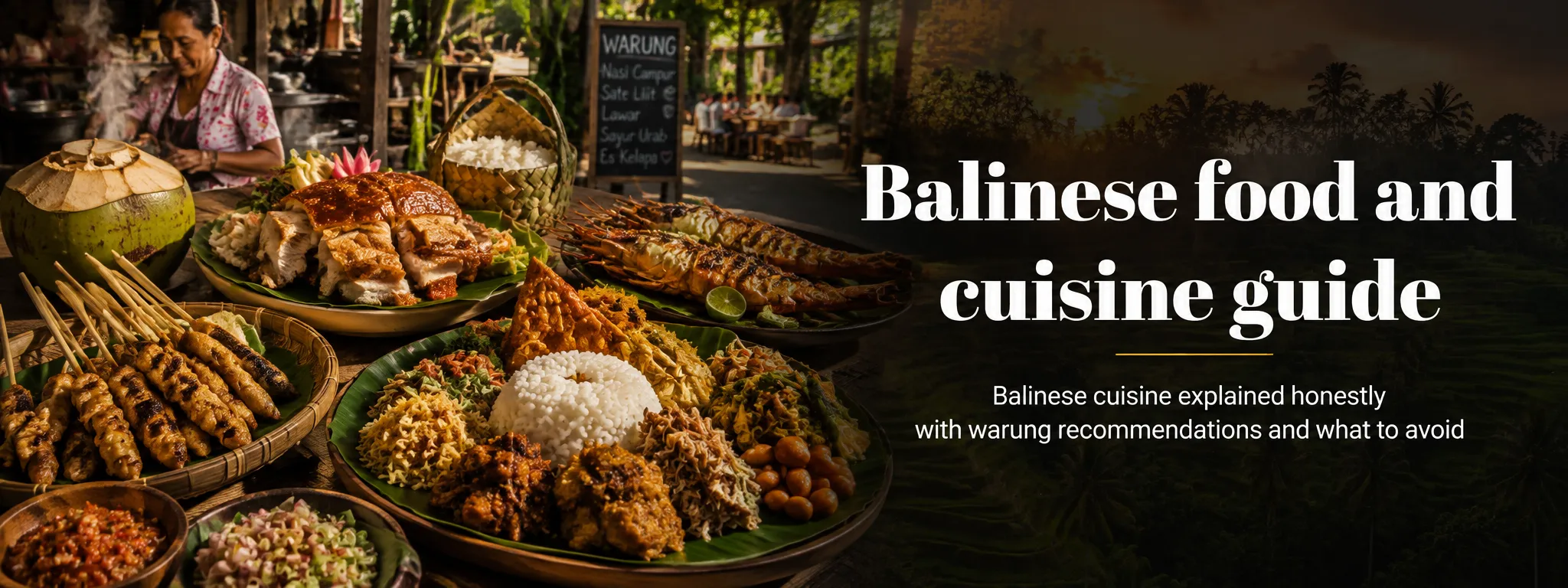
Balinese food deserves much better than being reduced to ‘nasi goreng and something spicy’. It is aromatic, layered, tied to ceremony and very much its own thing inside the enormous universe of Indonesian cooking. Pork appears far more often than across much of Indonesia, coconut and fresh aromatics do serious work, and one good plate of nasi campur can teach you more than a week of generic hotel buffets.
01 First things first: Balinese food is its own cuisine
Indonesia is an enormous archipelago with hundreds of culinary traditions, so ‘Indonesian food’ is about as specific as saying ‘European food’. Rendang, gudeg and pempek all come from different regional traditions. Balinese cooking has its own ingredients, ceremonial context and flavour logic, and it is worth learning the difference before ordering the same nasi goreng for seven consecutive days.
Bali’s Hindu-majority culture is one reason pork is far more visible here, especially in babi guling and pork lawar. Chicken, duck, fish and vegetables matter just as much, and ceremonial food preparation can involve whole communities rather than a restaurant chef quietly doing prep out back.
That distinction matters when you’re reading menus. Nasi goreng, mie goreng, rendang and gado-gado can all be excellent, but a menu full of them is an Indonesian spread, not automatically a tour of Balinese cooking. If you want Bali on the plate, look for the dishes that are actually rooted here.
02 The flavour engine: base genep, aromatics, coconut and sambal
One of the great flavour foundations is base genep (also written basa genep) — better understood as a family of complex spice pastes than one holy recipe carved into stone. Shallot, garlic, chilli, turmeric, galangal, ginger, candlenut and other aromatics can all play a part depending on the dish and cook.
Fresh coconut turns up everywhere: grated into lawar and vegetables, pressed into milk, toasted or used as oil. Kaffir lime leaf, lemongrass, turmeric and galangal bring fragrance; sambal then arrives to make sure nobody accuses the meal of being shy.
03 25 Balinese dishes and food terms worth knowing
| Dish | What it is | What to know |
|---|---|---|
| Nasi campur Bali | Rice surrounded by small portions of meats, vegetables, satay, lawar, egg, sambal or whatever that kitchen has prepared. | The best first meal because one plate teaches you several flavours. |
| Babi guling | Spice-seasoned roast pig, normally served as a mixed plate with crisp skin, meat, lawar, satay, sambal and broth/vegetables depending on the warung. | Non-halal; often best earlier in the day at specialist warungs. |
| Ayam betutu | Chicken heavily seasoned with Balinese spices and slowly cooked until tender. | Can be quite spicy; widely available. |
| Bebek betutu | The duck version of betutu, traditionally slow-cooked with a generous spice mixture. | Richer and often ordered for sharing. |
| Sate lilit | Minced seasoned meat or fish mixed with aromatics and often coconut, moulded around a skewer or lemongrass stalk and grilled. | Different texture and seasoning from cubed-meat satay. |
| Lawar | Finely chopped vegetables, grated coconut, spices and often minced meat. | Some traditional red lawar contains fresh blood; ask if that matters to you. |
| Lawar putih | “White” lawar without the blood used in red versions. | Not automatically vegetarian: it may still contain meat. |
| Sambal matah | Fresh raw shallot, chilli, lemongrass and citrus/oil condiment. | Bright, sharp and excellent with grilled fish or chicken. |
| Sambal embe | Balinese sambal based around fried shallots, garlic and chilli. | Crunchier and more cooked-tasting than sambal matah. |
| Nasi jinggo | Small inexpensive portion of rice with a few spicy accompaniments, traditionally wrapped for takeaway. | Snack/light-meal territory; good night-market food. |
| Tipat cantok | Rice cake and vegetables dressed in a peanut-based sauce. | Excellent inexpensive vegetarian-leaning option, but ask about shrimp paste if vegan. |
| Serombotan | Mixed vegetables with coconut and spicy dressings, associated especially with Klungkung. | A useful counterexample to the idea that Balinese food is all meat. |
| Jukut urab / urap | Vegetables mixed with seasoned grated coconut. | Common component on mixed plates. |
| Jukut ares | Soup/curry using tender banana-stem pith, often cooked with pork or chicken. | Ask about the stock/meat if vegetarian. |
| Tum | Seasoned minced meat, fish or other filling wrapped in banana leaf and steamed. | Think of it as a fragrant parcel rather than a dry grilled dish. |
| Pepes | Fish or other ingredients seasoned, wrapped in banana leaf and steamed/grilled. | Found across Indonesia; local versions fit naturally into Balinese meals. |
| Ikan bakar | Grilled fish, often with sambal and rice. | Jimbaran seafood is Bali’s most famous visitor version. |
| Be siap sambal matah | Chicken with Balinese raw sambal. | Simple way to understand how sambal transforms a mild protein. |
| Jaje Bali | Umbrella term for Balinese traditional cakes/sweets. | Best explored at morning markets rather than dessert menus. |
| Laklak | Small rice-flour cakes/pancakes commonly served with grated coconut and palm-sugar syrup. | Sweet, soft/chewy and very approachable. |
| Dadar gulung | Green pandan-flavoured crêpe rolled around sweet coconut filling. | Indonesian rather than exclusively Balinese, but common and worth trying. |
| Bubur injin | Black glutinous-rice pudding with coconut milk. | A rich traditional dessert/breakfast-style sweet. |
| Es daluman | Cooling drink/dessert using green grass jelly, coconut milk and palm sugar. | Useful antidote after a spicy meal. |
| Loloh cemcem | Herbal drink associated with Penglipuran/Bangli, made from cemcem leaves with a sweet-sour-salty profile. | More interesting than another bottled soft drink when you encounter it. |
| Kopi Bali | Local coffee ranging from traditional finely ground black coffee to modern specialty Arabica and Robusta. | Do not confuse good Bali coffee with the tourist marketing around kopi luwak. |
04 Start with nasi campur — the edible cheat sheet
At a Balinese warung, nasi campur is basically the kitchen introducing itself. Rice arrives with a changing collection of chicken, lawar, satay, vegetables, egg, sambal and crispy bits depending on the place and the day. That variability is the feature, not a quality-control failure.
That makes nasi campur the perfect first lesson and a terrible subject for rigid ‘best nasi campur in Bali’ rankings. Taste the plate, work out which component made you stop talking for a second, learn its name and go hunting for the specialist version later.
At display-counter warungs, pointing can get you a long way. Allergies and strict dietary restrictions are where pointing stops being a communication strategy: sauces, spice pastes and stocks can contain ingredients you cannot see, so explain the restriction properly.
05 Eating at a warung is easier than the internet makes it sound
‘Warung’ can mean anything from a tiny family food stall to a polished restaurant borrowing the word for atmosphere. The really satisfying local ones often specialise: babi guling here, nasi ayam there, fish somewhere else. Follow the speciality rather than assuming the longest menu wins.
- Go at the meal time the place is built around. Some famous pork/chicken rice warungs sell strongly at breakfast or lunch and may run out of key components.
- Carry small rupiah notes. Cards and QRIS are increasingly common, but cash remains useful at small local businesses.
- Ask before photographing staff, kitchens or ceremonial food preparation.
- Do not judge hygiene only by décor. Look for turnover, covered food where appropriate, clean utensils and sensible handling.
- If a sambal is on the side, taste a small amount first. Balinese “medium” can still be enthusiastically hot.
See our guide to Bali warungs, warungs by area and food-safety guide.
06 Let the part of Bali you’re in influence what you eat
Balinese food is island-wide but not identical everywhere. Gilimanuk is strongly associated with fiery betutu; Gianyar and the Ubud area are famous for babi guling and mixed-rice traditions; coastal areas naturally lean harder into seafood. Your route can be part of the menu.
Markets change personality by the clock. Morning is produce, spice, breakfast and household business; night markets lean much more towards cooked dishes and snacks. Go at the wrong time and you have not discovered a secret empty market — you have simply arrived at the wrong time.
07 Vegetarian, vegan, halal and allergies: ask proper questions
Vegetarian and vegan
Bali is ridiculously easy for purpose-built vegan cafés, particularly around Ubud and Canggu. Traditional Balinese food needs more conversation. Something that looks vegetable-based may still contain shrimp paste, stock or minced meat, so ‘it has green things in it’ is not a reliable vegan certification.
Useful phrases include tanpa daging (without meat), tanpa ikan (without fish), tanpa telur (without egg) and tanpa terasi (without shrimp paste). If the requirement is strict, explain the whole restriction rather than firing one phrase at the kitchen and hoping the rest of the recipe reads your mind.
Halal
Bali’s majority-Hindu food culture means pork is normal and shared kitchens are common. At the same time, Bali has Muslim communities and a huge range of halal Indonesian food, including Padang, Javanese and other cuisines. Travellers requiring certified halal food should look for explicit halal certification/signage or restaurants clearly operating as halal businesses rather than assuming that a chicken or seafood dish from a Balinese pork-serving warung meets their standard.
Allergies
Peanut, soy, seafood, shrimp paste, coconut and egg appear often. Severe allergies need more than a translation card that says ‘no peanuts’: small kitchens can have real cross-contact, and some ingredients sit inside sauces and spice mixes rather than appearing as obvious chunks.
08 How spicy is it? Anywhere from gentle to ‘well, that escalated’
Spice runs from gentle and aromatic to the sort of sambal that briefly rearranges your plans for the afternoon. Betutu can be deeply spiced without being brutally hot; sambal is often where the real chilli arrives.
If you like chilli, try different sambals instead of treating dinner as a masculinity test. Sambal matah is fresh and aromatic, sambal embe is fried and savoury, and house sambals can wander through smoky, sweet, fermented and absolutely merciless.
09 Seafood: Jimbaran is famous for a reason
Jimbaran Bay is the classic traveller ritual for good reason: choose seafood, get it grilled, sit on the sand and let sunset do the decorating. Kedonganan fish market nearby is more about the supply side and suits travellers who are genuinely interested in what is coming off the boats rather than just the table setting.
East and North Bali have their own fishing communities and simpler grilled-fish meals. Wherever you eat seafood, judge freshness and handling rather than assuming a beachfront table guarantees quality.
10 Breakfast does not have to involve smashed avocado
The visitor economy made Bali famous for elaborate brunch — sourdough, smoothie bowls, specialty coffee and eggs arranged like minor architecture. Local breakfast can be rice-based, savoury and much earlier. Try both. There is no rule saying cultural curiosity must begin after 10am.
Try both. Our Bali breakfast guide explains where the two cultures overlap and why “breakfast food” is not a rigid category here.
11 Coffee: from Kintamani beans to the luwak circus
Bali grows both Arabica and Robusta, with Kintamani particularly associated with Arabica. Modern specialty cafés can trace farms, processing and roast profiles; traditional Bali coffee is often much simpler — finely ground coffee brewed directly in the cup, leaving sediment at the bottom.
Kopi luwak is marketed at tourists with almost supernatural enthusiasm. I do not consider a captive-civet coffee farm an essential Bali experience. If welfare and traceability are vague, buy an excellent normal coffee and enjoy the revolutionary experience of drinking it without an ethical footnote.
Arak has deep cultural roots and a growing legitimate commercial industry, but provenance matters. Buy sealed reputable products or drink it at established licensed venues. Anonymous spirit in an unlabelled bottle is not ‘more authentic’; it is just harder to know what the hell you are drinking.
12 Arak: know what you’re drinking
A local mixed-rice meal can still be one of the cheapest deeply satisfying feeds on the island, while a resort restaurant or internationally recognised tasting menu can cost more than your room. Both can be worthwhile. They are simply not evidence for one magical ‘daily Bali food budget’.
| Type | Very rough planning range | What drives the price |
|---|---|---|
| Small local warung / market meal | Often Rp20,000–60,000 | Location, protein and whether it is a tourist-facing area. |
| Popular casual restaurant | Often Rp60,000–180,000 per person before drinks | Area, air-conditioning, imported ingredients and service. |
| Beach club / upscale hotel restaurant | Rp150,000–500,000+ per person | Setting, minimum spends, imported products and alcohol. |
| Fine dining / tasting menu | Can run well beyond Rp1,000,000 per person | Multi-course format, chef reputation, service and wine. |
These are planning bands, not quoted prices. Menus, taxes/service charges and tourist-area pricing change constantly.
13 What does food cost? Anything from cheap warung to silly money
| Indonesian | Meaning |
|---|---|
| Saya mau… | I would like… |
| Tidak pedas | Not spicy |
| Sedikit pedas | A little spicy |
| Tanpa daging | Without meat |
| Tanpa babi | Without pork |
| Tanpa kacang | Without peanuts/nuts — not sufficient on its own for a severe allergy |
| Bungkus | Takeaway / pack it up |
| Berapa harganya? | How much is it? |
| Enak! | Delicious! |
14 How to actually explore Balinese food
- Morning: go to a traditional market for fruit, cakes and breakfast, or eat a simple nasi campur/nasi ayam where locals are stopping before work.
- Lunch: choose a specialist — babi guling if you eat pork, or betutu/nasi ayam if you do not.
- Afternoon: proper Bali-grown coffee or a sweet such as laklak/bubur injin rather than another international café meal.
- Evening: seafood, a night market, or a Balinese restaurant where you can order several dishes to share.
Do that once — one local breakfast, one proper nasi campur, one specialist warung, one market wander, one seafood meal, one thing you cannot pronounce — and you’ll understand far more than you will from another ‘10 best restaurants in Seminyak’ list.
15 Food safety without ruining the fun
Most travellers eat their way around Bali without drama, but foodborne illness exists here just as it does elsewhere. High turnover, properly hot food, sensible refrigeration and clean handling matter more than whether the restaurant has fairy lights and a 4.9 rating.
Hydration matters in the heat, and serious symptoms deserve proper medical attention. Persistent vomiting, significant dehydration, blood in stool or severe symptoms are not improved by another joke about ‘Bali belly’ and blind faith in charcoal tablets.
16 Frequently asked questions
What is the most famous Balinese food?
Babi guling is probably the best-known specifically Balinese dish internationally, but nasi campur remains my preferred first introduction because you get several things on one plate. Betutu, lawar and sate lilit are every bit as useful for understanding how the cuisine actually tastes.
Is Balinese food very spicy?
It can be, but the cuisine is about aromatic spice as much as chilli heat. Sambal often supplies the most intense heat. Ask for tidak pedas or sedikit pedas, while understanding that batch-cooked dishes cannot always be changed.
Is it easy to eat vegetarian in Bali?
Yes overall, especially in Ubud and Canggu, but traditional dishes require questions because shrimp paste, meat stock and minced meat can appear in food that looks vegetable-based.
Is Balinese food halal?
Some is, some is not. Pork is common in Balinese cuisine and shared kitchens are common. Bali also has many clearly halal Indonesian restaurants. If certification matters, choose explicitly halal establishments rather than guessing from the protein on your plate.
17 Sources and further reading
- Indonesia Travel — iconic Balinese dishes.
- Indonesia Travel — lawar.
- Indonesia Travel — ayam betutu.
- Indonesian Ministry of Foreign Affairs — Bali Travel Guidebook.
TATS Man
conducting important nasi campur research
Got a question? Ask TATS Man · About the author