
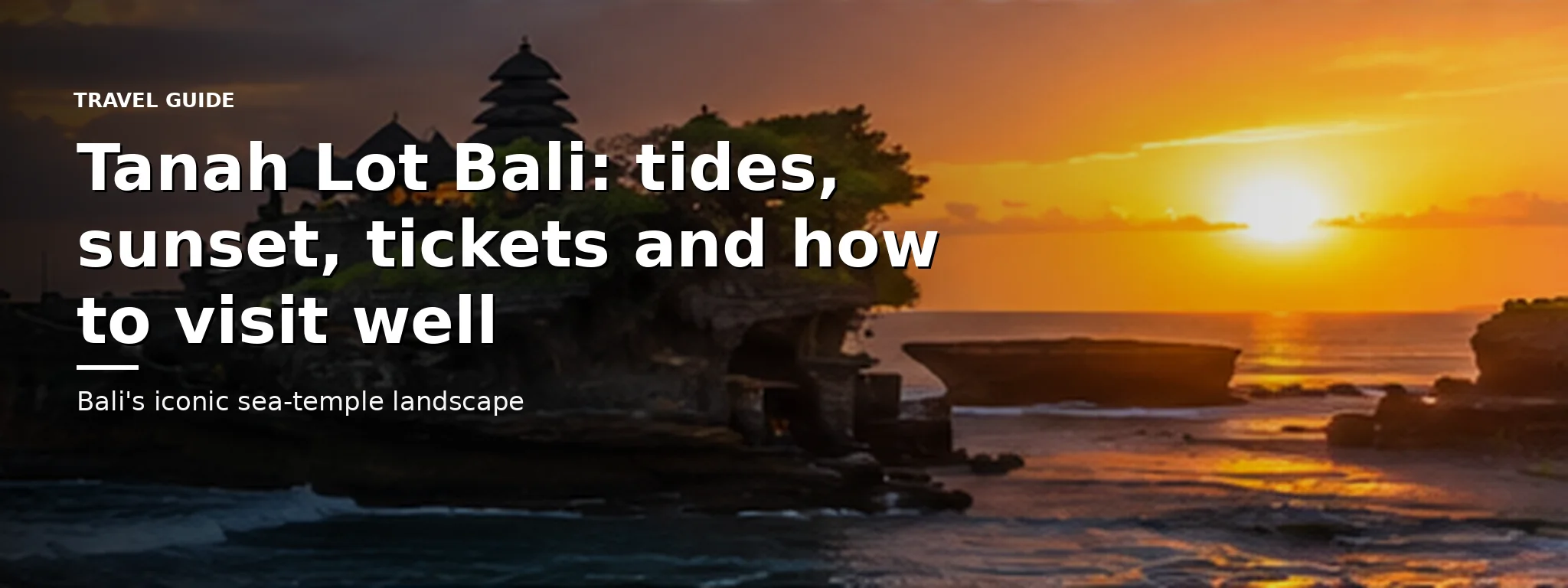
Tanah Lot is one of those Bali places that can be wildly touristy and genuinely worth seeing at the same time. The souvenir lanes do not cancel the temple, and the temple does not magically remove the crowds.
I plan it around tide, light and tolerance for company. Sunset is famous for a reason, but an earlier visit can be far more pleasant if you care more about the site than joining several thousand people for the same orange sky.
01 What Tanah Lot actually is
Tanah Lot is a temple complex on Bali’s west coast in Beraban, Tabanan. The famous shrine sits on an offshore rock formation just beyond the shoreline, while the visitor area includes cliff paths, viewpoints, other temples and the nearby Batu Bolong sea arch.
I treat Tanah Lot as a coastal temple complex, not a single offshore rock. The cliff paths and Batu Bolong help explain why allocating more than ten minutes pays off.
The postcard photograph can make the site look isolated. In reality, Tanah Lot is a major managed attraction with parking, shops, restaurants and substantial visitor numbers. That does not ruin it; it simply means you should arrive expecting a famous cultural landscape rather than a hidden beach temple.
02 High tide versus low tide
Tide changes the visual character of Tanah Lot. At higher tide, the main rock can appear more dramatically separated by water. At lower tide, more rock and shoreline are exposed and visitors may be able to approach the base area where local conditions permit.
Low tide can change physical access; high tide changes the whole composition. Neither is automatically better — they are different versions of the same place.
Do not assume low tide means unrestricted temple access. Sacred areas remain governed by religious rules and local staff direction. The sea also changes quickly around rock shelves, so never climb beyond barriers or stand where waves are breaking simply because someone else is doing it.
03 Sunset: beautiful, busy and optional
Tanah Lot faces Bali’s western sky, which makes late afternoon the classic time to visit. On a clear day, the temple silhouette can be excellent. It is also when buses, day tours and independent travellers converge, so the atmosphere is very different from a quiet morning.
Sunset is beautiful and busy. I would rather arrive early, walk the site and already have a viewpoint than spend golden hour joining a parking queue.
If photography matters more than the orange sky itself, earlier light and lower crowds may be a better trade. Cloudy sunset is also normal in the tropics. The temple does not stop being interesting because the sun disappears behind cloud. Our Bali sunset guide has alternatives if you want a less structured evening.
04 Current ticket prices
As at 31 August 2026, Tanah Lot’s official site lists foreign admission at Rp75,000 for adults and Rp40,000 for children, with separate small vehicle parking charges. Domestic prices are lower. Fees can change, so check the official ticket page if you are reading this later.
The official site also asks visitors planning commercial photo sessions, drone flights or filming to report to management. That is a useful reminder that “I am only making content” does not automatically exempt you from local permission rules.
05 Do not miss Batu Bolong
A short walk from the main Tanah Lot viewpoint brings you to Batu Bolong, another temple on a rocky arch above the sea. Many visitors rush straight to the famous offshore rock and barely look around, but the cliff path and arch give you a second strong coastal scene.
Walk the whole main viewpoint area before deciding where to wait for sunset. Different angles work as the tide and light change, and the best composition may not be the one directly in front of the most crowded railing.
06 Religious site first, attraction second
Tanah Lot is a sacred Balinese Hindu site. Tourist access does not mean every shrine or ceremony is open for photography. Follow barriers, dress instructions and staff direction, and keep clear of worshippers and offerings.
The temple remains a sacred place inside a large attraction. I do not use commercial crowding as an excuse to ignore barriers, ceremonies or local instructions.
You are not required to understand every ritual before visiting. You are required to behave as if the religious activity is real — because it is. Our Bali temples guide and etiquette guide cover the basics.
07 Photography without losing your phone to the sea
The strongest images usually use the temple as part of a wider coastal scene: waves, rock, sky and human scale. A telephoto lens can isolate the shrine and reduce foreground clutter; a wider lens works well from the cliff paths.
Rock shelves can be slippery, and waves do not care how expensive your camera is. Stay behind barriers, watch the sea between exposures and never walk backwards while looking at a screen. Drone and commercial work should follow the management process noted on the official site.
08 Facilities, shops and the managed attraction
Tanah Lot has the infrastructure of a major attraction: a large approach area, souvenir stalls, food and drink options, toilets and organised parking. That can feel commercial after a quiet village temple, but it also makes the stop straightforward for families and first-time visitors.
You do not have to buy anything on the way through. Allow the commercial area to be what it is, then concentrate on the coast and temple once you reach the viewpoints. If you want a quieter meal, eat elsewhere rather than choosing a restaurant simply because sunset has trapped you in the crowd.
09 How long to allow
A rushed stop can be under an hour if you only want the main viewpoint, but a more satisfying visit allows time to walk to Batu Bolong, watch the tide, explore the managed grounds and wait for changing light. Sunset visits naturally take longer because everyone is waiting for the same moment.
If you are travelling from Ubud, Canggu, Seminyak or farther south, road time can be less predictable than the attraction itself. Do not book a tight dinner, airport transfer or fixed appointment immediately afterwards.
10 What to pair with Tanah Lot
Tanah Lot combines naturally with Tabanan and west-of-Canggu routes. If you have a full day, Jatiluwih gives a completely different landscape, but it is far enough inland that you still need to plan the road rather than treating both as neighbouring stops.
Tanah Lot combines best with west-coast geography, not with every famous Bali attraction in one day. Route logic beats checklist ambition.
A closer and easier day can pair Tanah Lot with a relaxed coastal or Canggu morning. For regional context see our Tabanan guide. If you want rice terraces as the main event, use the Jatiluwih guide and give that landscape proper time.
11 Is Tanah Lot worth it?
Yes if you want one of Bali’s classic temple-and-ocean landscapes and you are comfortable with a popular attraction. It is visually distinctive, easy to understand and works well for first-time visitors.
Skip the sunset rush if crowds make you miserable. A morning or earlier afternoon visit still gives you the temple, coast and tide without making the entire experience depend on one five-minute patch of sky.
TATS Man bottom line: Tanah Lot earns its reputation when you give it more than a sunset drive-by. Check tide, arrive with time, walk beyond the first viewpoint and remember the sacred site is the reason the tourist machine exists.
Cheers, Carpe Diem & Check the Tide Before You Chase the Sunset! 🍻⏳🌊
your tide-checking, sunset-buffering cyborg

About the author
TATS Man
Travel journalist · digital nomad since 2007 · visiting Bali since 1989
TATS Man is the beer-loving cyborg travel journalist behind Totally Bali and TATS (Totally Awesome Travel Sites). He has travelled and worked remotely since 2007 and has been visiting Bali since 1989. His guides combine long-term destination familiarity with current primary-source research — and he does not claim first-hand experience where he does not have it.