
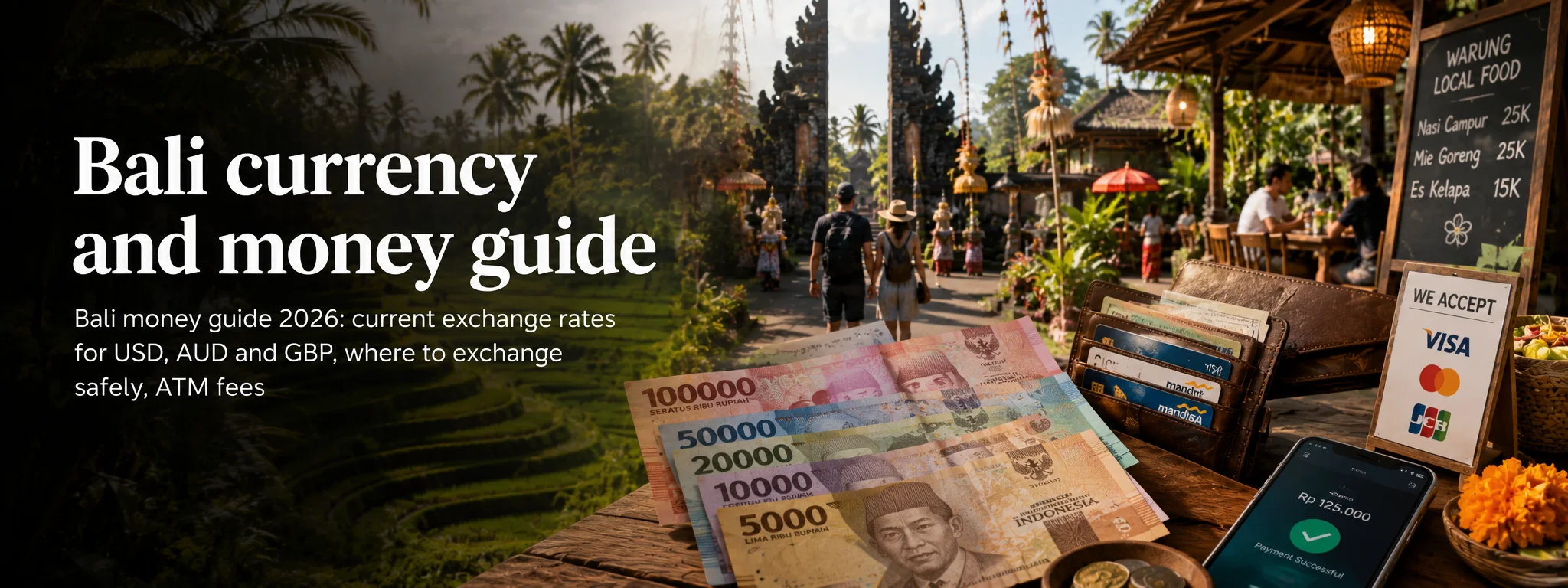
Bali is easy to pay for once you understand the layers: rupiah cash remains useful, cards are common, QRIS is ubiquitous, and authorised money changers are easy to find in tourist areas. The expensive mistakes happen when travellers accept dynamic currency conversion at an ATM, use a dubious exchange booth for a “too good” rate, or carry only one card that gets blocked on day two.
01 Rupiah first: the currency basics travellers actually need
Indonesia's currency is the rupiah, code IDR and symbol Rp. Bank Indonesia's mandatory-use rules require rupiah for transactions conducted within Indonesia, subject to limited legal exceptions that are irrelevant to an ordinary restaurant, hotel or shop purchase.
Large numbers are normal. Rp100,000 is not the same psychological unit as $100. Read zeros carefully, especially when tired. Many menus shorten thousands as “k”, so 85k means Rp85,000.
02 How much cash to carry and when cards are easier
You do not need to carry your whole holiday budget in notes. Cards are widely accepted at hotels, resorts, larger restaurants, supermarkets, malls, beach clubs and many attractions. Cash remains useful at warungs, markets, small shops, parking points, temples, local drivers and whenever a terminal/network fails.
A practical pattern is to keep a few hundred thousand rupiah for the day and withdraw again when needed. Store backup cash separately from your main wallet. Bali is not a cashless destination, but it is no longer a cash-only one either.
03 ATMs and dynamic currency conversion: read the screen
Use ATMs attached to or branded by established banks where possible, especially in well-lit, monitored locations. Inspect the card slot, cover the PIN keypad and do not accept help from a stranger if a card is retained. Keep your bank's international contact method accessible.
Withdrawal limits vary by machine/card. Indonesian ATMs may dispense Rp50,000 or Rp100,000 notes, and a per-withdrawal limit can make a fee-heavy foreign card expensive. Your home bank may charge a fixed fee, a percentage FX margin, or both.
Some ATMs and card terminals offer to convert the transaction into your home currency. This is dynamic currency conversion (DCC). It sounds helpful because you recognise the number, but the offered exchange rate can include a poor markup.
If your own card issuer gives you a good foreign-exchange rate, choosing to be charged in IDR/rupiah and letting your bank/network perform the conversion is often better. The exact answer depends on your card, so know your card's foreign transaction fee before travel. Never accept DCC merely because the screen calls it “guaranteed” or “convenient”.
04 Money changers: use authorised operators and count carefully
Bali's current code of conduct for foreign tourists explicitly says foreign currency should be exchanged only at officially licensed bank or non-bank money changers, identified by a licence number and Bank Indonesia QR-code logo. Bank Indonesia also educates the public to use licensed KUPVA BB operators and uses QR coding to help distinguish authorised businesses.
That makes the rule simple: ignore a suspiciously generous board in a souvenir shop or back-lane booth if the operator cannot demonstrate the proper licence. A tiny rate improvement is not worth a counting scam, hidden commission or dispute.
- Compare the actual net rate, not a headline rate followed by commission.
- Use an authorised exchanger with clear premises and receipt.
- Keep your foreign notes in sight.
- Watch the count and count the rupiah yourself once, without being rushed.
- Do not hand the counted rupiah back for a second “recount” unless you follow every note.
- Take the receipt and leave only when the amount is correct.
The old sleight-of-hand scam relies on distraction: a cashier counts correctly, takes the stack back, removes notes and returns it. A professional authorised counter reduces the risk; your own attention completes the job.
05 Cards and QRIS: useful, but not universal
Visa and Mastercard acceptance is broad in tourist businesses; other networks vary. Some smaller businesses impose a card surcharge. Ask before tapping if the amount matters, and check the terminal shows the correct rupiah total.
Hotels may place a deposit/pre-authorisation on a card. That can tie up available credit or debit funds for days after checkout. For a longer trip, a credit card with sufficient headroom is often safer than having accommodation deposits eat into the same debit balance you need for daily cash.
QRIS is Indonesia's standardised QR payment system and is extremely common, including at many small merchants. For local bank/e-wallet users it is seamless. International visitors can also use QRIS through QRIS Cross-Border where their home-country payment provider participates.
Bank Indonesia currently lists cross-border cooperation including Thailand, Malaysia and Singapore, with evolving links involving Japan and other markets. Do not assume that “my country is partnered” means every banking app from that country works; participating payment service providers are listed by Bank Indonesia.
06 Airport exchange: convenience first, rate second
You may need cash for a tip, small purchase or ride, but there is no need to exchange thousands of dollars immediately after a flight. Airport ATMs and exchange counters trade convenience against rate/fees. Get enough to be comfortable, then compare authorised options later.
The airport's official ride-hail/taxi options reduce the old pressure to arrive with a wad of cash. See our airport money section.
07 Tipping and day-to-day costs: avoid fake precision
Tipping is appreciated in tourism but is not a US-style compulsory percentage across every transaction. Some restaurants/hotels add service and government tax to the bill; others price differently. Check the bill before automatically adding another large percentage.
For a genuinely helpful driver, guide, housekeeper, spa therapist or restaurant team, a reasonable tip is welcome. Treat it as recognition for service rather than a fixed tariff. Small rupiah notes are useful for this.
Bali spans Rp20,000 local meals and luxury tasting menus, dorm beds and five-star pool villas. A single “Bali costs $55 per day” figure is therefore almost meaningless. Build a budget from your actual style: accommodation, two or three daily meals, transport pattern, alcohol/coffee, attractions, spa, surf/diving and shopping.
Our Bali budget guide breaks costs down by traveller type. For current hotel and airfare prices, check the dates you will actually travel because seasonal demand matters far more than an old average.
08 Card security, exchange rates and emergency backup
Enable transaction notifications. Use a card you can freeze instantly in its app. Carry a second card separately. Keep your bank's support number available somewhere other than the lost card itself. If an ATM keeps your card, contact the bank/ATM operator promptly rather than accepting help from a passer-by.
A phone wallet is useful but should not be your only payment method because a lost or dead phone can simultaneously remove maps, ride apps, boarding passes and money. Resilience beats cleverness.
Use a reputable market-rate reference (your card network, bank or a major FX service) to understand the approximate mid-market rate, then compare the rate you will actually receive after fees. Bank Indonesia also publishes reference rates, but the retail cash rate will differ from a central-bank reference.
This site intentionally removed hard-coded USD/IDR and AUD/IDR numbers from its header because a static exchange rate presented as current is misleading. The best number is the one from today, not the one embedded in a page template months ago.
09 Rupiah notes, ‘plus plus’ charges, deposits and refunds
Indonesia's large nominal numbers take a day to get used to. The practical safeguard is to say or read the full amount before handing over a note: Rp50,000 and Rp500,000 look very different on paper, but a tired traveller can mentally drop a zero when a price is spoken quickly. Organise notes by denomination in your wallet instead of keeping them as one folded bundle.
Small notes are disproportionately useful for parking, tips, market purchases and small warungs. If an ATM dispenses only Rp100,000 notes, break one at a supermarket or established café rather than expecting a tiny stall to provide change first thing in the morning.
Some Bali restaurants and hotels quote prices before tax and/or service charge, while others include everything. A menu price shown as “100k++” generally means additional tax and service will be added, but the actual percentages and treatment depend on the business and applicable local rules. Read the menu/footer and final bill rather than assuming the sticker price is the total.
This is also why comparing two restaurants purely by headline menu prices can be misleading. A slightly higher all-inclusive price may be cheaper than a lower number with additional charges.
Hotels, vehicle rentals and some activities may place deposits or pre-authorisations on a card. Even when released promptly by the merchant, the hold can take time to disappear at your bank. If your only card has a tight limit, several deposits can reduce the spending power you thought you had.
Use a card with adequate headroom for deposits and keep a separate method for daily spending. For large refunds or cancelled hotel holds, retain receipts until the money is visibly back in your account.
10 Official payment and currency sources
Bank Indonesia regulates non-bank foreign-exchange businesses and maintains current licensing information. QRIS is widespread, but cross-border QRIS for international visitors depends on participating countries and payment providers — it is not a universal foreign-card replacement.