
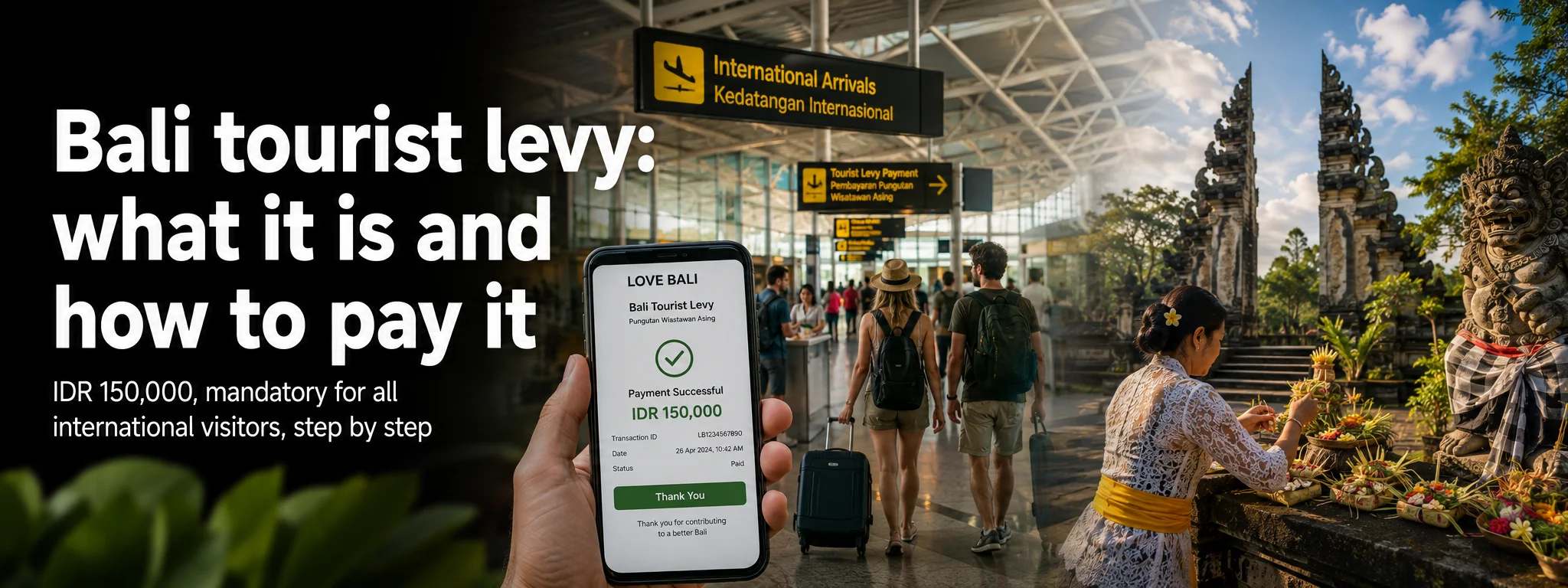
Bali's foreign tourist levy is easy once you separate it from the other paperwork. It is a provincial Bali levy of Rp150,000 per eligible foreign tourist, paid independently of your Indonesian visa and independently of the All Indonesia arrival declaration. The official system is called Love Bali, and the cleanest approach is to pay through it before you travel and keep the QR voucher on your phone.
01 What the Bali tourist levy is and who normally pays
What the Bali tourist levy actually is
The levy was created by the Bali Provincial Government to fund protection of Bali's culture and natural environment and to support tourism management. It applies to foreign tourists carrying out tourism activities in Bali. The headline amount is deliberately simple: Rp150,000 per person.
This is not an airport tax hidden in your airline ticket. It is not the B1 Visa on Arrival fee. It is not a customs fee. It is also not a fee charged by Totally Bali or a booking platform. Keeping those categories separate matters because travellers can arrive with a valid Indonesian visa and still have an unpaid Bali levy.
Who normally has to pay
Love Bali's current FAQ says the levy applies to every international tourist who travels to Bali and undertakes tourist activities, subject to specified exemptions. For a conventional holidaymaker arriving from overseas, the safe assumption is that it applies unless your immigration/residence status clearly falls into an exemption category.
It is charged per person rather than per family, hotel room or passport booking. If four eligible travellers arrive together, each traveller needs a valid levy payment/voucher.
02 Exemptions: check your actual visa or residence status
Love Bali currently identifies exemptions that include holders of diplomatic and official visas, transport crew, KITAS or KITAP residence permits, family-unification visas, student visas, Golden Visas and certain other visa categories. Some exemption categories are handled by showing the relevant permit; others require an exemption application through Love Bali.
Because Indonesia's visa naming and categories evolve, do not use a two-year-old travel blog's exemption table as legal advice. If you are not entering as an ordinary tourist, check the Love Bali FAQ and follow the current exemption process shown there.
03 How and when to pay through Love Bali
How to pay the levy safely
- Go directly to lovebali.baliprov.go.id.
- Enter the traveller details requested by the official system.
- Pay using an available cashless method. Love Bali lists cards, bank transfer/virtual account and QRIS among supported options.
- Use an email address you can access while travelling.
- Download or screenshot the levy voucher and QR code after payment.
- Keep the voucher until you have finished the Bali portion of the trip.
When should you pay?
The official FAQ strongly encourages online payment before departure to Bali because it simplifies arrival. Payment facilities also exist at designated airport and port counters and at registered endpoints such as participating hotels, travel agents and attractions, but relying on arrival payment creates another task at the exact moment you are juggling immigration, bags, customs, a SIM and transport.
For most travellers, the sensible routine is: organise the levy alongside your e-VoA and All Indonesia declaration, then save all three documents in one offline phone folder. Do not leave the voucher buried only in an email account that requires an SMS login code you cannot receive overseas.
04 How often the levy is paid
Love Bali describes the levy as paid one time while travelling in Bali, before leaving the territory of the Republic of Indonesia. In practical trip-planning terms, treat a new qualifying visit as requiring a new levy unless the official system confirms otherwise for your exact itinerary.
The tricky scenario is an itinerary that moves between Bali and another Indonesian island. For example, Bali → Java → Bali is not the same as leaving Indonesia and returning. Rules and enforcement processes can be refined over time, so if your route involves multiple Bali entries on one Indonesian trip, keep the original voucher and check Love Bali's current FAQ before paying a duplicate fee unnecessarily.
05 What happens on arrival in Bali
The levy is designed to be electronically verifiable through your voucher/QR code. Enforcement and checking points can change, so the useful habit is simply to keep the voucher accessible rather than trying to predict exactly which desk will ask for it on your flight.
At Ngurah Rai, the levy sits alongside several other arrival processes. Your immigration status is handled by Indonesian Immigration; your arrival declaration is handled through All Indonesia; customs comes after baggage; and your ride pickup is outside the controlled arrivals flow. See the full sequence in our Bali airport guide.
06 The levy does not change your visa
Paying Rp150,000 gives you no immigration rights. A traveller with 30-day visa-free entry still has 30-day visa-free entry after paying it. A traveller with a B1 e-VoA still has the stay authorised by that visa. If you need an extension, deal with Immigration; Love Bali cannot extend an Indonesian stay permit.
The reverse is also true: paying a visa fee does not pay the Bali levy. Our Bali visa and entry guide explains the current visa-free, VoA/e-VoA and extension routes.
07 What the levy is intended to fund
Bali's legal framework describes the levy as supporting protection of Balinese customs, traditions, arts and culture as well as the island's natural environment and tourism management. That context matters because the levy is often described online as simply a “tourist tax”, which is administratively convenient but tells only half the story.
The broader policy sits alongside Bali's 2025 code of conduct for foreign tourists, which also asks visitors to respect sacred sites and customs, use authorised money changers, obey traffic rules, use legal transport and accommodation, and pay the tourist levy. In other words, the provincial approach treats the levy as one part of how visitors participate in a heavily tourism-dependent island rather than as a standalone airport charge.
08 Payment problems and missing vouchers
Payment succeeded but no voucher arrived
First check spam/junk folders and the email address entered in the form. Keep proof of the transaction. If the official portal offers a status or support route, use that rather than immediately paying again.
Your bank shows a failed or pending payment
Do not hammer the payment button repeatedly. A pending card authorisation can later settle, leaving duplicate charges. Check the official payment status and your bank before making a second payment.
You used a third-party site by mistake
If you received a genuine Love Bali voucher, the underlying levy may still be valid even if the intermediary charged a service fee. If you did not receive a government voucher/QR code, verify your status directly with Love Bali and treat any unexpected card activity as you would any other online payment concern.
09 Common misinformation, families and children
Common levy misinformation to ignore
“It is included in the VoA”
No. They are separate payments to different levels of government for different purposes.
“Everyone pays at the airport”
No. The official system encourages pre-arrival online payment and also provides designated in-person channels.
“Cash is the normal method”
Love Bali specifies cashless electronic payment facilities.
“A hotel can waive it”
A hotel may be a registered payment endpoint; that does not create a discretionary exemption.
Children, families and group trips
The levy is a per-person charge, so do not assume that one parent's QR voucher covers a whole booking. When travelling as a family or group, save each traveller's voucher with a filename that includes their name rather than keeping four identical-looking screenshots in the camera roll. That small bit of organisation is useful when a staff member asks for one person's proof.
If a child or another traveller holds an immigration status that you think creates an exemption, verify that specific exemption in Love Bali rather than generalising from the adults in the group. Immigration status and levy liability are related only through the published exemption rules.
10 Wider Indonesia itineraries and final checklist
Bali inside a wider Indonesia itinerary
A Bali levy is provincial, while your Indonesian visa is national. If you land in Jakarta, travel through Java and later fly to Bali, the levy question still arises when you visit Bali even though you already entered Indonesia days earlier. Likewise, leaving Bali for Lombok does not reset your Indonesian immigration permission; it is still the same Indonesian stay unless you actually leave the country.
This distinction is useful when planning Bali–Lombok–Java combinations. Keep your levy voucher after leaving Bali and check Love Bali's current instructions if you will return to Bali during the same Indonesian trip. The official system, not a ferry seller, should decide whether any additional action is required.
Official sources and practical checklist
- Love Bali — official levy portal
- Love Bali — official FAQ, payment and exemptions
- Bali Government Tourism Office — 2025 foreign tourist code of conduct
- Totally Bali — current visa and entry rules
- Confirm whether the levy applies to your immigration status.
- Pay through Love Bali if required.
- Save the QR voucher offline.
- Keep it separate from your eVisa/e-VoA and All Indonesia QR code so you can produce the right document quickly.