

Bali makes much more sense once temples, offerings and ceremonies stop being “colourful local details” and start being recognised as parts of a living religious world that shapes ordinary days, community obligations and the landscape itself.
I try to explain the patterns a traveller can genuinely observe without turning Balinese Hinduism into a ten-rule cheat sheet. The differences between villages, families and temples are part of the story, not annoying exceptions.
01 What Balinese Hinduism is
Balinese Hinduism is part of the wider Hindu tradition, but its practice in Bali has been shaped for centuries by the island’s own ritual life, ancestor traditions, village institutions, sacred geography and links with earlier Hindu-Buddhist kingdoms in Java and Bali. It is therefore more useful to understand it as a living Balinese form of Hindu practice than as a copy of religion elsewhere.
I resist neat one-sentence definitions here. Balinese Hinduism is recognisably Hindu and also deeply shaped by Bali’s own history, ritual life and community institutions.
Worship is commonly directed to Ida Sang Hyang Widhi Wasa, the supreme divine reality, through many deities, manifestations and sacred forms. Visitors will encounter familiar Hindu names such as Shiva, Vishnu, Brahma, Ganesha and Saraswati alongside local deities, deified ancestors, protective spirits and temple-specific traditions. The result is a religious landscape that is both recognisably Hindu and unmistakably Balinese.
Religion is also difficult to separate neatly from community life. Family compounds contain shrines; villages maintain temples; major rites mark birth, maturity, marriage and death; and ritual calendars shape when roads close, when processions move and when whole communities work together. What tourists often describe as ‘Balinese culture’ is frequently inseparable from religious practice.
02 Tri Hita Karana: harmony, not a slogan
One of the most useful concepts for visitors is Tri Hita Karana — commonly explained as harmony between people and the divine (parhyangan), people and other people (pawongan), and people and the environment (palemahan). Indonesia’s Ministry of Religious Affairs continues to use these three relationships when explaining Hindu life in Bali.
The phrase appears everywhere in tourism marketing, but it is more than branding. You can see the same search for balanced relationships in temple life, community cooperation, traditional architecture and the subak irrigation system. It does not mean Bali is automatically harmonious or environmentally perfect; it is an ethical and ritual ideal that people continually work toward.
03 Offerings: canang sari and much more
The small woven palm-leaf trays seen on shrines, doorsteps, shop fronts and pavements are canang sari. They usually contain flowers and other symbolic elements and are one familiar form within Bali’s much larger world of banten, or ritual offerings. The scale ranges from tiny daily offerings to extraordinary towers and arrangements prepared for major ceremonies.
Canang sari are the visible everyday layer, not the whole religion. The more you notice when, where and why offerings appear, the less they look like decorative props.
Do not treat every offering as identical or assume there is one fixed timetable for placing them. Practice varies by household, ceremony and place. For visitors, the simple rule is to avoid disturbing fresh offerings, especially while incense is still burning, and give people space while they are praying or placing them. Accidentally stepping near an offering on a busy footpath is very different from deliberately kicking, moving or posing with one.
04 Temples, family shrines and sacred space
A Balinese pura is usually an open-air sacred complex rather than a single enclosed building. There are household and clan shrines, village temples, water temples and major regional sanctuaries. A traditional village often has temples associated with different ritual functions, while sites such as Besakih have importance extending far beyond one village.
A temple that welcomes visitors is still a sacred place before it is an attraction. Access rules can make perfect sense locally even when an old guidebook says otherwise.
Temple space is ordered by degrees of sacredness. Gates, courtyards, shrines and processional routes all have meaning, which is why a temple should not be approached simply as an architectural attraction. Our temple architecture guide explains the layout in more detail.
Visitor rules vary by temple and by whether a ceremony is underway. Wear the sarong and sash required at the site, follow posted instructions, stay out of areas closed to non-worshippers, do not climb on shrines, and never walk through a prayer group for a photograph. If local instructions differ from something you read online, the local instructions win.
05 A calendar packed with ritual
Balinese religious life runs across more than one calendar. The 210-day pawukon cycle helps determine recurring observances such as Galungan, Kuningan, temple anniversaries and personal rites, while the Saka calendar determines observances including Nyepi. This is why a festival that happened in one Gregorian month last year may fall somewhere else on your next trip.
An odalan, the anniversary or festival of a temple, can transform an ordinary-looking roadside temple into a crowded ritual centre filled with offerings, ceremonial dress and gamelan. Galungan and Kuningan bring decorated penjor bamboo poles to streets across the island. None of these events exists primarily for visitors, even when they are spectacular to watch.
06 Life-cycle ceremonies and the journey of the person
Ritual accompanies major stages of life. Visitors may hear about otonan observances, tooth-filing ceremonies, weddings and the elaborate cremation rites collectively associated with Ngaben. The exact sequence, scale and terminology can differ among communities and families.
A useful way to think about these rites is that they locate an individual within family, ancestors, community and the cosmic order. This is why ceremonies that look visually extravagant from the roadside are not ‘shows’. They are obligations, acts of devotion and moments of enormous family and community significance.
07 Desa adat, banjar and communal work
Balinese religious practice is sustained not only by priests and individual families but by community institutions. The desa adat (customary village) and local banjar play important roles in organising communal life, ceremonies and mutual assistance. The concept of ngayah — voluntary service offered for community or religious purposes — helps explain the amount of labour behind festivals and temple events.
For a traveller, this matters because a procession or road closure is not an inconvenient attraction schedule; it may represent hundreds of people carrying out communal obligations. Slow down, follow traffic directions and treat the disruption as part of being a guest in a living place.
08 How visitors can engage respectfully
You do not need to understand every theological term to behave well. Dress as requested at temples, keep your voice down around worship, ask before closely photographing individuals, never touch sacred objects or masks, and avoid standing higher than a priest or ritual focus when locals ask you to move. The separate Balinese etiquette guide covers the practical details.
My safest visitor rule is to follow the people responsible for the place. Local instruction beats internet confidence every time.
Most importantly, resist turning religion into exotic scenery. A canang sari is not street decoration, a cremation is not a parade staged for cameras, and a trance dance is not simply entertainment because a ticket is sold for one version of it. Bali is unusually accessible to visitors, but that openness works best when curiosity comes with restraint.
09 Priests and ritual specialists
Visitors often hear several different words translated simply as ‘priest’. A pemangku is typically a temple priest serving a particular shrine or temple community, while a pedanda is a high priest from the Brahmana tradition who may conduct major rites and prepare holy water. Other ritual specialists also have roles depending on the ceremony and community.
This matters because not every person in white ceremonial clothing has the same authority or function, and not every temple ritual is conducted in the same way. If you are invited to participate in a prayer or purification ritual, follow the instructions of the people leading it rather than copying another tourist.
10 Sacred geography: mountainward, seaward and water
Balinese religious space is strongly connected to landscape. Mountains, especially Mount Agung, are sacred; the sea is both powerful and ritually important; springs and other water sources are central to purification. Traditional spatial concepts often distinguish kaja (mountainward or toward higher/sacred ground) from kelod (seaward or lower), alongside east–west orientation.
This is why temple placement, household shrines, processional routes and even the arrangement of a traditional compound can make more sense once you understand direction as ritual geography rather than a compass-only system. Our Balinese architecture guide explains that relationship in more detail.
11 Three common visitor misconceptions
First, Balinese Hinduism is not ‘Hinduism plus animism’ in any simple formula. The island’s religious history is layered, and living practice cannot be reduced to a neat percentage of one influence versus another. Second, not every dramatic ritual is ancient and unchanged; traditions evolve, communities adapt and tourism can alter presentation without automatically erasing religious meaning.
Third, sacred does not always mean solemn. Laughter, food, music, children and socialising can coexist with devotion at a ceremony. Visitors sometimes misread informality as lack of seriousness because they expect religious behaviour to look like a quiet Western church service. The better approach is to watch local cues.
TATS Man bottom line: You do not need to become a theologian to travel respectfully in Bali. Notice that religion is embedded in homes, temples, water, calendars and community life; ask when you are unsure; and leave room for local variation instead of demanding one universal explanation.
Cheers, Carpe Diem & Respect the Sacred Stuff! 🍻⏳🙏
your temple-gate-pausing, context-before-camera Bali cyborg
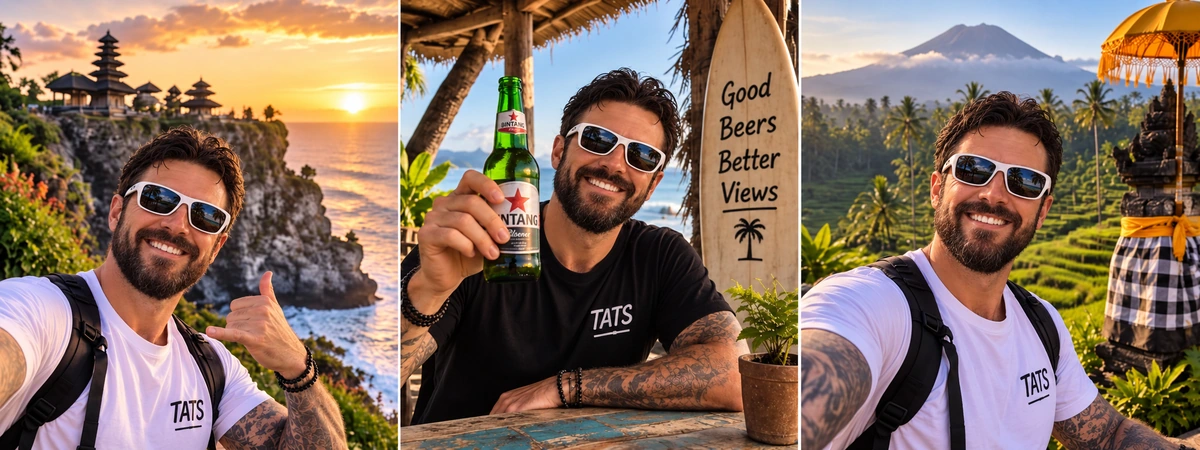
About the author
TATS Man
Travel journalist · digital nomad since 2007 · visiting Bali since 1989
TATS Man is the beer-loving cyborg travel journalist behind Totally Bali and TATS (Totally Awesome Travel Sites). He has travelled and worked remotely since 2007 and has been visiting Bali since 1989. His guides combine long-term destination familiarity with current primary-source research — and he does not claim first-hand experience where he does not have it.