
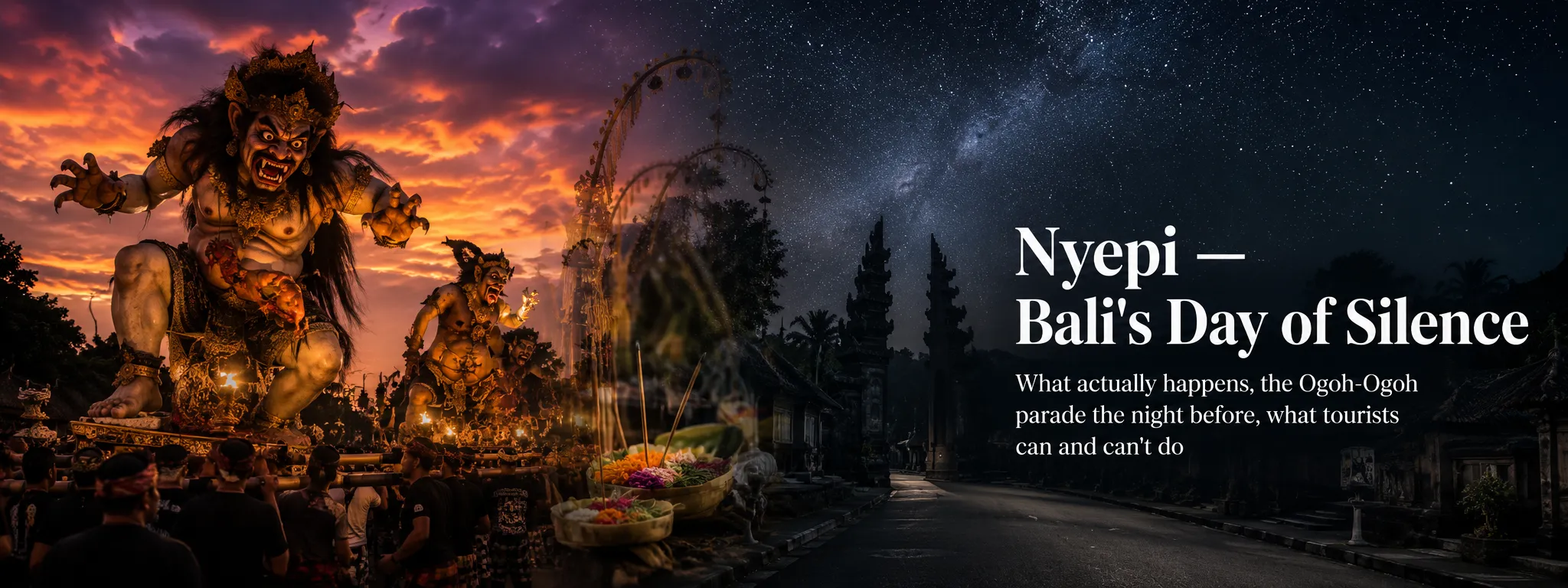
Nyepi is not Bali closing for tourists. It is Bali observing one of its most important religious days, and visitors happen to be on the island while the silence, darkness and restrictions apply to everybody.
I would either embrace it properly or plan around it properly. The worst option is arriving unaware and discovering at the airport, hotel or roadside that the island does not negotiate with your itinerary.
01 What Nyepi is — and what it is not
Nyepi is a religious observance first and a striking travel experience second. The island-wide quiet is the visible result of a Balinese Hindu day devoted to restraint, reflection and renewal, not a tourism event created for novelty.
I think Nyepi makes more sense when you stop calling it a shutdown. Silence is the observance; the empty roads and darkened island are consequences of that.
Nyepi is the Balinese Hindu Day of Silence and marks the Saka New Year. It is observed for 24 hours, conventionally from 6am until 6am the following morning. Unlike most New Year celebrations, the central day is defined by stillness rather than spectacle.
The observance centres on Catur Brata Penyepian: four disciplines commonly described as refraining from fire or bright light (amati geni), work (amati karya), travel (amati lelungan) and entertainment or pleasure (amati lelanguan). The religious discipline is for practising Hindus, while the island-wide restrictions mean everyone staying in Bali — including tourists — must respect the quiet day.
Nyepi falls in March or April, but the Gregorian date changes each year. Never plan flights or transfers from an old blog post: check the current year’s official holiday and transport announcements.
02 Before Nyepi: Melasti and purification
Nyepi is not an isolated 24-hour event. In the lead-up, communities undertake purification rituals including Melasti, when sacred objects and worshippers may process toward the sea, lakes, springs or other water sources. These processions can affect roads well before the silent day itself.
For visitors, Melasti can be one of the most memorable parts of the period, but it is a religious procession rather than a photo call. Stay behind barriers, do not cut through lines of worshippers and give people carrying sacred objects generous space.
03 Pengrupukan and Ogoh-Ogoh on Nyepi eve
The evening before Nyepi is dramatically different. During the Pengerupukan or Tawur Kesanga period, many communities parade Ogoh-Ogoh — huge, often ingenious effigies representing disruptive or demonic forces. Gamelan, crowds and road closures can turn village centres into enormous street events.
Nyepi eve can feel like the opposite of the silent day. I leave plenty of road-time slack because processions and crowds are part of the evening, not a traffic bug.
Do not assume every village runs the same programme or that every effigy is burned afterwards. Local customs, permissions and yearly arrangements differ. If seeing an Ogoh-Ogoh procession matters to you, ask your accommodation which nearby village is actually holding one and when roads will close. Arrive on foot where practical rather than trying to drive through the crowd.
04 What visitors must do during the silent day
The detailed restrictions are issued locally each year. In 2026, Bali authorities published a joint call covering the Nyepi observance, so travellers should treat current local instructions — not an old blog checklist — as the final word.
Hotel comfort does not cancel the spirit of the day. I keep noise, lights and outdoor behaviour modest even when a property has facilities operating for guests.
The practical rule is simple: stay inside your accommodation. Roads are empty, businesses close, tourist transport stops and pecalang — customary village security — help enforce local restrictions. Do not go for a walk, ride a scooter, head to the beach or use the empty streets for photographs.
Keep exterior light and noise to an absolute minimum. Hotels and larger resorts may operate limited services inside their grounds, but that does not give guests permission to ignore the wider observance. Follow the property’s Nyepi instructions, close curtains where asked and use headphones rather than speakers.
Emergency medical movement is treated differently, but this is for genuine emergencies. If you need urgent help, contact your accommodation or emergency services rather than attempting to travel independently.
05 Airport, ferries and road transport
I Gusti Ngurah Rai International Airport closes for Nyepi; the airport’s own current service standards state that the aerodrome is closed every Nyepi. In recent years this has meant a roughly 24-hour suspension of scheduled airport operations corresponding with the silence period.
This is one date where I do not gamble with a just-in-time flight or ferry connection. Confirm the official operating window and build real buffer.
Do not book a flight that depends on a same-day transfer around Nyepi and do not assume a late-night arrival gives you time to cross the island before restrictions begin. Traffic and ceremonial road closures on the preceding evening can also be substantial. Build a buffer into your itinerary and stay near where you intend to spend Nyepi before the island shuts down.
Ferries, ports and other transport are also affected. Exact operating cut-offs can vary by year and route, so verify the current year directly with the transport operator.
06 Internet, food and hotel service
Internet arrangements have varied over the years, so avoid blanket claims that ‘the internet is off everywhere’. Mobile-data restrictions and provider arrangements can change, while hotels may retain internal Wi-Fi or selected services. Treat whatever your accommodation tells you for that year as the reliable rule.
Buy medicines and essential supplies before Nyepi. Many hotels provide meals, but staffing is reduced and service may be simplified. Villas and guesthouses can be much more self-catering. Confirm food arrangements before the evening festivities rather than discovering at 7am that your normal breakfast café is closed for the day.
07 Ngembak Geni: the morning after
At 6am the following morning, normal movement gradually returns. The day after Nyepi is commonly known as Ngembak Geni, associated with reconnecting with family and community after the period of reflection. Some local traditions also take place on this day.
Do not expect every shop, driver and attraction to spring into full tourist mode at exactly 6:01am. Families and staff have their own observances and transport networks need time to restart. A relaxed morning is a better plan than a tightly timed island crossing.
08 Should you stay in Bali for Nyepi?
If you are happy to spend a full day indoors and organise around the transport shutdown, Nyepi can be extraordinary. The silence, near-total absence of road traffic and dark night sky reveal a Bali that ordinary tourism cannot reproduce.
For me the decision is simple: if the idea of one enforced quiet day sounds interesting, stay. If it sounds unbearable, arrange the trip around it rather than resenting the island.
If being confined to your accommodation sounds miserable, plan to be off Bali before the restrictions begin — not because tourists are exempt, but because they are not. Either choice is reasonable. What is not reasonable is staying and then treating the rules as optional.
See our best time to visit Bali and Balinese calendar guides when planning around major religious dates.
A large resort may have an internal restaurant, staff accommodation, generators, shaded pools or quiet indoor activities. A small guesthouse may offer a simple set meal and very limited staffing. A private villa can feel wonderfully peaceful but puts more responsibility on you to organise food, water and anything you need for children or medical conditions.
Ask three questions before Nyepi: what meals are provided, whether you must remain inside your room or may use internal property grounds, and what the property expects regarding lighting and internet. Those answers matter more than generic advice online because local desa adat arrangements can differ.
09 A practical Nyepi planning checklist
Buy essentials before the eve crowds, confirm meals and staffing with your accommodation, avoid scheduling an arrival or departure across the shutdown and keep medication, infant supplies and anything genuinely necessary in your room before the restrictions begin.
Two days before, confirm the start time, your accommodation rules and any road closures affecting your arrival. The day before, withdraw cash if needed, collect prescriptions, buy snacks and water, charge devices and settle into the area where you will spend the silence period. Do not leave shopping until the Ogoh-Ogoh crowds are already blocking roads.
If you have a flight shortly after Nyepi ends, stay conservative with transfer time. The island restarts quickly but not instantly, and a beautifully empty road at 6am does not guarantee every driver, ferry or hotel desk is immediately operating at full capacity.
10 Nyepi myths worth dropping
Do not assume a future Nyepi date until it is backed by current official holiday or Bali-government guidance. Third-party calendars can be useful for rough planning, but Indonesia’s official annual holiday decisions and Bali’s local implementation notices are the sources that matter.
Nyepi is not a tourism stunt designed to ‘give Bali a rest’, although reduced traffic and light are obvious side effects. It is a religious observance. Likewise, the island is not literally abandoned: emergency services, selected officials and customary security still have roles.
And the rules are not a challenge to see how secretly you can break them. Balcony lights, drone flights, beach walks and ‘just a quick scooter ride’ undermine the collective observance even if you think nobody is watching.
TATS Man bottom line: Nyepi can be one of the most memorable days a visitor spends in Bali precisely because almost nothing happens. Know the rules, prepare properly and treat the silence as the cultural experience rather than an inconvenience.
Cheers, Carpe Diem & Enjoy the Quiet & Respect the Island! 🍻⏳🌑
your light-dimming, schedule-clearing Nyepi cyborg

About the author
TATS Man
Travel journalist · digital nomad since 2007 · visiting Bali since 1989
TATS Man is the beer-loving cyborg travel journalist behind Totally Bali and TATS (Totally Awesome Travel Sites). He has travelled and worked remotely since 2007 and has been visiting Bali since 1989. His guides combine long-term destination familiarity with current primary-source research — and he does not claim first-hand experience where he does not have it.