
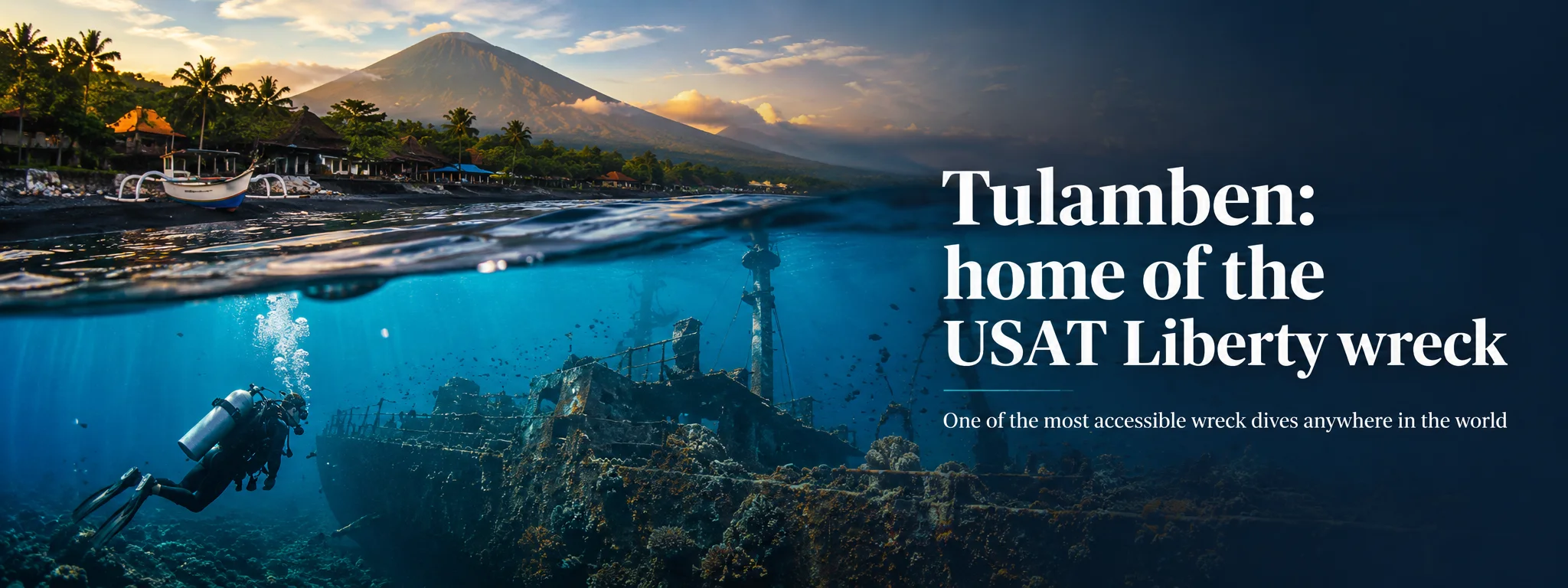
Tulamben earns its reputation because a genuinely important wreck dive sits ridiculously close to shore, but the easy access can make people underestimate the rest of the equation: pebbles, gear, conditions, operator quality and what they actually want from the dive.
I would stay here if diving is the point rather than treating the USAT Liberty as one more stop between temples. Early and repeat dives are where Tulamben starts making much more sense.
01 Tulamben in one minute
Tulamben sits on Bali's north-east coast in Karangasem Regency, beneath the wider Mount Agung landscape. It is not a conventional beach-resort town: the shoreline is dark volcanic stone rather than soft white sand, the main road is lined with dive centres, small hotels and restaurants, and nightlife is minimal.
That modest setting hides one of Bali's best-known underwater regions. The Liberty wreck is the obvious draw, but Coral Garden, the Drop Off and black-sand macro sites mean experienced divers can easily justify several days rather than treating Tulamben as a one-dive stop.
The area also links naturally with Amed, which lies farther south-east. The two destinations overlap as dive bases but feel different: Tulamben is more concentrated around shore diving, while Amed stretches across a chain of bays with more general holiday infrastructure, snorkelling and jukung boat diving.
02 The USAT Liberty wreck — why it is so accessible
The USAT Liberty was a US Army transport ship damaged by a Japanese torpedo during World War II. It was towed towards Bali and beached at Tulamben for salvage. During the 1963 Mount Agung eruption, volcanic activity and ground movement pushed the ship from the shore into the sea, where it became the wreck divers visit today.
The “shore dive” label can sound almost too easy. I still want a proper briefing, sensible entry help and a guide who understands the wreck and the day’s conditions.
PADI lists the wreck as a shore-entry site, with its shallowest structure around 5 metres and deeper sections extending to roughly 30 metres. The ship is about 120 metres long and lies only a short swim from the beach. That combination — large wreck, shallow upper sections and no compulsory boat ride — is what makes it unusual.
“Beginner-friendly” needs context. An Open Water diver can visit shallower sections with an appropriate guide, but the wreck still contains depth, overhead-looking spaces, sharp metal, other divers and changing conditions. Penetration into enclosed areas is a different activity requiring proper training and should not be confused with simply swimming around the exterior.
The wreck is heavily colonised by coral and marine life. Schools of fish, nudibranchs, reef species and occasional larger visitors make it interesting even after the novelty of the ship itself wears off. Photographers often return at different times of day because light, crowd levels and animal activity change the feel of the site.
03 Coral Garden, the Drop Off and macro diving
The Liberty dominates Tulamben's reputation, but it should not dominate your entire itinerary. Coral Garden is a shallower reef area used by divers and snorkellers, while the Drop Off follows a steep underwater wall formed by volcanic geology. Both provide a different shape and pace from circling a wreck.
Tulamben is also a strong macro destination. Black volcanic sand may look plain from the surface, but it creates habitat for small, unusual animals that underwater photographers actively search for: nudibranchs, shrimp, frogfish, scorpionfish and other cryptic species. A dedicated macro guide can be far more useful than a general “show me the highlights” dive if small subjects are your priority.
There are additional sites along the wider Tulamben–Kubu coast, including another wreck at Kubu and muck-diving locations. Ask the operator what has been good recently rather than arriving with a fixed list copied from a five-year-old blog post.
04 Can you snorkel at Tulamben?
Yes. In suitable conditions, snorkellers can see the shallow part of the Liberty area and use Coral Garden and nearby reef. PADI-listed snorkelling trips specifically include the Liberty, Coral Garden and Drop Off areas. The wreck's upper structure comes close enough to the surface that you do not need scuba equipment to understand why the site is famous.
The limiting factor is shore entry, not necessarily the reef itself. Tulamben's rounded volcanic stones can be awkward when small waves are pushing at your legs, especially while carrying fins. A local guide can choose the easiest entry and help with timing. Water shoes are useful for the shoreline, but once you are over reef, stay horizontal and avoid standing on coral.
If you are new to snorkelling, read our beginner snorkelling guide before deciding whether to enter independently. Weak swimmers should use flotation and a guide rather than assuming proximity to shore makes the water risk-free.
05 Conditions, visibility and the best time to dive
Tulamben can be dived year-round. PADI describes typical water temperatures around the upper 20s Celsius and generally calm conditions, with the dry season often producing clearer water. That is a useful broad pattern, not a promise for a particular morning.
Volcanic coastline, wind and sea state can change the experience quickly. I treat the morning plan as a plan, not a contract.
Visibility changes with swell, rain, plankton and local conditions. The sea can look calm and still have surge near the shoreline, while a slightly choppy surface can settle once you descend. Good dive centres make site decisions based on current observations rather than a fixed calendar.
Early dives are popular because the village is quiet, the site may be less crowded and morning conditions can be favourable. But “dawn is always best” is too simplistic. If your operator recommends a later slot because of conditions, tide or group logistics, listen to the people who have actually looked at the water that day.
06 Learning to dive and returning after a long break
Tulamben is a practical training base because shore diving reduces some of the logistics that can overwhelm a first-time diver. Several PADI centres run introductory experiences, Open Water training and refresher dives in the area. The Liberty's shallow upper sections also give newly certified divers a memorable site without immediately requiring advanced depth.
If you are already certified but have not dived for a year or more, tell the centre when booking. A refresher or easy first dive can rebuild mask, buoyancy and emergency skills before visiting busier parts of the wreck. Do not inflate your logged-dive number or recent experience to stay with a more advanced group.
For Open Water students, choose the centre on instructor quality, equipment, group size and safety culture rather than the cheapest course package. A certification is only useful if you finish comfortable enough to dive responsibly afterwards.
07 Why underwater photographers stay longer
Tulamben works unusually well for underwater photography because shore access allows repeated dives without spending much of the day on boats. The Liberty provides wide-angle structure, schooling fish and coral growth; the sand and reef sites provide macro subjects. That lets photographers switch lens strategy without moving to another part of Bali.
If photography is the main goal, ask for a guide who actually enjoys spotting macro life and understands photographers' slower pace. Also be realistic about buoyancy. A camera adds task loading, and photographers who cannot hold position without touching reef should practise buoyancy first.
Night diving is another reason experienced divers stay in Tulamben. Different animals emerge after dark and the same familiar site can feel completely different. Only do it with suitable training, a torch setup you understand and a guide or buddy plan appropriate to your experience.
08 What Tulamben is like above water
Tulamben is quiet, functional and dive-focused. Accommodation ranges from simple guesthouses to established dive resorts, but the point of staying here is convenience rather than resort glamour. Restaurants tend to serve divers who want breakfast early, lunch between dives and an easy dinner rather than a full nightlife circuit.
There is no broad pedestrian beachfront strip comparable with Sanur and no concentration of bars like Canggu or Seminyak. That can be a benefit: after two or three dives, a pool, dinner and an early night may be exactly what you want.
Non-diving partners can enjoy pool time, snorkelling and East Bali day trips, but someone who wants shopping, cafés and varied sightseeing every day may prefer Amed or Candidasa and visit Tulamben for diving.
09 Stay in Tulamben or visit from Amed?
Stay in Tulamben if you plan multiple Liberty dives, want dawn or night dives, are doing a course, or care about macro photography. Being close to the entry saves repeated transfers and makes it easy to change plans around conditions.
If I had travelled all the way east specifically to dive, I would rather sleep near the site than burn the best morning hours commuting from somewhere prettier.
Stay in Amed if you want a more varied coastal holiday with snorkelling bays, cafés and a longer choice of places to eat while still keeping Tulamben within easy reach. Many Amed operators also run trips to the Liberty.
A one-day transfer from South Bali is possible, but traffic makes it a long outing. If you are serious enough about diving to make Tulamben a priority, at least one night in East Bali usually improves the experience.
10 Choosing a dive centre
Look for recognised agency affiliation, properly maintained rental equipment, oxygen and first-aid capability, sensible group sizes, and staff who ask about your certification, last dive and medical considerations. A good centre should be comfortable saying a site is not suitable for you today.
Good dive centres answer boring safety questions clearly. That is a stronger selling point than a wall full of underwater photos.
Ask what the quoted price includes: equipment, dive computer, guide, tanks, Nitrox if requested, transport, lunch and any local fees. Cheap pricing is not automatically bad, but it is only comparable when the inclusions are the same.
For the Liberty, group control matters because popular times can be busy. A guide who understands site flow can avoid bunching everyone into the same section of wreck and can adapt the route to your air consumption and comfort level.
11 Practical Tulamben planning
- Bring or rent booties: the volcanic-stone beach is the most awkward part of many shore dives.
- Do not schedule a flight immediately after diving: follow your training agency's no-fly guidance and build proper surface time into the trip.
- Protect electronics from grit and salt: beach entries are hard on camera housings, charging ports and bags.
- Keep a flexible site list: the Liberty is famous, but Tulamben is better when you also dive a wall, coral or macro site.
- Check insurance: confirm scuba depth and certification requirements in your travel policy; our travel insurance guide explains what to look for.
For the wider picture, compare Tulamben with Amed, Penida, Menjangan and Padangbai in our Bali diving and snorkelling overview. Tulamben's strength is not that it is the only great place to dive in Bali — it is that such a good site is so unusually easy to access from shore.
TATS Man bottom line: Tulamben is one of Bali’s strongest specialist stays: simple above water, unusually rewarding below it. Come for the Liberty, but stay long enough for the other sites, calmer timing and the fact that repeated dives beat a rushed checkbox.
Cheers, Carpe Diem & Mind the Pebbles on the Way In! 🍻⏳🤿
your wreck-nerding, shore-entry-respecting Tulamben cyborg
About the author
TATS Man
Travel journalist · digital nomad since 2007 · visiting Bali since 1989
TATS Man is the beer-loving cyborg travel journalist behind Totally Bali and TATS (Totally Awesome Travel Sites). He has travelled and worked remotely since 2007 and has been visiting Bali since 1989. His guides combine long-term destination familiarity with current primary-source research — and he does not claim first-hand experience where he does not have it.