
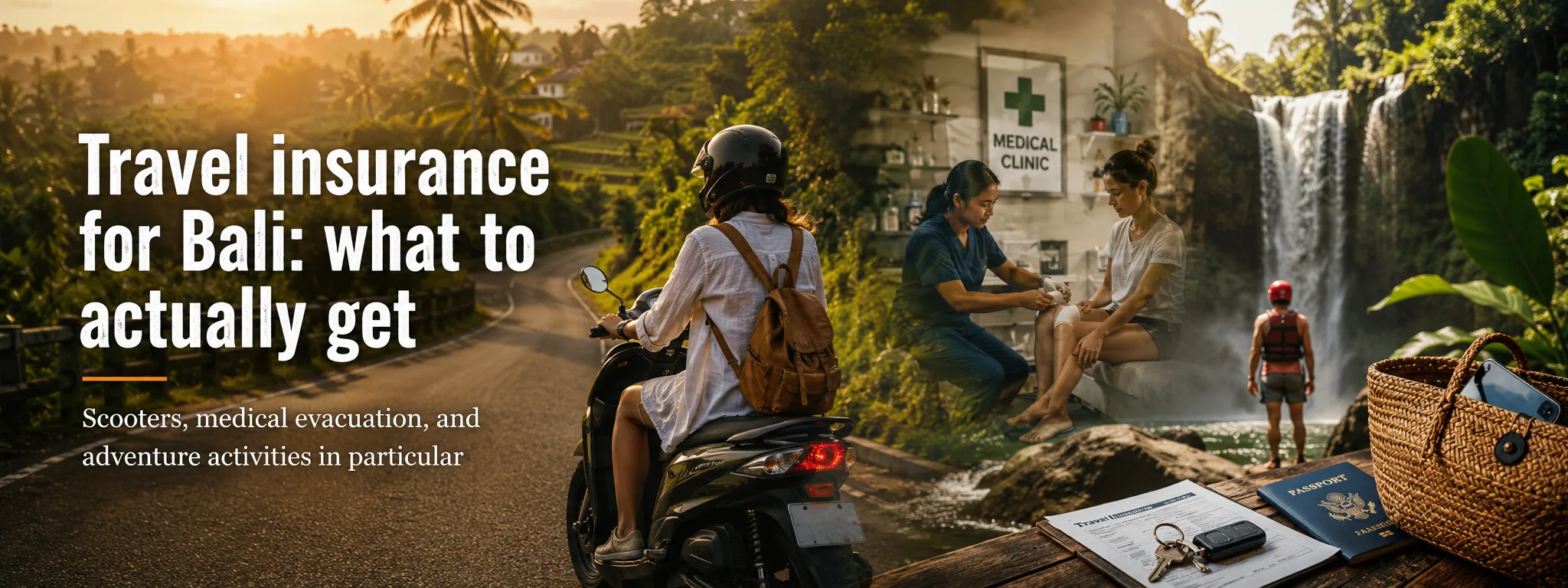
01 Start with the trip you are really taking
Travel insurance for Bali is less about protecting the price of the holiday and more about protecting yourself from the expensive things that can happen once you are there. A policy that looks generous on cancellation can still be poor for Bali if it excludes riding a scooter, scuba diving, hiking, pre-existing medical conditions or medical evacuation. The useful question is not “do I have travel insurance?” but “does my policy cover the exact activities, transport and health risks in my itinerary?”
For Australian travellers, Smartraveller explicitly recommends checking destination coverage, trip length and planned activities before buying. It also warns that activities such as scooter riding may not automatically be included. Read the product disclosure statement before departure, not after an accident. Start with our Bali safety and health guide and car and scooter guide so you know what you need the policy to cover.
02 Medical treatment, evacuation and up-front costs
Medical cover is the part that can save you financially
Bali has capable private clinics and hospitals, especially around Denpasar and the major tourism areas, but visitors normally pay for private treatment themselves or through insurance. A simple consultation may be manageable; surgery, intensive care, complex trauma or transfer to another country can become very expensive very quickly. Your policy should have a medical limit that would still look adequate if the problem became serious rather than stopping at a clinic visit.
Look specifically for emergency hospital treatment, ambulance costs, prescription medication, emergency dental treatment where appropriate, and repatriation or medical evacuation. If you have a pre-existing condition, do not assume it is covered because it feels minor: declare it when the insurer requires declaration and keep written confirmation of any accepted cover.
Medical evacuation and repatriation deserve their own check
Most Bali holidays never get anywhere near medical evacuation, which is exactly why travellers underestimate it. If a specialist treatment is unavailable locally, an insurer may need to coordinate transfer elsewhere in Indonesia or internationally. Evacuation can involve aircraft, specialist medical staff and hospital coordination, so the relevant cost is not comparable with buying another airline ticket.
Check that evacuation and repatriation are explicitly covered and whether the insurer — rather than you — must authorise the transfer. Save the insurer’s 24-hour emergency number in your phone and in a second place your travel companion can find. In a major emergency, contact the insurer as soon as practical rather than arranging an expensive transfer independently and hoping for reimbursement.
How private medical billing can work in practice
This is one reason buying insurance soon after committing meaningful money to the trip can be smarter than buying it at the airport. If disruption occurs, keep airline messages, cancellation notices, receipts for additional accommodation and any official alerts relevant to the claim.
Bali and neighbouring islands sit in an active volcanic and seismic region. Most trips are unaffected, but volcanic ash can disrupt aviation and severe weather can affect ferries or activities. Insurance generally distinguishes between an unforeseen event and a known event. Once an eruption, cyclone, ash cloud or other disruption is publicly known, a newly purchased policy may exclude losses connected with it.
03 Scooters, alcohol and policy exclusions
Scooter cover: the Bali insurance trap worth reading twice
Scooters are where insurance wording and holiday behaviour often collide. Indonesian police rules require drivers to hold an appropriate licence for the vehicle; Indonesian motorcycle licensing is a separate category from car licensing. Your insurer can impose additional conditions — for example requiring a valid home-country motorcycle licence, an International Driving Permit with the corresponding motorcycle class, helmet use, an engine-size limit, or a specific motorcycle add-on.
That means “I rented it legally from a shop” does not prove you are insured. Neither does “everyone in Bali rides one”. Before riding, read the motorcycle/moped section of the policy and confirm the licence requirements in writing if the wording is ambiguous. If you are not properly licensed, using a driver, taxi or ride-hailing service is a much better financial decision than relying on an insurer to be generous after a crash.
Alcohol, drugs and “reckless behaviour” exclusions
Insurance policies commonly contain exclusions involving intoxication, illegal drugs, deliberate risk-taking or unlawful behaviour. The precise wording differs by insurer, so there is no useful universal blood-alcohol rule to quote. The practical lesson is simpler: a claim arising from riding after drinking, jumping from an unsafe structure, entering a closed area or ignoring a safety instruction can become much harder to defend.
Bali’s nightlife is part of many trips, but insurance should not be treated as a licence to ignore normal judgement. Arrange a ride home, keep your accommodation address accessible, and do not ride a scooter after drinking.
04 Surfing, diving and adventure activities
Bali trips often include activities that sit outside the assumptions of a basic city-break policy. Scuba policies may set depth or certification limits; trekking cover may depend on altitude, route or whether a professional guide is required; surf, rafting, canyoning and other activities can have their own exclusions. If you are planning diving or snorkelling, a Mount Batur climb, surfing or organised adventure activities, search the policy wording for the activity by name.
Also check whether organised activities must be conducted by a licensed operator and whether protective equipment is mandatory. A policy that covers an activity does not necessarily cover every way of doing it.
05 Cancellation, volcanic ash and known-event rules
Cancellation, disruption and missed connections
Cancellation cover is useful, but look at why the policy will pay rather than just the headline dollar limit. Illness, natural events, airline disruption, government restrictions and “change of mind” are treated differently. If your itinerary contains separate airline tickets — for example an international flight to Bali followed by an independently booked domestic or regional flight — check whether a missed connection between unrelated bookings is covered.
Keep receipts, booking confirmations and written notices from airlines or operators. Insurers generally need evidence, and screenshots taken while the disruption is happening can be easier than reconstructing the story weeks later.
Volcanoes, earthquakes, ash and weather disruption
Also check whether the policy covers you when somebody else is driving. If you are a passenger on a rented scooter ridden by a friend who is unlicensed or uninsured, the claim position may be different from being a passenger in a licensed commercial vehicle. If this scenario matters to you, ask the insurer directly and keep the answer.
Policy documents are long, but several exclusions repeatedly matter in Bali. Look for unattended baggage, rental-vehicle excess, motorcycle use, watercraft, diving, hiking above a specified altitude, alcohol-related incidents, pre-existing conditions, pregnancy, dental care, expensive electronics and natural-event disruption. A policy can be excellent overall while being wrong for one traveller because the excluded activity is central to that person’s holiday.
06 Phones, cameras and baggage sub-limits
Nomads and photographers can easily carry equipment worth more than a generic baggage limit. Check both the total baggage cover and the per-item limit. A policy offering thousands of dollars of baggage protection may still cap an individual laptop or camera at a much lower amount unless you list it separately.
Read the unattended-property rules too. Leaving electronics on a scooter, in an unlocked villa common area or unattended on a beach can breach conditions. If you work remotely, our internet guide covers practical connectivity; insurance should separately cover the hardware you depend on.
07 Credit-card insurance: confirm it is actually activated
Complimentary credit-card travel insurance can be perfectly adequate, but “my card includes insurance” is not the same as having an active policy. Some cards require a minimum amount of prepaid travel spending, return tickets, registration or other activation steps. Trip-duration limits can also be shorter than long stays in Bali.
Download the current policy wording for your exact card before departure and confirm that Bali/Indonesia, your trip length and your activities are covered. Do not rely on an old brochure or something a friend’s different card included.
08 Compare policies beyond the headline price
What to compare before buying
- Overseas medical: the maximum limit and important exclusions.
- Evacuation/repatriation: whether it is included and who authorises it.
- Scooter/motorcycle use: licence, IDP, engine-size, helmet and add-on requirements.
- Activities: diving depth, trekking, surfing, rafting and anything else on your itinerary.
- Pre-existing conditions: automatic cover, declaration rules and exclusions.
- Cancellation: covered reasons, excess and booking-value limits.
- Valuables: per-item limits for phones, laptops and cameras.
- Trip duration: particularly annual policies and credit-card insurance.
- Excess: what you pay for each claim.
- Emergency assistance: a genuine 24-hour contact service is valuable when something serious happens.
Common coverage gaps worth hunting for
09 Long stays, one-way trips and families
Longer stays, one-way trips and digital nomads
Do not assume your national healthcare system at home will cover overseas private treatment. Australian Medicare, for example, does not function as a substitute for travel insurance in Indonesia.
For minor treatment you may be asked to pay first and claim later. For expensive treatment, a hospital may seek a guarantee of payment from your insurer before proceeding with non-emergency care. Have your policy number and insurer assistance line available. If you cannot contact your insurer immediately, ask the hospital what documentation it can provide and retain every receipt.
Families: check dependants, supervision and activities
Remote workers should consider business equipment and work activities separately. A normal leisure policy may cover a personal laptop but not professional equipment, lost income or business liability. If you are carrying expensive production gear, diving equipment or multiple computers, ask whether specified-item cover is required.
People staying for several months need to scrutinise trip-duration limits. Annual multi-trip policies often cap each individual journey even when the annual policy itself runs for a year. A 90-day Bali stay may therefore exceed a policy designed around repeated 30- or 60-day holidays. One-way travellers should also check whether the policy requires a return ticket or a declared end date.
10 If something goes wrong: claiming well
If something happens in Bali
For emergencies, get necessary medical help first. As soon as practical, call the insurer’s emergency assistance line, particularly before hospital admission, surgery, evacuation or other major expense. Ask the provider for itemised invoices, medical reports and payment receipts. For theft, an insurer may require a police report within a specified period.
Keep copies of your passport, policy, emergency contacts and important prescriptions in secure cloud storage. If your phone disappears, information saved only on that phone is of limited use.
Claim mistakes that are easy to avoid
If a child has allergies, asthma or another condition that could require treatment, carry the relevant medication and documentation even if the condition has been declared to the insurer. Insurance pays bills; it does not replace practical medical preparation.
Family policies can be good value, but check the definition and age limits for dependent children and whether children travelling separately from the named adults remain covered. If teenagers will surf, dive, ride as scooter passengers or participate in organised activities, check those conditions for them as well as for adults.
Totally Bali verdict
For Bali, prioritise medical and evacuation cover first, then make sure the policy matches how you actually travel. Scooter riders, divers, hikers, surfers and people carrying expensive equipment need to read further than the comparison-site headline. A cheaper policy that excludes the activity most likely to create a serious claim is not good value.
Official and useful sources
- Smartraveller — before you buy travel insurance
- Smartraveller — buying travel insurance
- Indonesian National Police — driving licence information
- Do not throw away receipts because the amount seems small at the time.
- Do not repair or replace expensive property before checking whether the insurer needs evidence.
- Report theft promptly where the policy requires a police report.
- Tell the insurer about major trip-date changes; cover does not always move automatically with a rebooked holiday.
- Answer medical and eligibility questions accurately when buying the policy.
- Keep communication in writing where possible.