
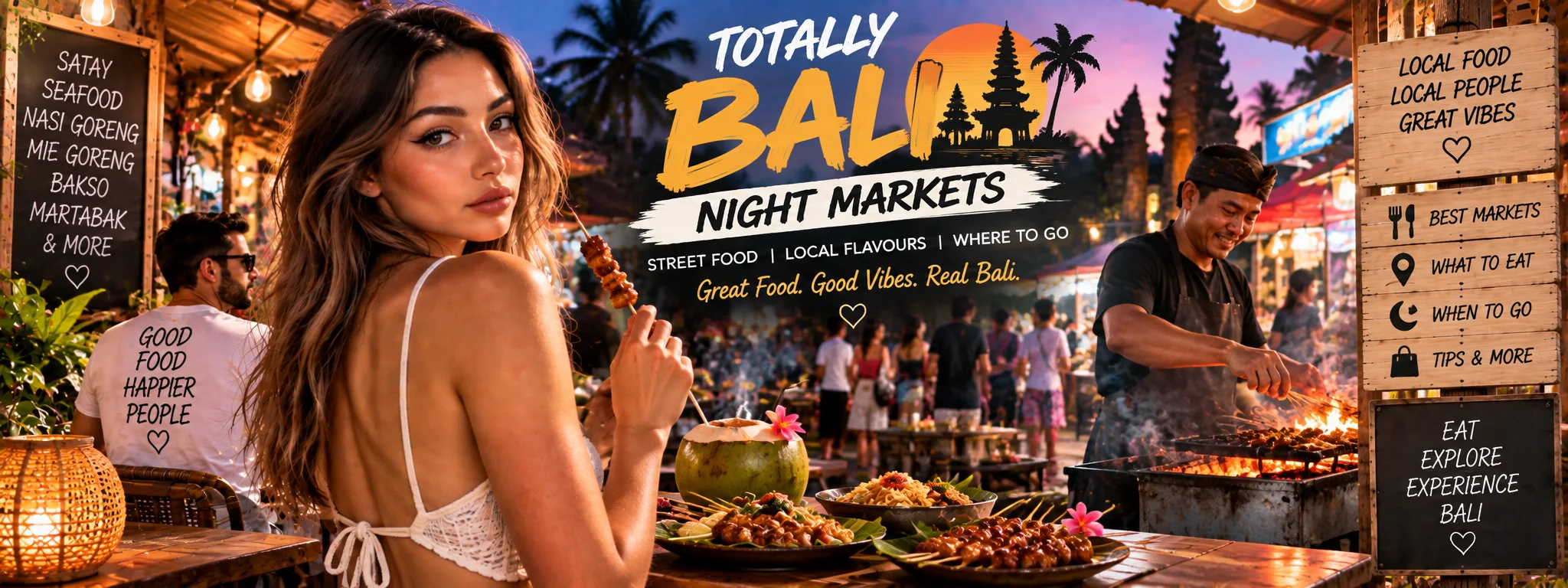
Bali night markets are at their best when you stop hunting for one legendary stall and start paying attention to what is cooking well in front of you. A market is a moving dinner menu, not a museum collection of permanent vendors.
I do one lap before ordering, watch where food is moving quickly, then build dinner across a few stalls. That gives me better odds than arriving with a three-year-old screenshot of somebody else’s “must-eat” list.
01What a Bali night market actually is
The phrase pasar malam literally means night market, but in Bali it covers several different evening food scenes. Some are permanent municipal markets whose cooked-food section becomes busiest after sunset; others are pasar senggol, informal evening clusters of carts and stalls; and some are periodic village markets tied to local events. They are not the same thing as a curated tourist food court. The best ones primarily serve residents who already know what a portion should cost and what good sate, bakso, nasi campur or sweet snacks should taste like.That local orientation is the attraction. You are eating in the same place families stop after work, students buy cheap dinner and vendors specialise in one dish they may have cooked for years. The trade-off is that menus can be limited, English may be minimal, seating is functional rather than photogenic and hours are often approximate. If you want polished service, air-conditioning and predictable dietary labelling, use our warungs by area guide. If you want variety, atmosphere and genuinely local pricing, a night market is one of Bali's most rewarding food experiences.
02The best-known markets — and how they differ
The best market is often the good one near where you are staying. I would not cross half of Bali in traffic just to prove I visited the “number one” pasar malam.
Gianyar Night Market is the obvious first choice for travellers based in Ubud or central Bali. It is a dense evening food market where the point is to browse before choosing: grilled meats, rice dishes, soups, fried snacks, juices and sweets appear side by side, and the crowd is a useful guide to which stalls are moving food fastest. In Denpasar, larger traditional markets and surrounding evening food streets provide a more urban version of the same experience, while smaller pasar senggol appear around towns and villages across the island.Do not assume the most famous market is automatically the best one for your itinerary. A 60-minute drive through traffic for a Rp20,000 snack defeats the point. If you are staying in Sanur, Kuta, Jimbaran or Canggu, ask accommodation staff where locals nearby buy evening takeaway rather than chasing a social-media checklist. Gianyar makes most sense when paired with Ubud, Penglipuran or central-Bali sightseeing. The deeper lesson is that Bali's night-market culture is distributed: the market closest to where people actually live is often more interesting than one repackaged as an attraction.
03What to eat: build a meal by stall, not by menu
I like building a meal in stages: one grill, one rice or noodle dish, something fried, then whatever sweet thing destroys the last of my self-control.
Night markets work best when you treat dinner as a sequence of small decisions. Walk the entire row first. A stall doing one thing — sate, martabak, grilled corn, soup, fried bananas, fresh juice — can be a better bet than one trying to reproduce a 40-item restaurant menu from a cart. Look for food being cooked to order, busy turnover and ingredients protected from dust and flies. The Balinese cuisine guide explains the dishes in more depth, but useful market targets include sate lilit, ayam or babi sate, nasi campur, bakso, soto, martabak, terang bulan, pisang goreng, klepon and seasonal fruit.Remember that a Bali night market is Indonesian as well as Balinese. You will see foods from Java, Madura, Sumatra and elsewhere because Bali's towns are culturally mixed. That is a feature, not a failure of authenticity. If you specifically want Balinese dishes, ask “ini makanan Bali?” or look for stalls advertising lawar, betutu, sate lilit or Balinese-style nasi campur. Pork is common at some Balinese stalls, while many Muslim-run stalls are pork-free; never infer dietary suitability from appearance alone.
04Food safety without becoming paranoid
Busy helps, but busy is not magic. I still look for food being cooked hot, sensible handling and a setup that does not scream avoidable risk.
Street food is not automatically unsafe and restaurants are not automatically safe. What matters is handling, temperature and turnover. Favour stalls where raw and cooked food are separated, cooked dishes are steaming hot, grills are actively used and popular items are replenished rather than sitting for hours. Be more cautious with lukewarm pre-cooked meat, uncovered sauces, raw garnishes washed in uncertain water and ice from an unknown source. Busy stalls have an advantage because food moves quickly.If you have a sensitive stomach, start conservatively: freshly grilled sate, hot soups, fried snacks and sealed bottled drinks are easier choices than raw salads or dishes that have been sitting at ambient temperature. Use hand sanitiser before eating if there is no wash basin. Our Bali food-safety guide covers water, ice, diarrhoea prevention and what to do if you become ill. The sensible goal is risk reduction, not sterilising the experience out of travel.
05Money, ordering and night-market etiquette
Small cash, one clear order and a bit of patience go a long way. A food stall is not where I practise aggressive bargaining.
Bring small rupiah notes. QR payments are increasingly common in Indonesia, but a visitor should not rely on being able to use a local QRIS payment method at every stall, and cards are usually irrelevant. Ask the price before ordering when it is not displayed, especially for seafood or anything sold by weight. At ordinary food stalls, aggressive bargaining is inappropriate; the amounts are already local-market prices. Keep Rp5,000, Rp10,000 and Rp20,000 notes handy so vendors are not forced to find change for Rp100,000.Pointing is completely acceptable when language fails. Useful phrases include satu (one), dua (two), tidak pedas (not spicy) and berapa? (how much?). Return plates or bowls to the stall if that is what other diners are doing. Do not block the cooking area while taking photographs, and ask before photographing a vendor at close range. A market is somebody's workplace and neighbourhood dinner stop, not a staged cultural performance.
06When to go and how long to allow
Early evening is usually the easiest time for a first visit: enough stalls are open to create choice, but the market has not yet reached peak congestion and the most popular items are unlikely to have sold out. Exact opening patterns vary by market and can change, so treat any published hour as a guide rather than a promise. Arriving around 5:30–7:00pm works well for many evening markets; local dinner activity often continues later.Allow roughly 60–90 minutes if the market is itself the activity, less if you simply want dinner. Rain changes the experience dramatically because some stalls are under permanent roofs and others are exposed. During the wet season, carry a compact umbrella and avoid planning a market stop that requires a long walk from parking. If you are travelling with children or anyone with limited mobility, inspect the ground surface and toilet situation before committing — traditional markets can be crowded, uneven and wet.
07Common mistakes — and who may not enjoy it
The first mistake is arriving hungry and buying from the first stall. Browse first. The second is expecting every “night market” mentioned online to operate identically every night; local markets evolve and vendors move. The third is treating low prices as an excuse to order far more than you can eat. Small portions make it easy to sample widely without wasting food.Night markets are less suitable for travellers who need precise allergen control, wheelchair-friendly circulation, quiet seating or a guaranteed vegetarian/vegan kitchen. Those travellers can still enjoy the atmosphere, but should consider eating a main meal elsewhere and using the market for packaged snacks or drinks. For everyone else, a good pasar malam is one of the clearest ways to understand how everyday Bali eats after dark — cheaply, socially and with far more regional variety than the phrase “Balinese food” suggests.
08Vegetarian, vegan, halal and allergy realities
Dietary needs require more communication at a night market than at a tourist-facing café. Vegetarian does not automatically mean a dish is free from fish sauce, shrimp paste, chicken stock or pork fat; sambal can contain shrimp paste and vegetable dishes may share cooking oil with meat. Vegans should ask about egg, condensed milk and butter as well as meat. If an allergy is severe, the combination of shared utensils, language barriers and unlabeled sauces makes traditional markets a higher-risk environment.For Muslim travellers, Bali's food markets include many Muslim-run stalls, particularly vendors serving Javanese, Madurese and other Indonesian food. Look for clear halal signage or ask directly rather than assuming every chicken or beef stall is halal. Conversely, Balinese stalls may serve pork and use pork-derived ingredients. A useful phrase is ada babi? — “is there pork?” — but for strict religious or medical requirements, choose a stall that can clearly explain its ingredients rather than relying on a single phrase.
09What things cost — and how to judge value
Prices vary by town, portion and ingredient, and we deliberately avoid pretending a 2026 stall price will remain valid forever. The useful benchmark is relative: ordinary market snacks and simple rice dishes should normally cost substantially less than equivalent food in Seminyak, Canggu or a resort restaurant. Seafood, large grilled fish and imported ingredients are exceptions because raw material cost matters.If no price is displayed, ask berapa? before ordering. For multiple items, keep a rough mental total. Most market sellers are straightforward, but visitor misunderstanding often comes from ordering by weight, adding several side dishes or assuming a displayed number covers an entire plate. Paying a fair local price matters more than “winning” a negotiation over cents. If a price feels unexpectedly high, clarify calmly before the food is prepared.
10Getting there and getting home safely
Night markets can be easier to reach than to leave. In larger towns, Grab or Gojek may work well, but pickup points can be awkward around busy market entrances and local transport restrictions sometimes affect where app drivers stop. If you use a private driver, agree whether they will wait or return later. Scooter parking is often easy for confident riders, but a market is a poor place to learn Bali traffic after dark.Save the market location offline before you go and pin your accommodation. Streets surrounding traditional markets can look completely different after stalls pack up. If drinking alcohol elsewhere afterwards, do not ride a scooter. See getting around Bali and essential Bali apps for transport planning.
11Sources & related reading
For local-market context, Gianyar Regency has documented village pasar senggol as part of local MSME and community economic activity; see Gianyar Regency. Market hours and individual vendors change frequently, so verify locally on the day.Continue planning: Balinese cuisine · street food · warungs by area · food safety.
TATS Man bottom line: Night markets work because they are ordinary local eating spaces with a lot happening at once. Go hungry, look before ordering, mix Balinese and wider Indonesian dishes, and let the market you are actually standing in beat the market somebody ranked online years ago.
Cheers, Carpe Diem & Save Room for One More Skewer! 🍻⏳🍢
your second-lap-ordering, sambal-testing night-market cyborg

About the author
TATS Man
Travel journalist · digital nomad since 2007 · visiting Bali since 1989
TATS Man is the beer-loving cyborg travel journalist behind Totally Bali and TATS (Totally Awesome Travel Sites). He has travelled and worked remotely since 2007 and has been visiting Bali since 1989. His guides combine long-term destination familiarity with current primary-source research — and he does not claim first-hand experience where he does not have it.