
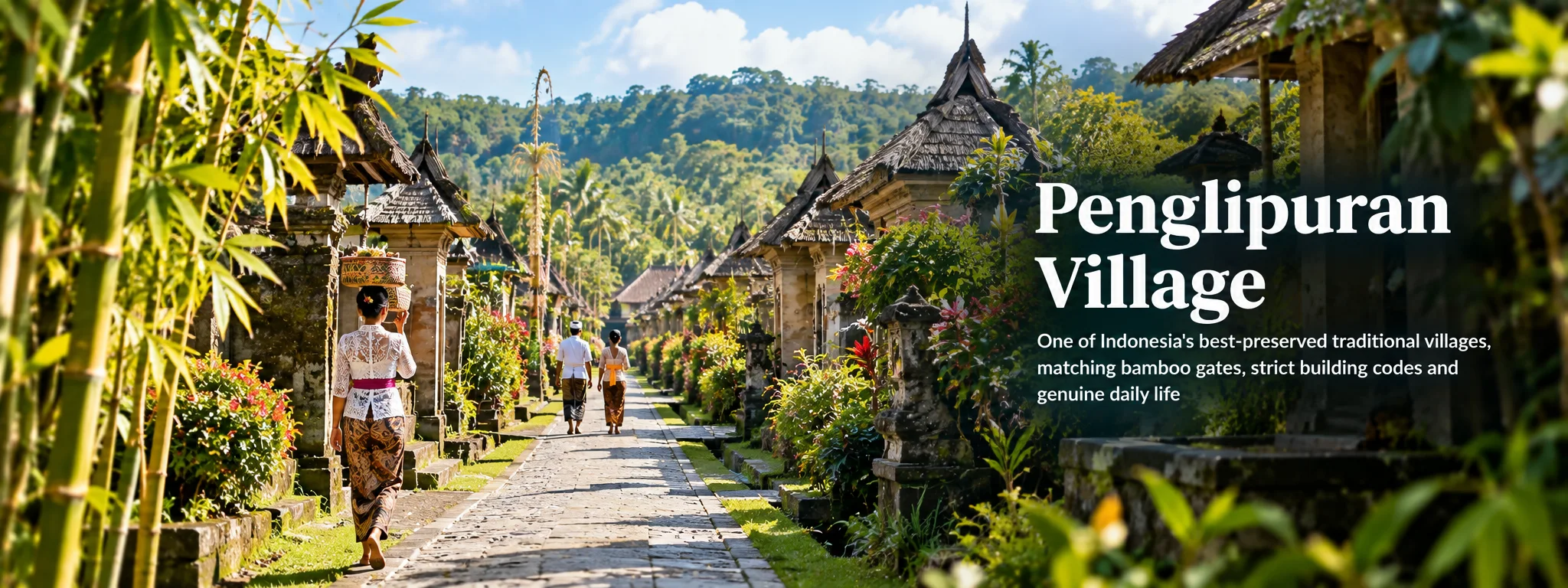
Penglipuran is visually immaculate, but its value is not that it looks staged for photographs. It is a living customary village in Bangli whose traditional spatial organisation, family compounds, bamboo landscape and community-based tourism are still connected to everyday life.
01 Why Penglipuran matters beyond the photographs
Penglipuran is often reduced online to a row of photogenic gateways, but that misses why the village matters. It is a living customary community in Bangli Regency that has preserved a distinctive settlement layout, traditional architecture and local institutions while deliberately managing tourism. Indonesia's tourism ministry describes a 112-hectare village with agricultural land, a large bamboo forest, residential areas and sacred spaces; UN Tourism selected Penglipuran as one of its Best Tourism Villages in 2023, highlighting heritage preservation, community participation and environmental management.
That recognition does not mean the village is frozen in the past. Residents live modern lives inside a landscape governed by inherited spatial principles and awig-awig customary rules. Visit with that in mind and the experience becomes far more interesting than “walk up the street, take a photo, leave”.
02 Read the village layout before photographing it
The central street is the visual signature: rows of family compounds with related entrance forms create an unusually coherent streetscape. The settlement is organised according to Balinese spatial concepts often described through Tri Mandala, separating zones by sacredness and function. Indonesia Travel notes three conserved architectural components expected in traditional compounds: the angkul-angkul gateway, a traditional kitchen and a six-post pavilion (bale saka enam).
Do not assume matching gateways mean the houses are museum replicas. They are private family compounds. Some residents invite visitors into sections of their compounds, sell crafts or snacks, or explain architecture, but permission matters. The upper end of the village leads toward temple/sacred space; the broader territory includes agricultural land and bamboo forest. Moving slowly from the lower entrance through the residential axis makes the spatial logic much easier to read.
03 Bali Aga heritage and the Bayung Gede connection
Penglipuran is associated with Bali Aga heritage and traditions linked to Bayung Gede in the Kintamani area. Official tourism material says the community's ancestors came from Bayung Gede and that the customary village has maintained inherited institutions for centuries. “Bali Aga” is sometimes oversimplified as “pre-Hindu Bali”; in practice it refers to communities with distinctive customary traditions, settlement patterns and ritual histories that differ from the court-influenced forms familiar elsewhere on the island.
The respectful way to engage with this is to ask questions rather than treating residents as representatives of an untouched ancient culture. A local guide can add enormous value because architecture, kinship, ritual and village governance are not obvious from photographs alone. If you are genuinely interested in Bali's social landscape, pair Penglipuran with our traditional houses, Balinese architecture and traditions and festivals guides.
04 The bamboo forest is part of the village story
North of the village, the bamboo forest is both a pleasant walking area and a practical cultural resource. UN Tourism notes that bamboo is used locally for construction, furniture, handicrafts, ceremony and workshops, while village tourism material describes roughly 45 hectares of bamboo forest. The forest also supports environmental goals including water catchment and waste/compost initiatives.
Allow time for it rather than turning around at the end of the main street. Shade makes the forest particularly welcome later in a hot visit, although Bangli's elevation means Penglipuran is generally cooler than the south coast. Paths can be damp after rain. If a craft workshop or local guide is available, that is a better way to understand bamboo's role than simply using the grove as a photo backdrop.
05 When to visit, weather and how long to allow
The village's own Indonesia Travel profile recommends arriving around 8am when the main street is quieter. Another current Indonesia Travel guide lists public visiting hours of approximately 08:15–18:30, except Nyepi; treat those as current guidance rather than an eternal timetable and recheck before a special trip. Early morning gives cleaner photographs and cooler walking conditions, while late afternoon can also be pleasant once day tours thin out.
Allow at least 90 minutes for the main street, a few open compounds and bamboo forest; two to three hours is better if using a guide, eating locally or joining an activity. A rushed 30-minute coach stop produces exactly the superficial experience people then complain about online.
Penglipuran sits around 600–650 metres above sea level according to Indonesia Travel, so it is often cooler than Kuta, Seminyak or Sanur. That does not mean cold: tropical sun is still strong and the main street has exposed sections. Wear breathable clothes, comfortable walking shoes and carry rain protection in the wet season. After rain, stone and bamboo-forest paths can be slippery.
A light layer can be useful for travellers who feel the cold easily, particularly early morning or after a shower. Because this is a traditional village rather than a beach attraction, modest clothing also fits the setting better and means you are already appropriately dressed if entering temple-adjacent areas.
06 What to eat, buy and do
Local tourism material highlights loloh cem-cem, a herbal drink associated with the area, and purple sweet-potato klepon among foods to try. Souvenir sellers and household enterprises offer bamboo items and other crafts, while organised experiences can include making offerings, penjor decoration, traditional dress or craft activities. Buying directly from village households keeps more spending within the community than treating Penglipuran as a free photo studio.
Quality varies, so buy because you like an item rather than because a guide claims it is uniquely available nowhere else. If you want a deeper experience, ask about community guides or workshops rather than negotiating aggressively over inexpensive handicrafts.
07 Etiquette and photography in a living village
Stay on visitor routes unless invited farther into a compound. Ask before photographing people closely, especially during prayer or household activity. Dress respectfully; this is not a beach destination, and temple areas require greater modesty. Ceremonies are not performances scheduled for tourist convenience. If a procession or ritual is underway, follow local instructions and allow residents space.
Penglipuran is unusually tidy, but “cleanest village” marketing should not encourage visitors to judge other Balinese communities against an award slogan. Its significance lies in community management and continuity, not in being a theme-park version of Bali. Carry your rubbish out if bins are full and avoid single-use purchases where practical.
The central axis photographs best when it is quiet and the light is low, which is another reason to arrive early. Instead of standing in the middle of the street for identical symmetrical photos, look at gateways, plantings, roof materials, household details and the transition toward the bamboo forest. A longer lens lets you photograph architectural patterns without entering private space.
Ask before photographing residents at close range or entering a compound. If a household is selling drinks or crafts and welcomes visitors, buying something is a natural way to support the interaction. Drones should never be assumed acceptable over homes and temples; obtain permission from local management first.
08 Tickets, guides and community-based tourism
Indonesia’s official tourism-village profile describes Penglipuran as community-based tourism managed with local residents involved in tourism activity. It also records Penglipuran’s recognition as a Best Tourism Village by UN Tourism in 2023. That does not make every visitor experience automatically authentic, but it is useful context for understanding why local management and household participation matter.
Penglipuran charges visitor admission, with rates set by local management and subject to change. Current Indonesia Travel information has listed an entrance fee, but verify the amount at the official ticket point rather than treating an old online figure as permanent. Pay only at authorised counters and keep the ticket if requested. The village's community-based tourism model means visitor spending contributes to management, local employment and conservation rather than simply entering a privately owned attraction.
A guide is not compulsory for a basic walk, but this is one destination where paying for interpretation can transform the visit. Without explanation, visitors see symmetrical gates. With a knowledgeable local guide, those gates become an introduction to compound organisation, customary rules, family life, ritual and community planning. Ask what the guide fee covers before starting and whether workshops or household visits are included.
09 Combine Penglipuran sensibly — or stay longer
Geographically, Penglipuran works best with Bangli and Kintamani rather than south-Bali beach sightseeing. Good combinations include Kintamani and Mount Batur, Tirta Empul or a slower central-Bali circuit. Trying to add Uluwatu, Canggu or Nusa Dua on the same day creates unnecessary driving.
If you are based in Ubud, Penglipuran can be a half-day or part of a full-day north/east loop. Check traffic rather than trusting kilometre distances: the tourism ministry lists roughly 60 km from the airport, but Bali road time varies heavily by hour.
Most travellers visit Penglipuran as a day trip, but community homestays and nearby accommodation can make sense for people interested in village life rather than a checklist circuit. UN Tourism specifically notes homestays as part of Penglipuran's tourism model. Staying nearby also makes an early-morning walk easy before coach traffic arrives.
Do not book a “traditional village stay” expecting residents to perform heritage for you all evening. The value is slower observation: cooler air, ordinary household rhythms and easier access to Bangli/Kintamani the next morning. If nightlife, bars and restaurant choice matter, base yourself in Ubud instead.
10 Ceremonies, festivals and how to leave with context
Penglipuran observes the Balinese ritual calendar, including Galungan, Kuningan and village ceremonies. Decorative penjor can make the main street extraordinarily beautiful during festival periods, but those are living religious occasions rather than staged tourist events. Access may be restricted around temple activity and residents may be busy with obligations.
If your visit coincides with a ceremony, follow directions from village staff and guides. Do not step into processions for photographs or expect people carrying offerings to stop and pose. The reward for respectful behaviour is the chance to see how architecture and ritual actually connect — something a quiet non-festival visit cannot fully show. Read the Balinese calendar before planning around festival dates.
Penglipuran is worth visiting because a community has kept a distinctive customary landscape functioning while welcoming visitors. The respectful version of tourism here is simple: arrive with curiosity, spend locally, ask before entering private spaces and leave the village feeling more real rather than more staged.
Sources checked
Primary references: Indonesia Travel — Penglipuran Tourism Village and UN Tourism Best Tourism Villages — Penglipuran.
Continue planning:Bangli Regency · Kintamani & Batur · Balinese architecture · traditional houses.