
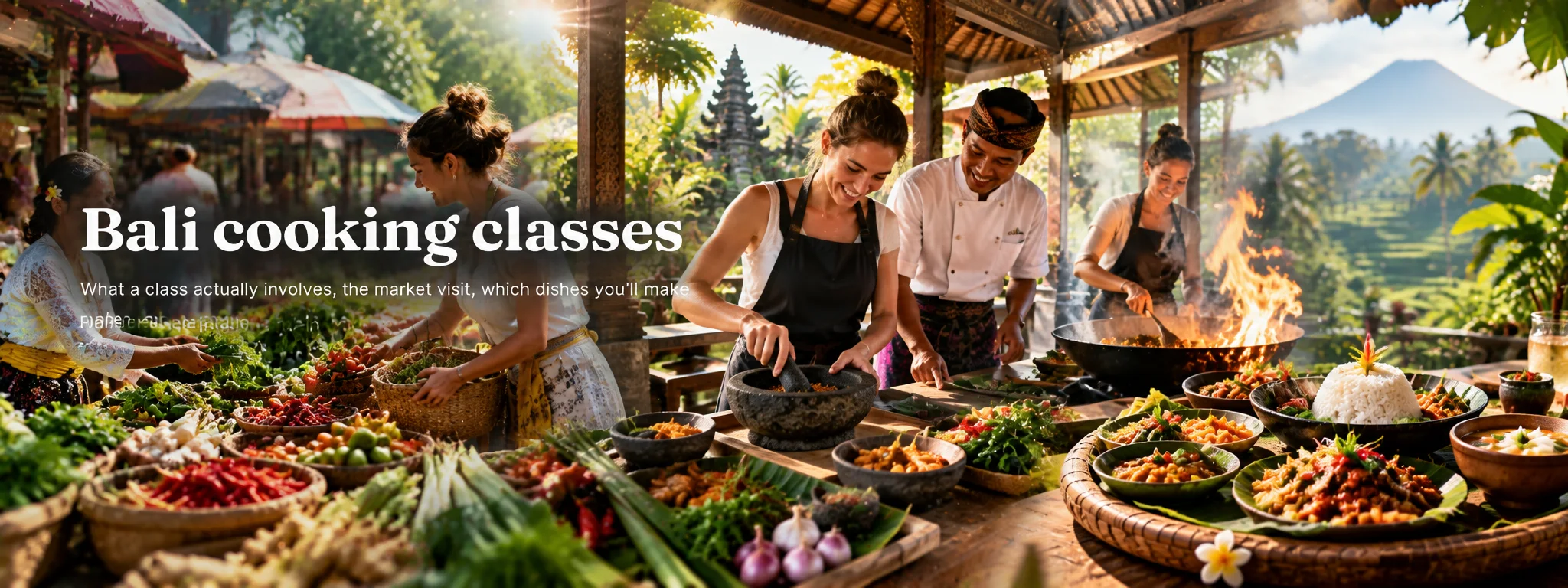
A Bali cooking class can be one of the most useful souvenirs you take home — provided you learn more than how to pose beside twelve tiny bowls of ingredients.
I look for classes that explain spice pastes, ingredient logic, substitutions and technique. Dish count is marketing; understanding why the food works is the bit you can still use six months later.
01 What a good Balinese cooking class should teach
A worthwhile class gives you more than a recipe sheet. It should explain how ingredients are selected, how spice pastes are built, why ingredients are prepared in a particular order and what can realistically be substituted when you cook at home. You should leave understanding a method, not just remembering a finished plate.
I want the teacher to explain what changes flavour, texture and heat — not just say “now add this”. That is the difference between a class and supervised chopping.
Formats range from family compounds and village kitchens to polished teaching studios. Neither is automatically better. Look for a class whose description explains the cooking, group size and level of participation clearly. If the entire sales pitch is scenery, costumes or an enormous menu, ask how much actual knife, mortar, stove and preparation time each guest receives.
02 Market visits: useful when they are genuine
A morning market visit can make a class much more useful when the guide identifies herbs, roots, chillies, vegetables, coconut products and pantry staples that later appear in the meal. Ask which market is visited, how long you spend there and whether it is a real shopping stop or a quick walk designed mainly for photographs.
A market visit is worthwhile when somebody interprets the ingredients and buying habits. Walking past stalls behind a guide holding a flag is just an early start.
Markets are working places. Keep aisles clear, ask before taking close portraits of sellers, and let the guide handle any purchasing process you do not understand. Some excellent classes skip a market entirely and spend more time cooking; that is not a weakness if ingredient explanation and hands-on instruction are stronger.
03 What you might cook — and what matters more than dish count
Menus vary, but classes often include a spice paste or sambal, vegetables, satay-style preparations, soups, curries and rice-based dishes. A smaller menu that teaches grinding, seasoning, coconut preparation and heat control can be more useful than racing through ten dishes where most components were prepared in advance.
Ask whether participants cook individually, in pairs or as one large group. Also ask how much is pre-chopped before arrival. There is nothing wrong with sensible preparation, but ‘hands-on’ should mean you actually perform the key techniques rather than watch an instructor complete the difficult parts while the group stirs at the end.
04 Group, private and demonstration formats
Group classes suit social travellers and are usually the best value, but group size changes the experience dramatically. Six people around separate workstations is different from twenty people sharing a few jobs. Private classes cost more but can focus on technique, dietary requirements or dishes you specifically want to learn.
Demonstration-heavy classes can work for travellers with limited mobility or people mainly interested in tasting and explanation. Just choose them knowingly. Before booking, ask how many people share a station, whether everyone cooks the same dishes and whether the class is designed for complete beginners or assumes basic kitchen confidence.
05 Vegetarian, vegan, allergies and dietary restrictions
Balinese food can adapt well to vegetarian or vegan cooking, but do not assume every paste, sauce or garnish is plant-based. Shrimp paste, fish sauce, stock and shared frying oil can matter. Tell the operator your requirements before paying and ask which dishes will be changed, not merely whether they ‘can accommodate’ you.
Dietary requests need to be discussed before booking, especially allergies. “Vegetarian option available” tells me almost nothing about shrimp paste, stock or shared equipment.
Food allergies need more specific discussion. Ask about ingredient labels, shared utensils, preparation surfaces and cross-contact. A small cooking class is not automatically an allergy-controlled environment. If a reaction could be severe, decide whether the operator’s answers and emergency plan are adequate for your needs rather than relying on a generic dietary checkbox.
06 Kitchen hygiene and food safety
A teaching kitchen should make safe practice visible: clean hands and surfaces, raw and cooked ingredients kept appropriately separate, safe water and ingredients, proper cooking and sensible temperature control. Those principles align with Indonesia’s Ministry of Health food-safety guidance and are especially relevant when visitors are handling unfamiliar raw ingredients.
Look at how raw poultry, seafood and ready-to-eat garnishes are managed, whether handwashing is easy and whether utensils are clean. A busy market-to-kitchen experience should still have basic hygiene. If the setup feels unsanitary, you do not need to stay simply because the class is prepaid; raise it with the operator or choose another provider.
07 Children, accessibility and comfort
Cooking can be an excellent family activity when the class is designed for children rather than merely allowing them to attend. Ask about minimum ages, sharp-knife tasks, hot oil, open flames, mortar work, seating and whether shorter attention spans are accommodated. A child who only watches adults cook has not really joined a cooking class.
For mobility or fatigue concerns, ask about steps, standing time, market surfaces, stools, toilets and heat in the kitchen. Village and family-compound settings can have thresholds or uneven surfaces. A modern studio may be easier to access, while a private class may be able to adjust pace and tasks more readily.
08 Family compounds, villages and cultural etiquette
If the class takes place in a family compound, remember you are entering a home and social space, not a themed venue. Follow guidance about shoes, household areas and any nearby shrine or ceremony. Do not wander into private buildings or photograph residents without permission simply because the booking includes ‘village life’.
A family compound is somebody’s home, not a themed restaurant set. I follow the host’s cues on shoes, photography, shrines and where guests should wander.
Good hosts will explain context without claiming that one household’s method represents every Balinese family. Recipes and ceremonial practices vary. Treat the class as an introduction to ingredients and techniques rather than a definitive statement about all Balinese cuisine.
09 Transport, timing and what to take home
Morning classes often work best for market activity and cooler conditions, while afternoon sessions may be more convenient if food rather than the market is your priority. Confirm pickup boundaries, return time and whether transport is private or shared. Bali traffic can make a supposedly short transfer a substantial part of the day.
Ask whether recipes are provided digitally or on paper and whether they use quantities you can reproduce at home. The most valuable takeaway is knowing which ingredients are essential, what can be substituted and which techniques need practice. Bringing home understanding is more useful than buying a bag of unfamiliar ingredients you cannot legally or practically import.
10 Booking checklist: compare value, not menu size
Before paying, confirm group size, workstation sharing, actual hands-on time, market details, menu, dietary handling, transport, duration and cancellation terms. Reviews are most useful when they describe instruction and organisation rather than only saying the food tasted good.
I compare teaching time, group size, hands-on involvement and transport before dish count. Ten good minutes of explanation can be worth more than another curry on the menu.
A strong class fits your goal: technical learning, family fun, social experience or cultural context. Choose accordingly. For more food planning, use our Balinese cuisine guide and Bali food-safety guide alongside the operator’s current information.
TATS Man bottom line: The best class changes how you cook after Bali. Choose one that teaches method, handles dietary needs properly and gives you enough hands-on time to remember what your hands actually did.
Cheers, Carpe Diem & Learn the Paste, Not Just the Plate! 🍻⏳🌶️
your sambal-stirring, recipe-questioning cyborg

About the author
TATS Man
Travel journalist · digital nomad since 2007 · visiting Bali since 1989
TATS Man is the beer-loving cyborg travel journalist behind Totally Bali and TATS (Totally Awesome Travel Sites). He has travelled and worked remotely since 2007 and has been visiting Bali since 1989. His guides combine long-term destination familiarity with current primary-source research — and he does not claim first-hand experience where he does not have it.