
01 What a warung actually is
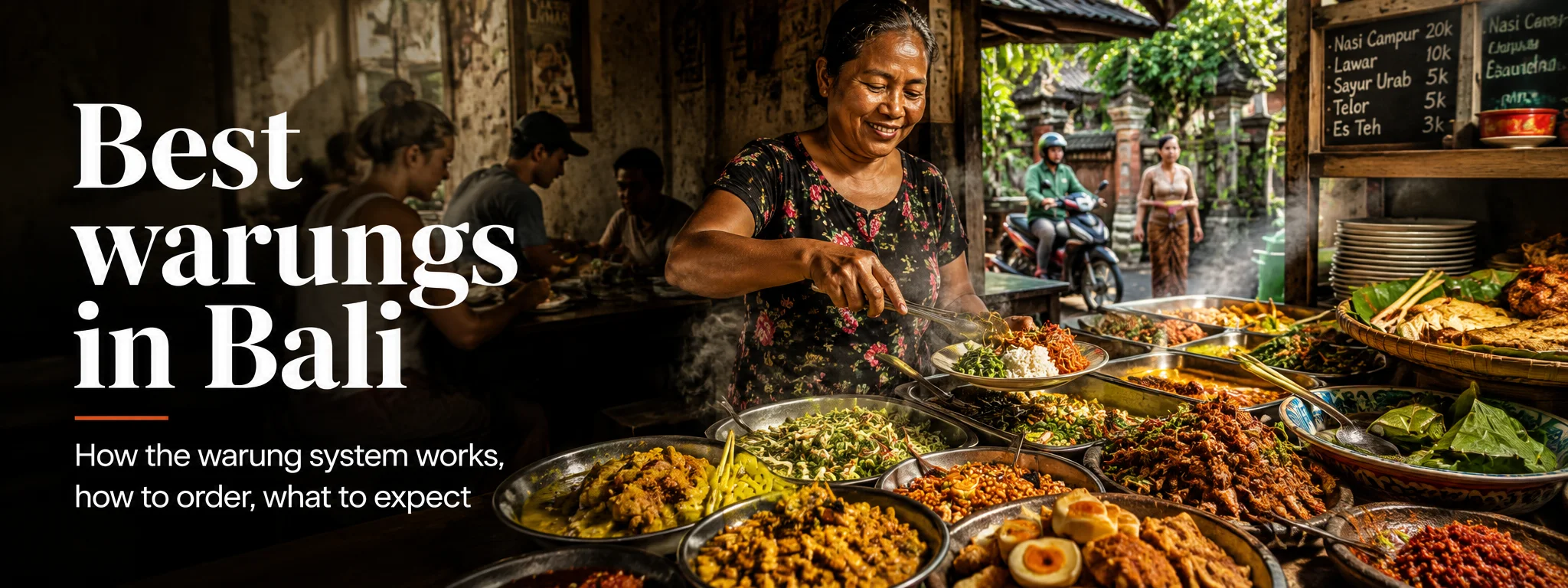
A warung is a small, usually family-run food stall or café — the backbone of everyday eating across Bali and Indonesia more broadly. At their simplest, a warung might be a few plastic tables under a tarpaulin with a display case of pre-cooked dishes; at their most developed, a proper small restaurant with a fixed menu. What unites them is the format: home-style Indonesian and Balinese cooking, prepared fresh (usually each morning), and priced for locals rather than tourists.
02 How to order
Most warungs serving nasi campur (mixed rice) display their dishes at a counter — you simply walk up, point at what you want added to your rice, and the server assembles your plate. This removes any language barrier entirely; pointing works everywhere. For warungs with a written menu, dishes like nasi goreng (fried rice), mie goreng (fried noodles) and various soups are commonly available and simple to order even without much Indonesian. See our Balinese food guide for what specific dishes to look for.
03 Finding a genuinely good warung
The single most reliable signal of quality is a warung genuinely busy with local customers around lunchtime — locals don't return to mediocre food, and a full house of Balinese diners rather than exclusively tourists is a strong positive sign. Food that's been sitting since early morning without much turnover is worth avoiding by early afternoon; freshly cooked, actively replenished dishes are both tastier and safer.
04 What it costs
A full warung meal — rice plus several sides — typically costs IDR 20,000–40,000, roughly USD 1.25–2.50, among the best value food available anywhere in Southeast Asia. This compares to IDR 120,000–250,000 for an equivalent meal at a tourist-oriented restaurant in Seminyak or Ubud, making warungs the backbone of any reasonable Bali food budget. See our warungs by area guide for specific recommendations across the island's main tourist zones.
05 Basic etiquette
Warungs are casual and welcoming to visitors — no reservation needed, no dress code beyond basic modesty, and staff are generally happy to help point out what dishes are and aren't spicy if you ask. Payment is typically at the counter after eating rather than table service with a bill. Tipping isn't expected but rounding up is appreciated.