
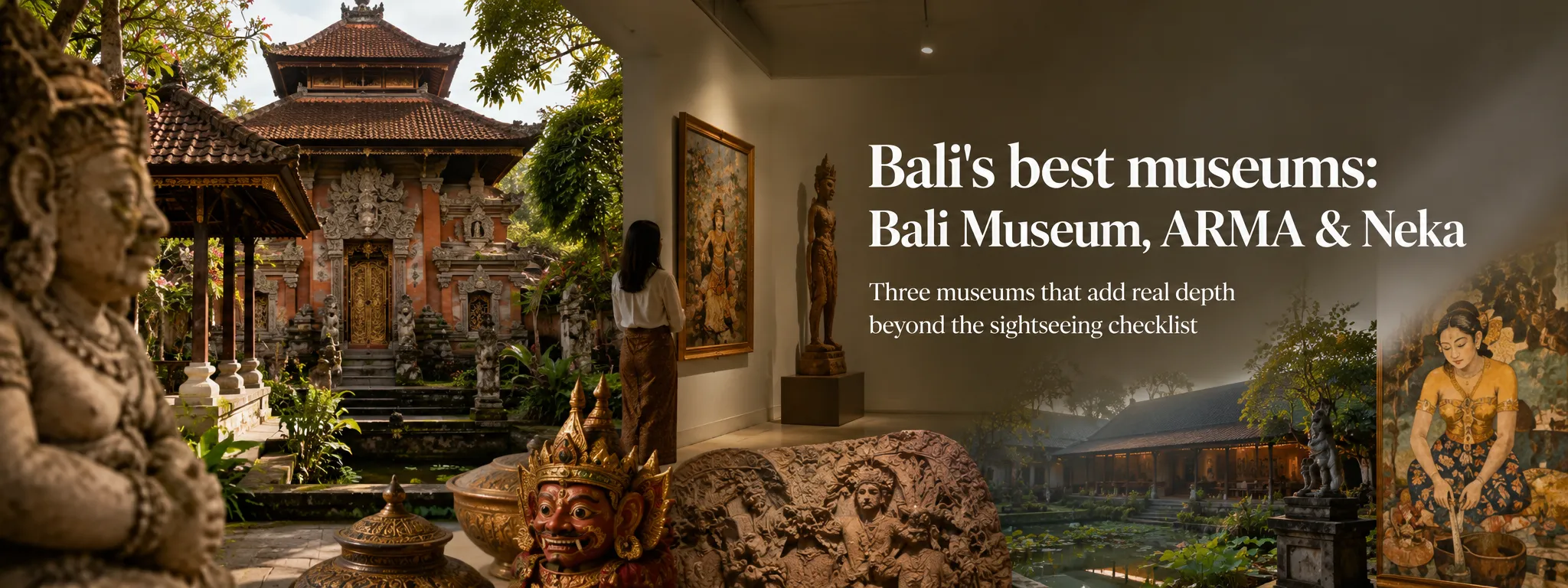
Bali's museums are where a lot of the island finally clicks. Temples, paintings, masks, manuscripts and royal history make far more sense once you spend an hour somewhere that explains what you have been looking at all week.
I would pick one museum that matches the part of Bali I actually care about rather than treating museums as wet-weather punishment. Ubud is strongest for art, Denpasar for broad cultural context, and Singaraja for the extraordinary lontar archive.
01 Why a museum changes what you notice around Bali
Why museums make the rest of Bali more interesting
Bali’s temples, ceremonies, paintings and architecture are easy to admire without understanding them. A good museum supplies the missing context: why particular painting styles developed, how ritual objects are used, how the island’s political history changed, and how knowledge was recorded before modern books.
A museum is not time away from 'real Bali'. Done well, it is the bit that helps you understand the real Bali you are already walking through.
Museums are therefore not merely rainy-day backups. Visit one early in your trip and later temple, palace and village visits become easier to read. The best institutions also provide a quieter counterweight to Bali’s high-volume attractions.
Which museum should you choose?
- For broad Balinese culture and material history: Bali Museum, Denpasar.
- For the widest art-and-culture campus experience: ARMA, Ubud.
- For understanding the development of Balinese painting: Neka Art Museum, Ubud.
- For Ubud/Pita Maha art history: Museum Puri Lukisan.
- For manuscripts and traditional knowledge: Gedong Kirtya, Singaraja.
If you have limited time, choose based on interest rather than trying to collect museums. Two well-chosen museums are more useful than racing through five.
02 Museum Bali in Denpasar
UPTD Museum Bali sits near Puputan Square in Denpasar and is the best general introduction to the island’s material culture. Its buildings themselves draw on regional Balinese architectural styles, while collections cover archaeology, history, textiles, ritual life and art. Denpasar’s tourism office notes dedicated Karangasem, Tabanan and Buleleng buildings with different collection themes.
The museum officially opened in 1932 and is now managed by the provincial government. It is particularly useful before visiting temples because ritual objects and traditional textiles make more sense when seen with explanatory context.
Denpasar Tourism currently lists opening Monday–Thursday 08:00–15:00 and Friday 08:00–12:30, closed Saturday, Sunday and official holidays. Government schedules can change, so recheck before a special visit.
03 ARMA, Neka and Puri Lukisan in Ubud
ARMA: art museum plus living cultural centre
The Agung Rai Museum of Art is more than rooms of paintings. Founded by Agung Rai and officially opened in 1996, ARMA’s mission includes collecting and preserving art while supporting painting, sculpture, dance, music and cultural education. Its collections range from classical Kamasan and Batuan work to Indonesian modernists and foreign artists associated with Bali.
Ubud gives you several genuinely different art museums. I would choose by collection and atmosphere rather than trying to tick all three before lunch.
Walter Spies is particularly important here because his role in twentieth-century Balinese art and performance history is often simplified in tourist narratives. ARMA’s strength is that visual art sits inside a larger cultural campus with gardens, performances, workshops and educational activity.
The current official collection page lists adult admission at Rp150,000 and free entry for children under six. Google Arts & Culture and ARMA’s own current material list daily museum access around 09:00–18:00; verify before visiting because performances and special programmes have separate schedules.
Neka Art Museum: best for seeing styles side by side
Neka is one of the clearest places to understand how Balinese painting changed across the twentieth century. Founded by collector Pande Wayan Suteja Neka and inaugurated in 1982, the museum brings together traditional Balinese work, Ubud and Batuan styles, Indonesian artists and foreign painters who worked in Bali.
Rather than hunting only for famous names, compare galleries. Look at how composition, perspective, subject matter and use of colour shift between traditional narrative painting, the Ubud school, Batuan work and later modern approaches. That visual comparison is more educational than reading a chronological list of artists.
Indonesia’s national museum data currently lists Neka as a registered specialist museum. Opening information can vary between sources, so check the museum directly before a special trip.
Museum Puri Lukisan: Ubud’s foundational art institution
Museum Puri Lukisan grew from the Pita Maha artistic movement and efforts by Rudolf Bonnet and Ubud’s royal family to preserve important Balinese art on the island. Indonesia’s Ministry of Culture records the museum’s formal inauguration in 1956, making it a foundational institution in Ubud’s modern art history.
The collection is particularly valuable for travellers who want to understand the development of modern traditional Balinese painting and woodcarving. Its central Ubud location also makes it one of the easiest museums to include without a dedicated driver.
The museum’s official website lists daily opening around 09:00–18:00, although government museum data may show slightly different hours. Check the official site on the day.
04 Gedong Kirtya: Bali’s lontar archive
Gedong Kirtya in Singaraja is unlike the Ubud art museums. Established in 1928, it preserves lontar palm-leaf manuscripts and related texts covering religion, customary law, medicine, philosophy, history and literature. It is a working preservation and research institution as much as a visitor attraction.
Gedong Kirtya is the odd one out in the best possible way: less gallery outing, more window into how Balinese knowledge has been recorded and preserved.
If you have ever wondered how Balinese knowledge was stored and transmitted before printed books, this is the place. The current UPTD site documents active digitisation and public programmes in 2026. Official information lists weekday hours, with Friday closing earlier.
Gedong Kirtya deserves to be combined with Singaraja’s old harbour and heritage district rather than treated as a stand-alone dash from South Bali.
05 Other museums and specialist collections
Bali has many smaller specialist museums and artist houses. The Blanco Renaissance Museum is popular for the personality and studio environment surrounding Antonio Blanco; Museum Rudana focuses on Indonesian art; Setia Darma House of Masks and Puppets is useful for mask and performance traditions when open. Because smaller institutions can change hours, displays or operating status, confirm current details before building a day around them.
Do not assume “museum” means Western-style climate-controlled galleries with extensive English labels. Some Bali museums are strongest for architecture, atmosphere and objects, while interpretation can be limited. A guide or preliminary reading may add a lot.
06 How to look at Balinese art without rushing
Start with subject matter. Many traditional paintings depict episodes from Hindu epics, local stories or ritual life rather than purely decorative scenes. Then look at composition: older narrative styles may fill the surface densely without Western linear perspective. Twentieth-century contact with foreign artists influenced technique and composition, but Balinese artists were active agents in that change rather than passive recipients of “Western modernity”.
Compare Ubud and Batuan work, notice how individual artists handle figures and landscape, and read labels where available. The goal is not to memorise names; it is to make the visual language less opaque.
07 Rainy days, children and accessibility
Are museums really good rainy-day options?
Yes, with caveats. Ubud museums often involve walking between separate pavilions in gardens, so heavy tropical rain still matters. Denpasar traffic can also become slow in storms. Museums are better planned as genuine cultural visits than emergency shelter from a downpour.
During wet season, carry an umbrella and waterproof bag for electronics. Air conditioning varies; some galleries are naturally ventilated rather than sealed.
Museums with children
ARMA’s grounds and broader cultural programmes can work well for families, while Bali Museum gives older children tangible objects connected to ceremonies they may see elsewhere. Art museums become more engaging if children have a simple task: find animals in paintings, compare two styles or sketch a favourite detail.
Do not expect every gallery to be interactive. Check current workshop programmes if hands-on activity matters.
08 How to build a museum into an itinerary
Ubud art half-day: choose two of ARMA, Neka and Puri Lukisan, with lunch between them. Three can become visual overload.
My rule is one or two museums with breathing room around them. Cultural overload is still overload, even when the paintings are magnificent.
Denpasar culture half-day: Bali Museum plus Puputan Square and nearby heritage/commercial streets.
Singaraja history half-day: Gedong Kirtya, the old harbour, Kampung Bugis and Ling Gwan Kiong.
These clusters are much more efficient than crossing the island to tick off isolated museums.
09 Etiquette, photography and interpretation
Museum etiquette and photography
Photography rules vary by gallery and exhibition. Ask before using flash, tripods or photographing fragile manuscripts. Do not touch paintings, carvings or display cases. In museum grounds containing shrines or active cultural spaces, ordinary temple-style respect still applies.
If a museum includes a shop, buying a catalogue can be more useful than another generic souvenir: it lets you continue learning after the visit and often supports the institution directly.
Labels, guides and how much interpretation to expect
Interpretation varies enormously. Major Ubud art museums generally provide artist names and collection context, but not every gallery offers the dense wall text common in large Western institutions. Bali Museum can also feel object-heavy if you arrive without background knowledge. This is not a reason to skip the museums; it is a reason to prepare.
Read a short history of Balinese painting before an Ubud museum day, or hire a knowledgeable guide if the institution offers one. At Gedong Kirtya, staff explanation is especially valuable because the significance of a lontar manuscript is not obvious from looking at a bundle of palm leaves behind glass.
English information is common at visitor-oriented museums but should not be assumed for every temporary display. Translation apps can help with Indonesian labels, although specialist art and religious vocabulary may translate poorly.
Accessibility and physical comfort
Museum accessibility is mixed. Purpose-built galleries may have relatively level floors, while traditional compounds, garden paths, steps and split-level pavilions can create barriers for wheelchair users or people with limited mobility. ARMA and Puri Lukisan involve outdoor movement between buildings; wet paths can become slippery in heavy rain.
If accessibility is critical, contact the museum directly before travelling and ask about step-free routes, accessible toilets and vehicle drop-off. Do not rely on the word “museum” to imply modern accessibility standards.
For everyone, carry water and allow breaks. Museum fatigue is real in tropical heat, especially when combining galleries with walking around Ubud.
10 Our shortlist and current visitor information
Our museum shortlist
If we could send a first-time visitor to only one general museum, we would choose Bali Museum for cultural breadth. For art, ARMA gives the richest overall experience, while Neka is excellent for comparing painting traditions. Puri Lukisan is ideal if you are already walking central Ubud. Gedong Kirtya is the specialist choice for travellers who want something genuinely unusual and intellectually important.
Sources & current visitor information
Primary sources: Denpasar Tourism — Bali Museum, ARMA Museum, Indonesia museum registry — Neka, Museum Puri Lukisan and UPTD Gedong Kirtya. Hours and admission can change; confirm directly before a special journey.
Continue planning: arts & crafts · Bali history · Ubud · Singaraja.
TATS Man bottom line: A good Bali museum should change what you notice after you leave. Choose the collection that fits your interests, slow down enough to read the context, and let the rest of the island look a little different afterwards.
Cheers, Carpe Diem & Read the Labels Before the Beer! 🍻⏳🖼️
your gallery-wandering, lontar-curious culture cyborg

About the author
TATS Man
Travel journalist · digital nomad since 2007 · visiting Bali since 1989
TATS Man is the beer-loving cyborg travel journalist behind Totally Bali and TATS (Totally Awesome Travel Sites). He has travelled and worked remotely since 2007 and has been visiting Bali since 1989. His guides combine long-term destination familiarity with current primary-source research — and he does not claim first-hand experience where he does not have it.