
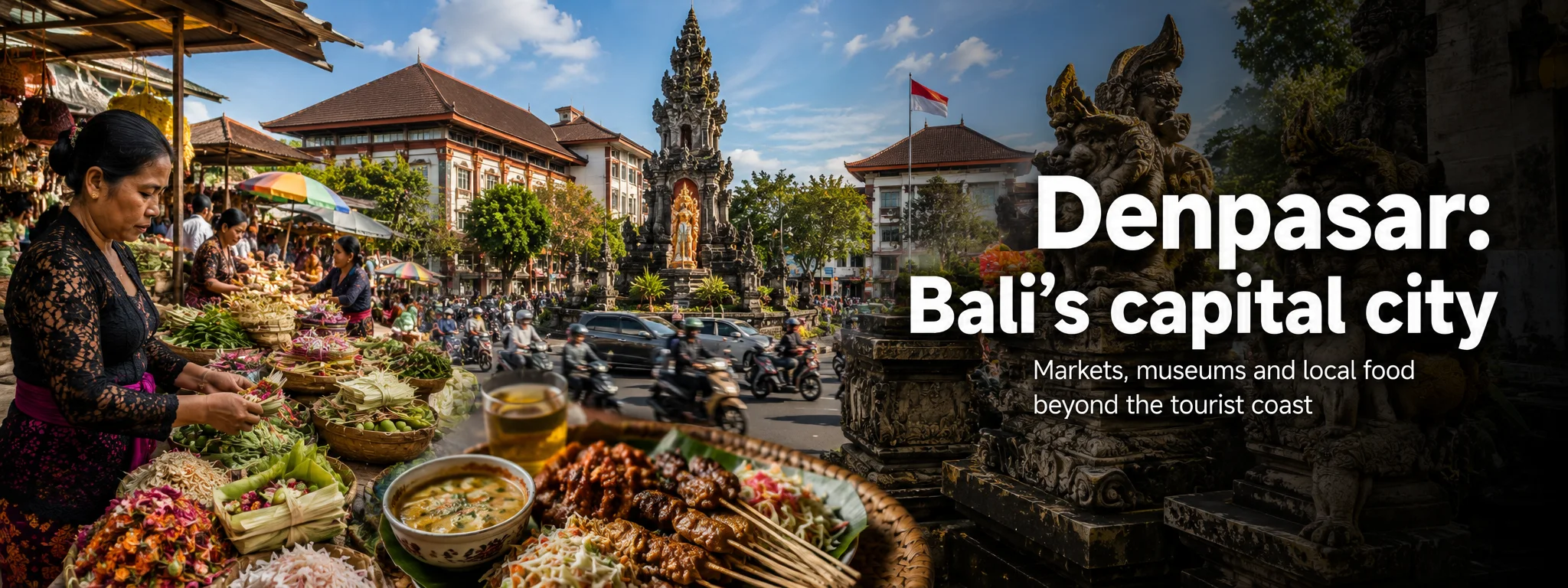
01Overview
Denpasar is Bali's administrative capital and by far its largest city, yet it barely registers on most visitors' itineraries — the international airport carries its name (DPS) and sits at the city's southern edge, but almost everyone transfers straight out toward Kuta, Seminyak or Ubud without stopping. That's a reasonable choice for a beach holiday, but it means most visitors never see how the majority of Balinese people actually live day to day.
02Why you might actually stop here
Denpasar isn't a beach destination and doesn't try to be — what it offers instead is a genuinely local city experience: proper markets, museums, and food that's cooked for residents rather than adapted for visitors. If you've spent a week in the more tourist-dense parts of the island, a half-day here is a useful reset on what Bali looks like outside the resort areas.
03What to see
- Bali Museum — a solid overview of Balinese art, history and architecture, useful context if you're visiting temples elsewhere on the island.
- Pasar Badung — one of Bali's largest traditional markets, spanning multiple floors of produce, spices, textiles and daily goods, with essentially no tourist pricing or performance to it.
- Puputan Square — a central public park commemorating the 1906 mass ritual suicide by Balinese royalty rather than surrender to Dutch colonial forces, one of the more sobering pieces of the island's history (see our history timeline).
- Jalan Gajah Mada — the old colonial-era shopping street, with a mix of gold shops, textile stores and street food.
04Where to eat
Denpasar's food scene skews heavily local — this is where to find genuinely unfiltered Balinese and broader Indonesian street food and warung cooking, often at prices noticeably lower than the tourist-area equivalents. It rewards being a bit adventurous with ordering over sticking to what's familiar.
05Practical notes
Denpasar isn't set up for a multi-day stay the way South Bali or Ubud are — most visitors treat it as a half-day stop, either on the way to or from the airport, or as a deliberate day trip from a base elsewhere on the island. Traffic can be heavy and the layout more sprawling and less walkable than Ubud's compact centre, so a driver rather than a scooter is the easier way to cover the main sights in one visit.
06Understanding the city
Denpasar is Bali's provincial capital and largest urban centre. It is a working city of government offices, schools, markets, hospitals, homes and commercial streets rather than a self-contained resort. The wider urban area blends towards Sanur, Kuta, Seminyak and neighbouring regencies, which can make boundaries confusing to visitors.
The appeal is everyday urban Bali: morning markets, regional food, museums, temples and civic history. Visitors expecting beaches and resort facilities should stay in Sanur or another coastal area and make a day trip. Those interested in culture, trade and local life can justify a longer look.
07Puputan Square and civic history
Puputan Badung Square commemorates the 1906 puputan, when the Badung royal court and followers made a final stand during the Dutch invasion. It is an important and tragic historical reference, not merely a landscaped photo stop. The monument and surrounding civic buildings are best understood alongside the nearby museum and palace history.
Visit earlier in the day for cooler conditions, but remember that museums and public sites may alter opening arrangements. Check locally before travelling across the island for a single attraction.
08Bali Museum
The Bali Museum presents material relating to the island's archaeology, arts, textiles, ritual life and historical development. Its pavilion-style architecture also rewards attention. Interpretation may be less extensive than in major international museums, so a knowledgeable guide or some advance reading can make objects more meaningful.
Allow enough time to distinguish regional forms and functions rather than treating every carved or painted object as generic “Balinese art”. Follow photography rules, avoid touching displays and dress respectfully because the complex sits within an important civic and religious precinct.
09Pura Agung Jagatnatha
Jagatnatha Temple stands near the museum and square. Access can depend on ceremonies and local rules. Wear modest clothing and a sarong and sash where required, follow attendants' directions and do not cross in front of worshippers. Visitors should never climb sacred structures or use prayer as a backdrop for staged photographs.
Pairing the temple, museum and square creates a coherent central visit with limited driving. If a ceremony is taking place, observe only from permitted areas and accept that access may be restricted.
10Badung and Kumbasari markets
The Badung market area is a major trading centre for produce, spices, household goods and daily necessities. Across the river, Kumbasari is associated with textiles, crafts and other goods. The district is busiest in the morning and can feel intense to newcomers: traffic, deliveries, heat and crowds are part of its function.
Carry small notes, keep valuables secure and ask before photographing vendors. Bargain politely when appropriate, but do not treat modest differences as a contest. Product quality and origin vary; ask what an item is made from rather than assuming every textile or carving is handmade locally.
11Bajra Sandhi Monument
Bajra Sandhi in Renon is a prominent monument dedicated to the struggles of the Balinese people. Its form recalls a ritual bell used by Hindu priests. The surrounding field is popular with residents for exercise and gatherings, giving the precinct both commemorative and everyday civic roles.
Interior access, exhibitions and hours can change. The exterior and grounds still provide architectural interest, but midday heat is punishing and shade can be limited. Combine Renon with nearby food rather than repeatedly crossing the city.
12Eating in Denpasar
Denpasar is one of the best places to explore food aimed primarily at local diners. Options include Balinese, Javanese, Sumatran, Chinese-Indonesian and other regional cuisines. Some famous stalls specialise in pork or spicy preparations, while the city's diverse population supports many halal choices. Never assume dietary suitability from appearance alone.
Busy establishments with high turnover are often a sensible choice. Order food cooked thoroughly, use bottled or properly treated water and ask about peanuts, shellfish, shrimp paste or meat stock when relevant. Severe allergies require extra caution because shared utensils and preparation areas are common.
13Useful areas and nearby Sanur
Central Denpasar holds the historic square and market district. Renon has government buildings, the monument, broad roads and contemporary cafés. Southern and eastern urban areas merge towards Sanur, which provides the closest convenient beach base while remaining within Denpasar municipality.
Sanur and central Denpasar should not be treated as the same visitor experience. Sanur is coastal, relatively walkable and accommodation-focused; the centre is dense, commercial and best explored with a planned route.
14Getting around
A car with a driver is the simplest option for visitors combining several sights. Ride-hailing can work well, though pick-up points around markets and busy roads need care. Journey times expand around commuting and school periods. Plan stops by district rather than zigzagging across the city.
Self-driving a scooter is not recommended for inexperienced riders. Intersections are complex, traffic is dense and lane positioning can be difficult to read. Anyone riding must hold suitable licences and insurance, use an approved helmet and avoid alcohol.
15Walking, heat and accessibility
Short walks within the central precinct are practical, but pavements are inconsistent and crossings can be challenging. Wear sun protection, carry water and use closed footwear around crowded markets. Open drains and uneven kerbs require attention, especially after rain.
Travellers with limited mobility should arrange door-to-door transport and request exact access details from each venue. Labels such as accessible may not account for steps, narrow entrances or broken footpaths.
16Urban etiquette
Denpasar is not staged for tourism. Dress more conservatively than at a beach club, keep out of working areas in markets and do not block pavements or shopfronts for photographs. Ask before entering compounds, workshops or religious spaces.
During processions, traffic may pause and roads may close. Follow directions patiently. A ceremony is part of community life, not an obstacle to a sightseeing schedule.
17A practical half-day itinerary
Begin at the central square, visit the Bali Museum and Jagatnatha Temple if access permits, then walk or drive to the Badung market district. Finish with lunch selected for its regional speciality. For a longer day, add Bajra Sandhi in Renon rather than forcing in distant coastal attractions.
Denpasar rewards curiosity more than checklist tourism. Its value lies in seeing Bali as a contemporary island with a capital city—not only a collection of resorts and scenic villages.