
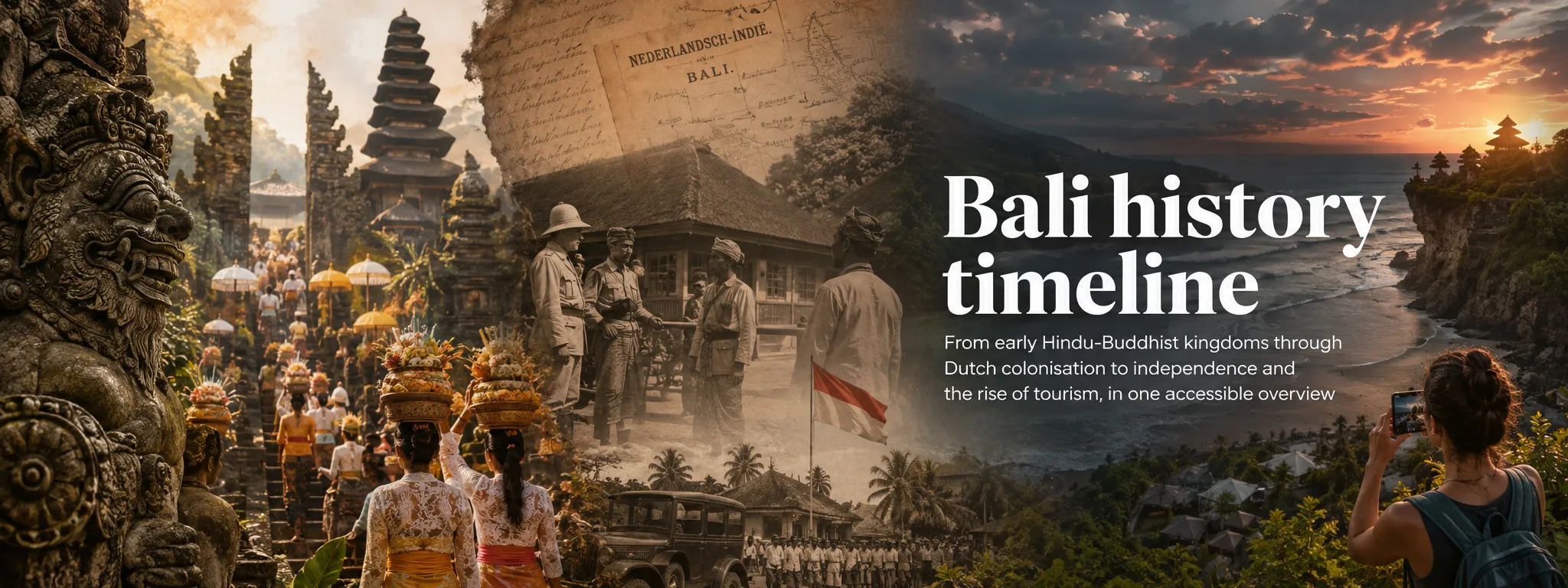
01 Before the famous kingdoms: Bali was never isolated
Bali’s story did not begin with a single migration from Java. Archaeology and early records show an island connected to wider maritime Southeast Asia, with trade, farming communities and cultural exchange long before the tourist-era image of an isolated “Island of the Gods” appeared.
Hindu and Buddhist ideas reached Bali through regional networks and were adapted locally rather than copied intact from India. Over centuries, Bali and Java repeatedly influenced one another through religion, dynastic marriage, trade and political power.
02 Early written Bali and the Hindu-Buddhist kingdoms
Stone and copper inscriptions from the first millennium CE provide some of the earliest written evidence for Balinese rulers, settlements, taxation and religious institutions. The Warmadewa dynasty is among the best-known early ruling lines, and central Bali sites such as Gunung Kawi and Goa Gajah are often discussed in the context of this period.
These places are useful because they show that Bali already had sophisticated political and religious life centuries before Majapahit. A visit to Tampaksiring or Bedulu therefore belongs in a much longer timeline than the simplified “Java fell, Hindu culture moved to Bali” story.
Early Balinese history is also visible in water management and sacred landscapes, not only royal monuments. Temple networks, irrigation organisations and agricultural settlement patterns developed over long periods and help explain why later political history cannot be separated neatly from religion and land.
03 1343 and Majapahit: important, but not the whole origin story
Majapahit forces from Java intervened in Bali in the fourteenth century, traditionally dated to 1343. Later Balinese courts developed strong connections to Majapahit political and cultural traditions, and elite genealogies often looked back to Java. That influence is real and important.
What should be avoided is turning it into a single founding event in which Bali suddenly became Hindu. Hindu-Buddhist traditions were already established. The Majapahit connection reshaped power, court culture and identity rather than creating Balinese civilisation from nothing.
04 Gelgel, Klungkung and regional kingdoms
From the fifteenth and sixteenth centuries, the Gelgel court near Klungkung became a major centre of political and cultural influence. Its authority later fragmented, and Bali developed several regional kingdoms whose rivalries, alliances and courts shaped the island into the nineteenth century.
Klungkung remained symbolically important. The Kertha Gosa complex today is one of the easiest places for visitors to connect court history with architecture and Kamasan-style narrative painting. Regional identities in Badung, Buleleng, Karangasem, Mengwi and elsewhere also make more sense against this background.
05 Dutch expansion and the puputan, 1840s–1908
Dutch intervention increased through the nineteenth century, beginning with campaigns in North Bali and expanding south. The final conquests were exceptionally violent. In 1906 Dutch forces attacked Badung; in 1908 they defeated Klungkung, the last independent Balinese kingdom.
The word puputan is commonly used for the collective last stands associated with these conflicts. Cambridge’s history of modern Indonesia describes royal families and followers advancing against Dutch fire rather than accepting surrender. These events remain central to Balinese memory and are commemorated in monuments, museums and place names.
06 Colonial Bali was also being reinvented for outsiders
After conquest, Dutch rule did not simply erase Balinese institutions. Colonial authorities governed through local elites while also promoting an image of Bali as a preserved Hindu culture. Scholars and administrators documented, classified and sometimes hardened social categories that had previously been more fluid.
Tourism began before the Second World War, and the romantic image of Bali as an artistic, timeless paradise grew alongside colonial rule. That contradiction — political domination paired with cultural preservation rhetoric — is important when reading old travel photography and museum displays.
The colonial period also helped shape what foreigners came to expect from Bali. Dance, painting, ritual and village life were photographed and marketed as signs of an untouched culture even while roads, administration, schooling and commercial networks were changing the island. That tourism gaze still influences how Bali is sold today.
07 Japanese occupation, revolution and Indonesian independence
Japan occupied the Dutch East Indies during the Second World War. After Japan’s surrender in 1945, Indonesian nationalists declared independence and a violent struggle followed against attempts to restore Dutch colonial control. Bali was part of that national conflict.
The Battle of Margarana in 1946, associated with I Gusti Ngurah Rai, became a major symbol of Balinese resistance. His name now appears throughout the island, most visibly at I Gusti Ngurah Rai International Airport. Dutch sovereignty over Indonesia was formally transferred in 1949.
08 1965–66: the chapter many tourist timelines skip
The nationwide anti-communist violence of 1965–66 affected Bali severely. Political conflict, local rivalries and national upheaval led to mass killing across the island. Exact local experiences varied, and this history deserves more care than a quick casualty statistic in a travel article.
For visitors, the key point is that modern Bali was not an uninterrupted story of temples and tourism. Families and communities lived through profound political violence within living memory. Serious histories and museum or academic sources are better places to explore the subject in depth.
09 From cultural tourism to a global resort economy
International tourism expanded rapidly from the late 1960s and 1970s, with major resort development concentrated first in South Bali. Airports, roads and hotels transformed livelihoods and land values. Kuta, Sanur and Nusa Dua became symbols of very different phases of resort growth, while Ubud’s artistic reputation attracted its own visitor economy.
The 2002 and 2005 bombings were devastating shocks, followed by recovery and another long period of growth. Today Bali faces the consequences of success: congestion, water and waste pressure, development debates, rising land prices and a constant negotiation between tourism and local life.
Tourism development also changed political and economic geography inside Bali. South Bali became the main gateway and employment centre, drawing workers from elsewhere on the island and Indonesia. That helps explain today’s contrast between dense resort corridors and regions where agriculture, fishing and local administration remain more visible.
10 How to read Bali’s history while you travel
History becomes easier to remember when attached to places. Goa Gajah and Gunung Kawi point toward early kingdoms; Klungkung and Kamasan connect to court culture; Puputan Square in Denpasar and Klungkung’s monuments evoke colonial conquest; Margarana connects to the independence struggle; Kuta and Nusa Dua show different eras of tourism.
Do not try to reduce the island to a neat timeline of “ancient tradition versus modern development”. Bali has been adapting to outside influence for centuries. That long history of adaptation is one of the reasons contemporary Bali is both recognisably itself and constantly changing.
A useful rule when reading plaques and travel articles is to be suspicious of sentences beginning “the Balinese have always…”. Bali has never been culturally static. Different regions, courts and communities responded differently to political change, and modern identities were built through those changes rather than preserved outside history.