
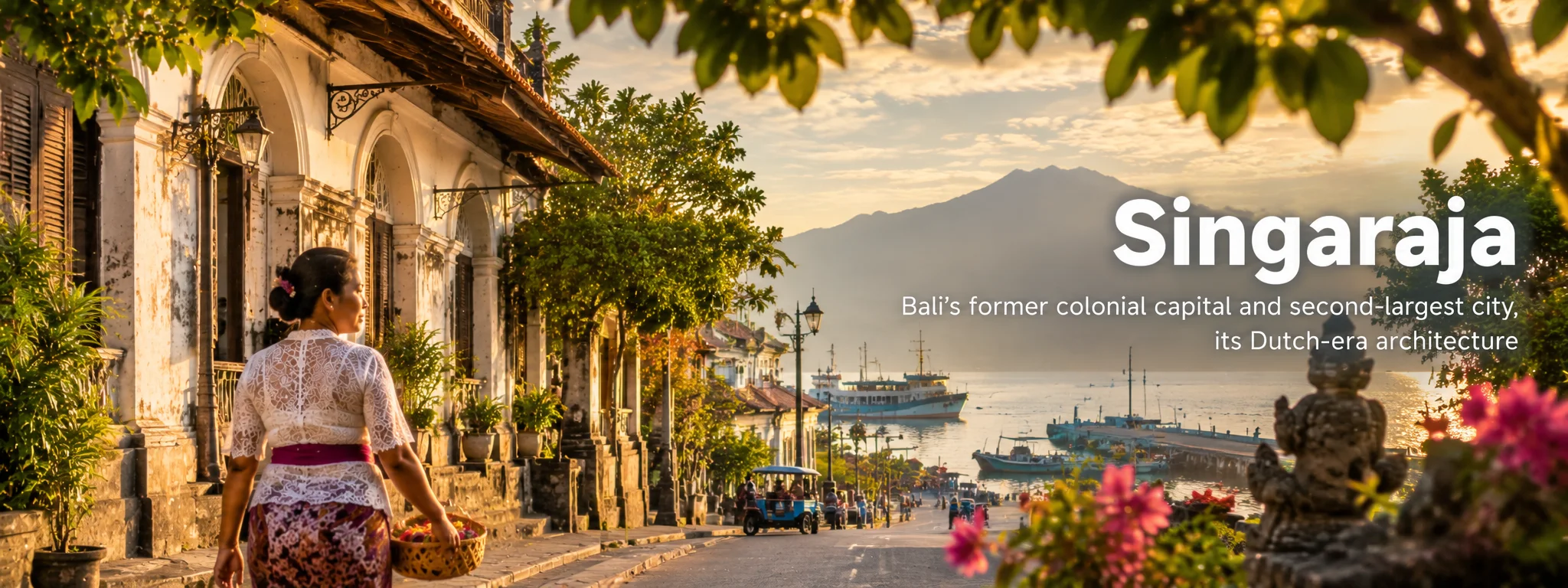
Singaraja rewards travellers who want colonial-era streets, manuscript history, temples, markets and a working northern city rather than another resort strip.
01 Why Singaraja feels different
Singaraja was the administrative centre of Bali during part of the Dutch colonial period and remains the capital of Buleleng Regency. The result is a northern cityscape that feels very different from South Bali’s tourism corridor: older civic buildings, neighbourhood commerce, temples, mosques, markets and a waterfront shaped by trade.
It is not a prettier version of Lovina. Singaraja is a working city. Come for history and everyday urban North Bali; stay in Lovina if your priority is a resort pool, sunset drinks and easy beach-tour infrastructure.
The city is hot and busy in the middle of the day, so a morning start helps if you intend to walk. Shade is inconsistent, and distances that look tiny on a map can feel longer in tropical heat. Use a driver between scattered stops if anyone in your group has limited mobility.
02 Start at the old harbour
The old harbour area helps explain Singaraja’s importance before the centre of Bali’s visitor economy shifted south. Northern Bali had strong maritime links to Java and the wider archipelago, and the waterfront still contains traces of that trading history.
Treat the area as historic urban fabric rather than a manicured heritage precinct. Conditions and individual buildings change, and not every old structure is open to visitors. Walk in daylight, keep out of working areas and use a local guide if architecture or colonial history is a major interest.
The waterfront is also a good place to think about how Bali’s transport geography changed. Before the rise of the southern airport-and-resort corridor, northern ports were far more central to movement and trade. That shift helps explain why Singaraja can feel historically substantial but tourism-light today.
03 Gedong Kirtya and the lontar collections
Gedong Kirtya is one of Singaraja’s most distinctive cultural institutions. Buleleng’s Culture and Tourism office describes it as a repository for lontar manuscripts from Bali and other islands, created during the colonial period and still used for preserving written cultural material.
The value is not simply seeing old palm leaves in cases. Lontar can contain literature, genealogy, religious texts, traditional knowledge and historical records. Visitor access, research procedures and opening arrangements can differ from a normal museum, so check before making it the single reason for a timed trip.
The Buleleng government dates Gedong Kirtya to the late 1920s and describes the collection as including manuscripts from Bali, Java and Lombok. Treat the institution as an archive as well as a visitor attraction: conservation requirements may limit what can be displayed or handled.
04 Buleleng’s royal and colonial layers
North Bali’s history cannot be told as “Dutch buildings plus a palace”. Buleleng had its own royal politics long before colonial administration, and Singaraja later accumulated European, Chinese, Muslim and Balinese influences through trade and government.
Look for those layers in street patterns, places of worship and civic buildings rather than treating one monument as the whole story. A knowledgeable local guide can add more value here than a generic sightseeing driver if history is your main reason for visiting.
05 Temples, Chinese heritage and religious life
Ling Gwan Kiong near the harbour is an important Chinese temple, while Balinese Hindu temples and Muslim communities form other visible parts of the city’s cultural landscape. These are living religious spaces.
Ask before photographing worshippers, dress conservatively and do not walk into a prayer or ritual area because a door is open. Singaraja is particularly good at reminding visitors that Bali’s identity is more diverse than resort marketing suggests.
06 Markets, food and a normal city rhythm
Singaraja’s markets and food streets are useful for travellers who enjoy regional cities. Expect local produce, snacks and everyday shopping rather than a curated tourist market. Morning is generally the most active time for traditional markets.
North Bali food can be spicier and less adapted to international tastes than resort areas. That is an opportunity, not a challenge to “conquer”. Ask what a dish contains, communicate allergies clearly and start with portions and spice levels you will actually enjoy.
Bring small notes and be prepared for a less English-heavy environment than the main resort belt. That is not a problem; a few Indonesian words, patience and pointing go a long way. Do not treat bargaining as a sport when the amount in question is trivial.
07 A city that is still changing
Buleleng authorities have continued city-centre and heritage-area work in recent years, so streets, access and public spaces may not look exactly like older photographs. That is normal for a functioning city.
Use current maps and local advice rather than building a route around a ten-year-old blog. Construction or traffic changes are a reason to keep a city day flexible, not a reason to skip Singaraja.
08 Singaraja or Lovina?
Choose Singaraja if you have business, family, university or cultural reasons to be in the city, or if you prefer an urban local base. Choose Lovina for a conventional leisure stay with more hotels, pools, beach restaurants and dolphin-tour logistics.
The two areas are close enough to combine. Many visitors are better off sleeping in Lovina and giving Singaraja a focused half-day rather than expecting Singaraja itself to behave like a beach resort.
09 How it fits a North Bali route
Singaraja works naturally with Lovina, Banjar, Munduk and waterfalls in the Buleleng interior. It can also be a resupply stop before continuing west toward Pemuteran and West Bali National Park. Major shopping and services are easier to find here than in smaller mountain villages.
Do not underestimate cross-island travel. A North Bali day from Seminyak or Canggu can be dominated by driving. If the north matters, spend a night or more in the region.
If you are heading west, Singaraja is a sensible place to withdraw cash, buy supplies and sort practical issues before quieter areas. If you are heading into the mountains, weather can change quickly and road conditions vary, so leave daylight for unfamiliar routes.
10 A practical first visit
Begin with the old harbour and nearby heritage, then visit Gedong Kirtya/Museum Buleleng if open, have lunch in town and add a market or religious site according to your interests. That is enough for a meaningful first visit without turning the city into a checklist.
Continue with North Bali, Lovina, Pemuteran and our Bali history guide.
We checked current Buleleng Culture and Tourism material on Singaraja and Gedong Kirtya while refreshing this page. Museum hours, city works and access can change, so confirm the institution you care about most before making a special journey.