
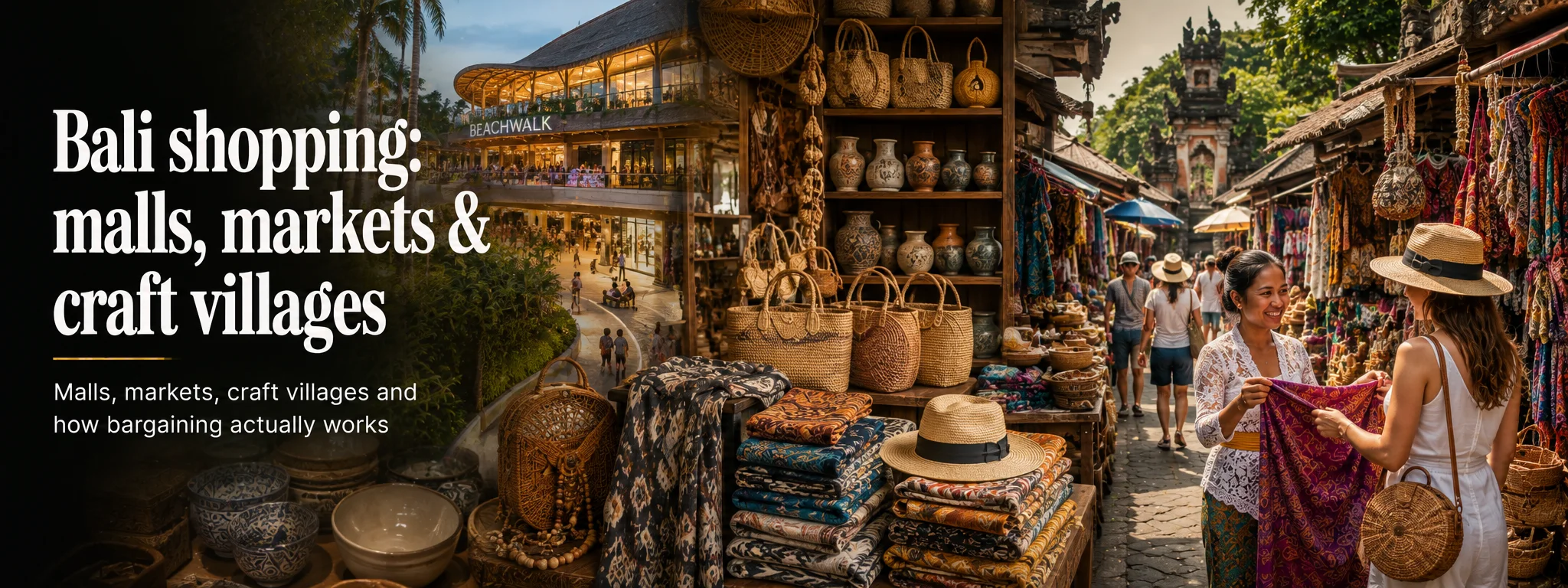
Shopping in Bali is most rewarding when it connects you with something the island actually makes well: textiles, silverwork, carving, art, homewares, food products and independent design. The weakest approach is letting every driver stop become a “must-see factory” or treating the lowest quoted price as the only measure of value.
01 Start with what Bali is genuinely good at buying
Bali is strongest for things connected to its craft traditions and contemporary design scene: textiles, silver jewellery, woodcarving, ceramics, baskets, homewares, art, resort clothing, surfwear, natural-body products and food gifts. It is weaker as a destination for generic imported souvenirs that happen to have “BALI” printed on them. If you want something worth carrying home, buy fewer pieces and understand where they came from.
Seminyak is strongest for boutiques, resort fashion, jewellery and polished homewares. Canggu mixes independent fashion, surf/lifestyle brands and markets. Ubud is the obvious centre for art, craft, textiles and wellness-related products. Denpasar is better for everyday Indonesian shopping and large local markets. Craft villages around Gianyar specialise more directly in particular traditions.
Our Seminyak, Canggu, Ubud and Denpasar guides help you decide where shopping fits naturally rather than spending a holiday in traffic chasing a souvenir.
02 Markets and Ubud: where bargaining fits
Traditional tourist markets often expect negotiation, while fixed-price boutiques, malls and branded stores do not. If there is no displayed fixed-price policy, ask the price politely and make a counter-offer you would genuinely be happy to pay. Bargaining works best as a short friendly conversation, not a theatrical battle over the last few thousand rupiah.
If you agree on a price, buy the item. Do not spend ten minutes negotiating for entertainment and then walk away after the seller accepts your number.
Central Ubud is the easiest place to browse a wide mix of textiles, baskets, small crafts and tourist souvenirs alongside galleries and boutiques. Quality ranges enormously. The market is useful for browsing, but the best piece of art or craft is not necessarily found in the busiest tourist aisle.
Walk beyond the obvious market, visit galleries and specialist shops, and compare workmanship before buying expensive items. Ubud’s surrounding villages and workshops are more interesting for travellers who want to understand how things are made.
03 Craft villages and silver: look past the showroom pitch
Celuk is associated with silver and gold work; Mas and nearby villages are known for woodcarving; other communities specialise in painting, stonework and textiles. The “craft village” label does not guarantee every showroom is an artisan workshop — some are large retail operations — but visiting the production areas gives you a better chance to ask about materials and process.
For significant jewellery or art purchases, get a proper receipt and ask about metal purity, artist attribution, shipping and return policies rather than relying on a verbal claim.
Bali has a strong silver-working tradition and an equally strong tourist jewellery industry. For higher-value purchases, ask what silver standard is used, whether stones are natural or synthetic, and whether the piece was made locally. Reputable sellers should be comfortable documenting expensive jewellery.
If you want the experience as much as the object, consider a supervised silver-making workshop rather than simply buying from a showroom.
04 Batik, ikat and Balinese textiles
Not every colourful cloth sold in Bali is Balinese, and not every “batik” is handmade. Traditional Indonesian textiles involve distinct techniques, regions and levels of labour. Learn enough to understand whether you are buying hand-drawn/waxed batik, stamped batik, woven ikat, songket or a machine-printed imitation.
There is nothing wrong with an inexpensive printed sarong if that is what you want — the problem is paying handmade-artisan prices for mass production. Our Bali textiles guide explains the differences in more detail.
05 Art, furniture and homewares: documentation and shipping matter
Ubud and surrounding villages support everything from decorative tourist painting to serious contemporary and traditional art. For an inexpensive piece, buy what makes you happy. For a high-value work represented as being by a particular artist, ask for provenance, a receipt and any certificate the gallery provides.
Do not assume an old-looking painting is an antique. Exporting cultural property, antiques or protected objects can involve restrictions.
Baskets, ceramics, carved doors, stone pieces and furniture can look inexpensive until international freight, fumigation, customs and import taxes are added. For large purchases, use a seller experienced in export documentation and get a written shipping quote that explains what is included.
Wood and plant materials are particularly relevant to biosecurity when returning to countries such as Australia. Declare items as required and check your home-country import rules before buying something difficult to treat or surrender.
For furniture, stone, large artwork or multiple boxes, a professional freight company is safer than informal promises. Ask who is responsible for export paperwork, packing, insurance, destination customs charges and delivery after the goods arrive in your country. Photograph the item and packaging before it leaves Bali. If the seller cannot explain the shipping chain clearly, reconsider the purchase.
06 Coffee, spices and gifts you can actually take home
Packaged coffee, tea, spices, sambal and sweets make easy gifts, but again check your destination country’s biosecurity rules. Commercially sealed products are generally easier to travel with than fresh fruit, loose plant material or homemade food.
For coffee, avoid assuming the most expensive product is the best. Bali produces excellent conventional coffee; you do not need civet coffee to bring home something distinctive. See our coffee guide.
Your home country’s customs and biosecurity rules matter more than the seller’s reassurance. Australia, in particular, has strict declaration requirements for food, plant, wood and animal materials. Avoid products made from protected wildlife, coral, shells or questionable animal parts regardless of whether somebody is willing to sell them.
Keep receipts for valuable purchases and declare goods where required.
07 Malls, Seminyak, Canggu and Denpasar
Malls are useful for air-conditioned shopping, pharmacies, electronics, known brands and rainy-day practicality. Beachwalk in Kuta, shopping centres around Kuta/Tuban and major Denpasar malls serve a different purpose from Ubud craft markets. If you need a charger, replacement shoes or a reliable supermarket, authenticity is not the priority.
Seminyak and Canggu are strongest when you want contemporary Bali — resort wear, surf/lifestyle labels, jewellery, interiors and independent brands — rather than traditional craft markets. Prices are usually fixed and substantially higher than market stalls, but design, sizing, air-conditioned fitting rooms and quality control can also be better.
Petitenget and central Seminyak suit a browse between meals; Batu Bolong and Berawa have clusters of fashion and lifestyle retail. Do not spend an hour in traffic chasing a shop simply because it appeared in an influencer reel: group shopping by neighbourhood.
If you want a less tourism-focused shopping experience, Denpasar has traditional markets, fabric shops, household goods and malls used primarily by local residents. It is more chaotic and less curated than Seminyak, but it shows a different retail side of the island. Pasar Badung and the surrounding commercial area are more interesting for market atmosphere than for a perfectly packaged souvenir experience.
08 Tailoring, payment, card fees and tax paperwork
Indonesia has had VAT refund arrangements for eligible foreign visitors at participating retailers, but minimum spending, participating stores, documentation and airport procedures can change. If a purchase is large enough for the refund to matter, ask the retailer for the current process at the time of purchase and verify it through official Indonesian tax information rather than relying on an old travel blog.
Bali has tailors and leather workshops offering custom pieces, but quality and turnaround vary. If you want something made, order early in the trip so there is time for a fitting and correction. Agree on fabric, lining, hardware, dimensions, price and completion date in writing. A rushed final-night pickup leaves no time to fix poor fit.
Markets and small workshops may prefer cash; boutiques and malls commonly accept cards. Ask before paying whether a card surcharge applies. For expensive purchases, a card can provide a cleaner transaction record, but do not let dynamic currency conversion convert the price into your home currency at an unattractive rate without comparing it. Our money guide explains that trap.
09 Counterfeits, commissions and common shopping mistakes
Fake branded bags, watches, shoes and clothing create legal and quality issues and may be subject to seizure when you return home. If the price proves a “designer” item is obviously not genuine, treat it as counterfeit rather than pretending you discovered an impossible bargain.
- Buying the first “handmade” item without comparing quality.
- Assuming every market starts from the same bargaining margin.
- Paying large deposits for furniture/shipping without written terms.
- Buying jewellery without understanding metal/stone claims.
- Carrying prohibited natural products home.
- Letting a driver’s commissioned showroom stop become your only view of Balinese craft.
Drivers may receive commission from certain shops, restaurants or attractions. That does not automatically make the business bad, but it can explain why a particular showroom is presented as an essential stop. If you want a specific workshop, gallery or village, tell the driver where you want to go rather than asking vaguely for “the best silver shop”.
10 Pack, ship and buy with a plan
If shopping matters, pack a foldable bag or leave suitcase capacity rather than buying an extra hard case on the final night. Wrap fragile ceramics carefully and put receipts for high-value goods somewhere accessible for customs.
The best Bali shopping is specific: a piece of silver from a good maker, a textile you understand, art you genuinely like, or useful design from an independent local brand. Shop slowly enough to tell the difference between craft and mass production. A suitcase full of generic “Bali” souvenirs is much less interesting than two or three objects with a real story.