
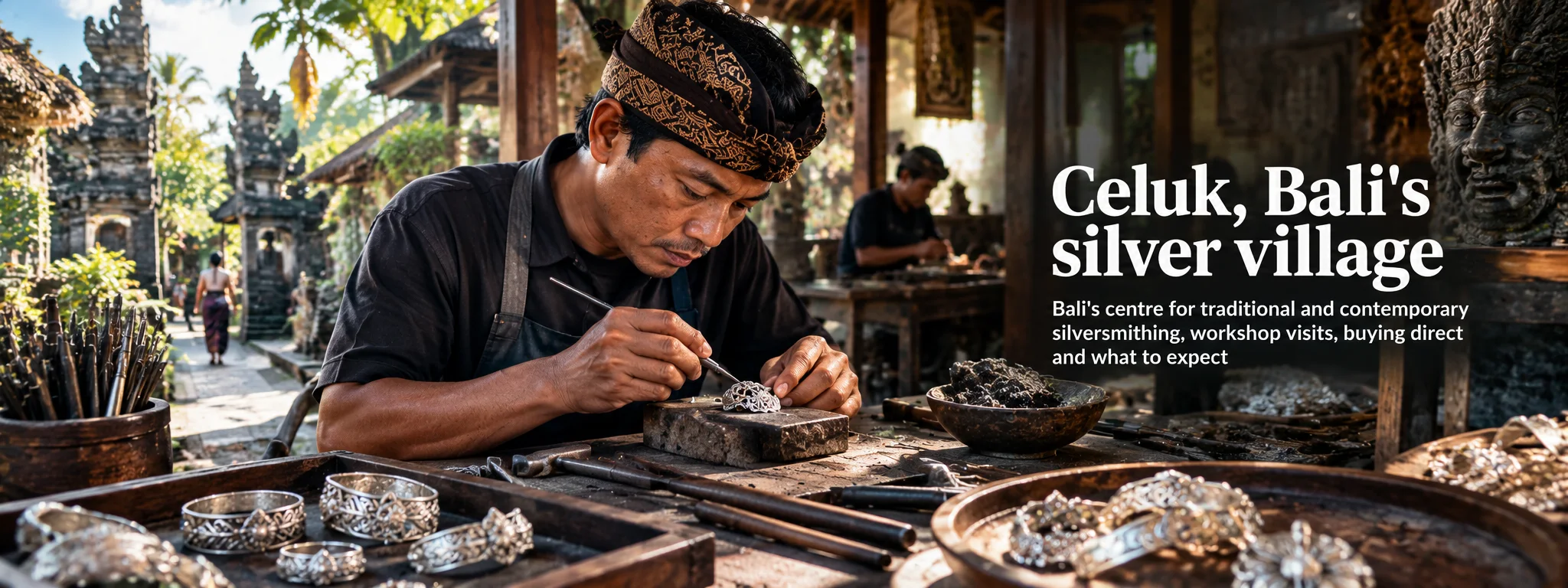
Celuk is Bali’s best-known silver and gold craft village, but the visitor experience varies from tiny family workshops to large export showrooms. The useful approach is to decide whether you want to learn, commission, compare or simply buy — then choose the workshop accordingly.
01 Why Celuk still matters in Bali’s craft landscape
Indonesia Travel continues to describe Celuk as a centre for Bali’s gold and silver craft, including both traditional decorative work and modern jewellery. That is a better reason to visit than the old tour-bus idea of Celuk as a compulsory showroom stop.
Celuk is not simply a road lined with jewellery showrooms. The village, in Sukawati district south of Ubud, has long been associated with gold- and silversmithing, and Gianyar’s tourism authority continues to promote Celuk as a centre of the craft. Indonesia Travel likewise identifies Celuk as Bali’s best-known centre for gold and silverware, particularly intricate decorative jewellery.
That reputation has attracted large retailers, tour buses and export businesses, so the visitor experience ranges from small family workshops to polished showrooms. The useful question is therefore not “is Celuk authentic?” but which part of Celuk are you visiting, and what do you want from the visit? If you are interested in technique, ask to see a working bench and talk through fabrication. If you simply want a reliable piece of jewellery, concentrate on workmanship, metal content, weight, finish and after-sales information rather than romantic workshop stories.
02 How the silver work is made — and what 925 actually means
Traditional jewellery production can combine sawing, hammering, soldering, wire work, granulation, repoussé-style shaping, chasing, polishing and stone setting. Fine decorative wire and tiny silver beads are common visual features, but “Balinese silver” is not a single protected style. Contemporary Celuk workshops produce everything from temple and ceremonial pieces to minimalist rings designed for export.
Watching a craftsperson work is useful because it shows why apparently similar pieces can have very different prices. Hand-fabricated jewellery may involve dozens of solder joints and substantial finishing time. Cast pieces can be quicker to reproduce and are not automatically inferior, but the production method should match the price being asked. If a shop uses phrases such as “handmade”, ask which stages are actually done by hand.
Sterling silver is normally 92.5% silver alloyed with other metals for strength, hence the common “925” stamp. A stamp is useful evidence but not an independent laboratory test, and tourist-market jewellery varies. Ask the seller what alloy is used, whether the piece is solid silver or plated, whether stones are natural or synthetic, and whether a receipt will state the material.
Silver naturally tarnishes, especially in humid or sulphurous environments. Tarnish is not proof that an item is fake; it is a surface reaction that can usually be polished away. By contrast, flaking that exposes a different-coloured base metal suggests plating. For expensive purchases, deal with an established business willing to document weight, metal content, gemstone details and return or repair arrangements.
03 Family workshops, export producers and large showrooms
Celuk’s businesses are not all the same. At one end are family-run workshops where a handful of craftspeople make pieces at benches attached to a home or small shop. At the other are large jewellery businesses with design teams, casting equipment, export customers and air-conditioned showrooms. Between those sit many hybrids: family companies that have grown into substantial manufacturers while still employing local artisans.
For visitors, the distinction matters because each offers a different experience. A tiny workshop may provide the most direct conversation with a maker but a narrower range and fewer formal guarantees. A large producer may be better for consistent sizing, documented materials, card payment and international shipping. Neither is automatically “more authentic”. Ask how the business works and decide what matters to you.
If a driver takes you to a particular showroom, remember that tour-industry commission arrangements can influence where visitors are delivered. That does not mean the shop is bad, but it is another reason to compare rather than assume the first stop is the whole of Celuk.
04 A sensible process for buying jewellery
Some Celuk visits are structured around a demonstration followed by a large showroom. That can still be interesting, but understand the format before you arrive. Independent travellers can ask whether a workshop visit is free, whether there is any expectation to buy, and whether photography is allowed around tools and designs.
A good craft visit is conversational. Ask what the artisan is making, how long the piece takes, which tools are locally made and which techniques were learned within the family. Avoid leaning over benches or touching unfinished work. Soldering torches, acids, polishing equipment and sharp tools are part of a functioning workshop, not a staged attraction.
If you want a hands-on class, book a workshop specifically designed for visitors rather than assuming a production workshop can stop work to teach you. A proper class should explain duration, materials included, safety procedures and whether you keep the finished piece.
Start by deciding whether you are buying a souvenir, wearable everyday jewellery or a high-value piece. For a souvenir, design and budget may matter most. For a substantial purchase, slow down: compare several pieces, inspect clasps and solder joins, ask about resizing and repairs, and get material details in writing.
Do not assume the largest showroom offers the best value, or that a tiny workshop must be cheaper. Larger businesses may have better quality control and warranties; small producers may offer more direct contact with the maker. Jewellery pricing reflects silver weight, labour, stones, complexity, brand and retail overhead.
Polite negotiation may be possible in some independent shops, but aggressive bargaining over labour-intensive craft is a poor default. Ask whether the price is fixed before negotiating. If you commission a piece, agree on design, dimensions, metal purity, stones, deposit, completion date and what happens if the result differs from the brief.
05 Custom orders and repairs need a clear brief
Celuk can be a good place for custom work, particularly simple rings, pendants and adaptations of an existing workshop design. The more complicated the commission, the more important a written specification becomes. Reference photos help, but copying another designer’s protected work exactly is different from using an image to discuss proportions or general style.
If you have only a few days in Bali, do not commission something that requires multiple fittings unless the workshop can realistically meet the schedule. Confirm whether the final collection must be in person or whether insured shipping is available. For rings, specify the sizing system being used; US, UK/Australian and European sizes are not interchangeable numbers.
06 Ask better questions about originality and “handmade” claims
Celuk sits inside a global jewellery supply chain. Some workshops make their own designs from start to finish; some subcontract stages; some retail pieces made elsewhere. None of those models is automatically deceptive, but the marketing should be honest. If buying specifically to support local craft, ask who designed and made the piece and whether production occurs in Celuk.
Be wary of stories that every item uses a centuries-old sacred design or is uniquely available in one shop. Bali’s craft traditions are living and commercial as well as ceremonial. The most respectful approach is to value skill without demanding a simplified “untouched village” narrative.
07 Where Celuk fits — and what to combine with it
Celuk lies on the well-travelled route between south Bali and Ubud, making it easy to combine with nearby craft villages. Celuk is associated with metalwork, while Mas is known for woodcarving and the broader Sukawati area for markets and craft production. Ubud is farther north.
Traffic is the main planning variable. A distance that looks short on a map can take much longer during peak periods. If Celuk is a genuine priority, visit earlier in the day rather than squeezing it into the final half-hour of a packed Ubud excursion.
A coherent day might pair Celuk with Ubud, Goa Gajah, Tirta Empul or other Gianyar craft stops. If shopping is the focus, combine fewer attractions and allow time to compare workshops. If culture is the focus, use Celuk as a short craft stop between larger sites rather than treating it as a full-day destination.
Families with children may find a booked jewellery-making workshop more engaging than showroom browsing. Serious jewellery buyers may want the opposite: fewer demonstrations, more time inspecting pieces and discussing custom work.
08 Receipts, taking jewellery home and long-term care
- Time needed: about 45–90 minutes for a workshop/showroom visit; longer for a class or serious shopping.
- Best time: morning generally gives easier traffic and more working activity.
- Payment: ask about card fees and currency before a large purchase; use our money guide for cash/card basics.
- Shipping: obtain tracking, insurance terms and a detailed receipt for valuable pieces.
- Jewellery care: keep silver dry when stored, avoid harsh chemicals and use a suitable polishing cloth.
Keep receipts for valuable jewellery, especially if the document states metal purity, gemstone type and purchase price. Your home country may have customs or tax rules for high-value purchases, and those rules are determined by the country you are entering rather than by the Celuk seller. If in doubt, check your own customs authority before buying an expensive piece.
For everyday care, store silver away from humidity and chemicals, remove it before swimming in heavily chlorinated water, and use a non-abrasive silver cloth when tarnish develops. Gemstone pieces may need different treatment, particularly porous stones, pearls or glued settings. Ask the workshop how they recommend cleaning the specific item rather than applying aggressive silver dip to everything.
If the business offers repairs by post, clarify shipping responsibility and insurance. A beautifully made piece that can be resized or repaired locally is often a better purchase than a cheap souvenir with no support once you leave Bali.
09 Who gets the most from Celuk
Yes, if jewellery, craft technique or buying direct interests you. It is less compelling if you dislike shopping and only want a picturesque village street; the main road can feel commercial and traffic-heavy. The strongest Celuk visit is one where you know whether you want a workshop conversation, a class, a commission or a purchase — and choose the business accordingly.
10 How to use a Celuk stop well
The best Celuk visit has a purpose. Watch a maker, ask about technique, compare a few pieces and buy only when the workmanship and terms make sense. You do not need to turn craft appreciation into compulsory shopping.
Sources checked
Primary context: Gianyar Tourism Office and Indonesia Travel — Bali silver and crafts. Workshop hours, classes and retail policies vary by business, so confirm directly before making a special trip.
Continue planning: Ubud · shopping in Bali · Balinese arts & crafts · batik & textiles.