
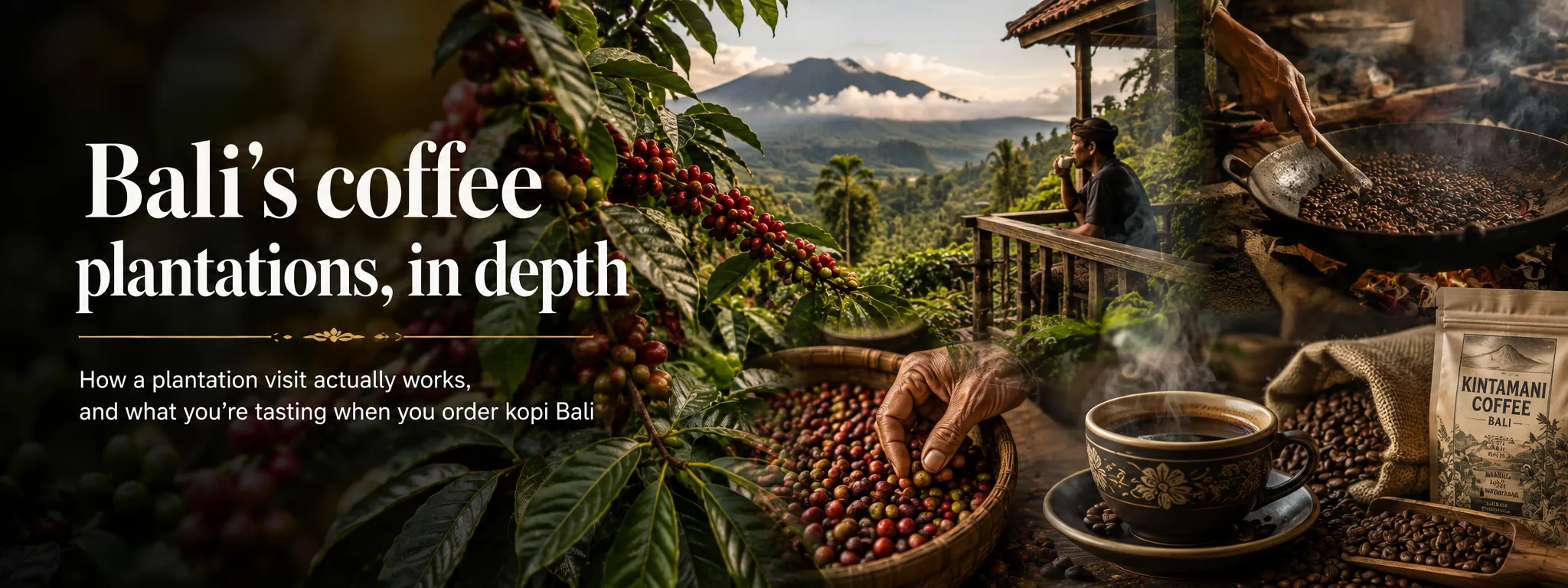
01Bali coffee is more than kopi luwak
Tourist “coffee plantation” stops in Bali often centre on trays of flavoured drinks and caged civets. That is a poor introduction to the island’s actual coffee story. The more important subject is Kintamani Arabica, a recognised regional product with a formal Geographical Indication and a farming system shaped by altitude, volcanic soils, shade trees and mixed agriculture.
Indonesia’s intellectual-property authority lists Kopi Arabika Kintamani Bali as a registered Geographical Indication. That means the name is tied to defined origin and production standards rather than simply being marketing shorthand for any coffee sold near Kintamani.
02Where coffee is grown
The Kintamani highlands are the best-known Arabica area, while robusta is grown in lower or different microclimates elsewhere in Bali, including western parts of the island. Elevation, rainfall, soil and processing all affect flavour.
A roadside tasting stop may not actually sit inside a productive coffee farm. If seeing agriculture is important, ask what is grown on the property, whether the coffee served was produced there, and whether you will walk through working trees rather than a demonstration garden.
03What the Kintamani Geographical Indication tells you
The GI specification covers more than geography. Indonesian guidance describes cultivation under shade, selective harvesting of ripe cherries and production practices intended to preserve regional quality. The system emerged from cooperation between farmers, researchers and institutions and became one of Indonesia’s early coffee GIs.
A GI does not guarantee every cup will be excellent — roasting and brewing still matter — but it gives “Kintamani” more meaning than a generic café label.
04What Kintamani coffee tastes like
Descriptions commonly emphasise clean acidity, citrus or fruit notes, though flavour varies by farm, altitude, processing and roast. Do not expect every Kintamani bean to taste identical. A dark roast can overwhelm delicate regional character, while fermentation methods can produce flavours that have more to do with processing than origin.
If you want to learn, taste two coffees side by side and ask about variety, elevation, process and roast date. That is far more useful than tasting coffee next to vanilla cocoa, ginger tea and ten sweetened powders.
05Washed, natural and honey processing
After harvesting, coffee fruit must be processed to remove the seed we call the bean. Washed processing removes fruit before drying and often gives a cleaner cup. Natural processing dries the whole cherry and can produce heavier fruit character. Honey-style processes leave some mucilage during drying.
Many modern Bali roasters experiment with fermentation and specialty processing. There is nothing inherently more “traditional” about a funky anaerobic coffee. Ask what you are tasting rather than relying on exotic terminology.
06What a good plantation visit should include
A worthwhile visit explains the coffee plant, harvest cycle, picking, pulping, fermentation/drying, roasting and brewing. Even better if you can talk with growers or see processing equipment during the appropriate season. A weak visit shows a few plants, an animal cage and then funnels everyone into a shop.
Ask whether there is an entry fee or compulsory purchase before starting. Free tours are usually sales experiences; there is nothing wrong with that if the arrangement is transparent.
07Harvest season and what you will actually see
Coffee is seasonal. Outside harvest, trees may have flowers, green cherries or no ripe fruit at all. Marketing photos of red cherries do not mean visitors can pick coffee year-round. A responsible farm should not stage harvesting simply to satisfy tourists.
If seeing processing is important, contact the farm or roaster in advance and ask what stage of production is active.
08Kopi luwak: the animal-welfare problem
Kopi luwak is coffee made from beans that have passed through the digestive tract of Asian palm civets. The product became globally famous and expensive, which created strong incentives for captive production. Tourist plantations may display civets in cages while claiming coffee is “wild collected”. Those claims are difficult for visitors to verify.
From an animal-welfare perspective, we recommend avoiding attractions that keep civets in small cages or use handling/photo opportunities. If curiosity is the only reason to try kopi luwak, a conventional high-quality Kintamani coffee tells you much more about Bali’s growers and terroir.
09How to taste coffee without pretending to be a judge
Smell it first, then taste as it cools. Notice sweetness, acidity, bitterness, body and aftertaste. You do not need to identify “bergamot over volcanic cacao” to have a useful opinion. Ask yourself whether the cup tastes clean, balanced and enjoyable.
Sweetened flavoured coffees can be pleasant drinks, but they are poor tools for evaluating the underlying bean. Taste plain coffee before adding sugar or milk if origin is what interests you.
10Buying beans to take home
Look for a roast date, origin, process and preferably whole beans. Buy an amount you can use reasonably soon rather than a giant souvenir bag. Whole beans retain quality longer than pre-ground coffee; ask the roaster to grind only if you do not own a grinder.
Packaging should have a one-way valve and a good seal. Customs rules for roasted coffee vary by destination, especially countries with strict biosecurity, so check your home-country requirements rather than relying on the seller’s assurance.
11Plantation visit vs specialty café
If your primary interest is flavour rather than farming, a good specialty café or roastery may teach you more than a plantation stop. Baristas can often compare origins and brew methods in a controlled setting. Plantation visits are strongest for agricultural context.
Ideally do both: see where coffee grows in Kintamani, then taste carefully roasted versions elsewhere.
12Combining coffee with Kintamani
Coffee fits naturally into a Kintamani and Mount Batur day. Do the main landscape/temple priorities first and use coffee as a slower stop rather than building the itinerary around a random roadside showroom.
If travelling from Ubud, Tampaksiring and Penglipuran can also be combined geographically, but avoid turning the day into ten five-minute stops.
13Questions worth asking at a plantation or roaster
- Where exactly was this coffee grown?
- Is it Arabica or robusta?
- What altitude?
- How was it processed?
- When was it harvested and roasted?
- Was it grown on this property or bought from farmers?
- If kopi luwak is sold, are civets kept on site?
14Our verdict
A coffee stop is worthwhile when it connects you with farming, processing and flavour. Skip the places whose main attraction is captive civets and free sugar-heavy samples. Bali’s coffee story is interesting enough without gimmicks.
15Coffee, shade trees and mixed farming
Kintamani coffee is often grown within mixed agricultural systems rather than isolated industrial monoculture. Shade trees, citrus and other crops can coexist with coffee, and livestock/manure may form part of farm nutrient cycles. Indonesia’s GI guidance specifically references shade-grown cultivation and diversification.
This makes a real farm walk more interesting than rows of coffee alone. Ask why particular shade species are used, how pruning works and what farmers grow between or beside coffee. Agroforestry decisions affect both farm economics and the cup.
16Selective picking and why labour matters
High-quality Arabica depends on harvesting ripe cherries rather than stripping everything from the branch at once. The Kintamani GI guidance emphasises selective hand-picking of ripe fruit. That requires labour and repeated passes through the farm as cherries ripen at different times.
When specialty coffee costs more, part of that price should reflect agricultural work, processing and quality control rather than only café branding. Plantation tourism is more meaningful when it makes the labour visible instead of presenting coffee as a magical bean that appears in a tasting cup.
17Roast level can hide or reveal origin
Very dark roasting creates strong bitter, smoky flavours that can dominate regional character. Medium or lighter roasting often preserves more acidity and fruit, although there is no universally correct style. Indonesian coffee is not inherently supposed to be black and oily.
If a plantation sells only very dark pre-ground coffee, it may still be enjoyable, but do not assume that represents the full potential of Kintamani beans. Specialty roasters around Bali increasingly offer lighter profiles and traceable farm lots.
18Brewing Bali coffee at home
Traditional Indonesian kopi tubruk is made by adding hot water directly to fine coffee grounds in the cup and allowing them to settle. Kintamani Arabica also works well with pour-over, AeroPress and other filtered methods, depending on roast.
If buying beans, ask the roaster for a simple brew recipe. Water quality and grind size matter more than expensive equipment. Start with their recommendation and adjust to taste.
19Common plantation-tour traps
- Claiming every plant in a demo garden produced the coffee you are drinking.
- Using captive civets as the main attraction while describing the product as wild.
- Calling flavoured instant drinks “coffee tasting”.
- Pressuring visitors into high-priced retail purchases after a supposedly free tour.
- Making medical claims about coffee, cocoa or herbal drinks.
None of these means you must avoid every roadside stop. Just recognise the sales model and ask questions.
20Water quality and why the same beans taste different
Coffee is mostly water, so mineral content and temperature strongly affect extraction. A Kintamani bean brewed at a plantation, a specialty café and your kitchen at home may taste surprisingly different even at the same roast level. This is normal, not proof one cup is fake. If you love a tasting, ask for the brewing recipe and water approach as well as the beans.
21Sources & related reading
Primary source: Indonesia Directorate General of Intellectual Property — registered Geographical Indications, including Kopi Arabika Kintamani Bali. DJKI has also documented the product’s role as one of Indonesia’s early coffee GIs.
Continue planning: Kintamani · Bali coffee culture · Balinese food · Ubud.