
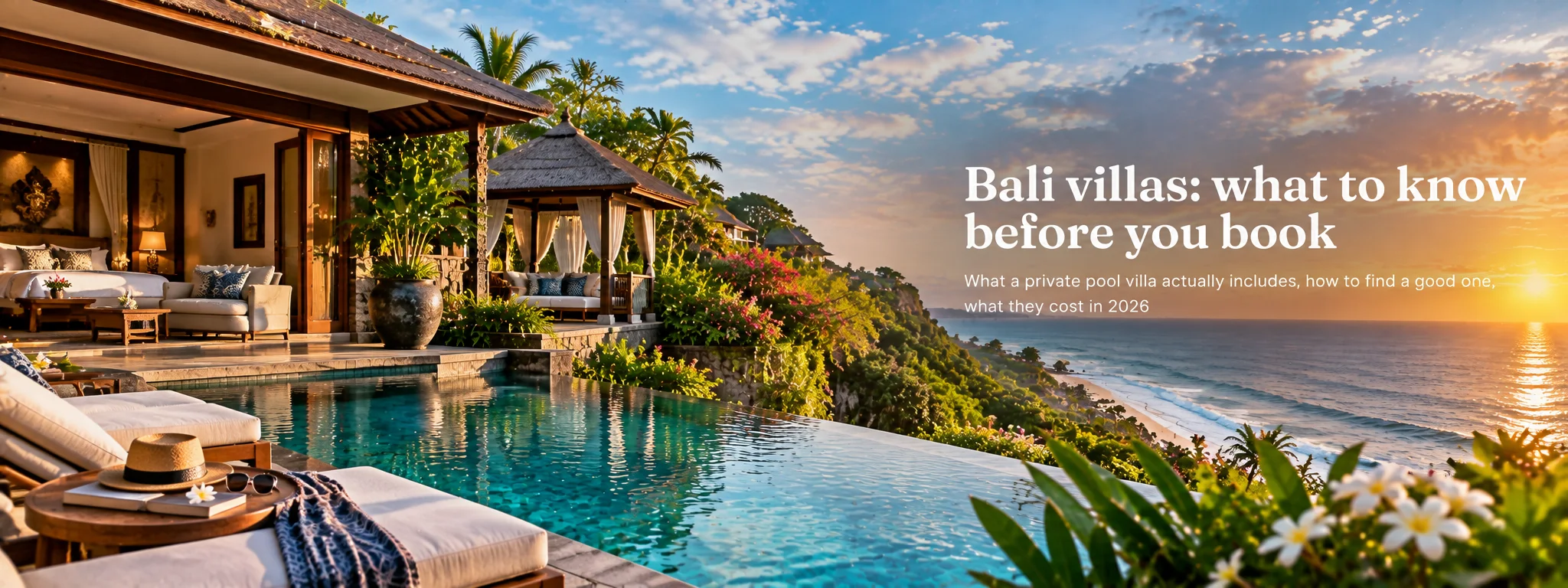
Bali villa listings are extremely good at showing you the pool and remarkably bad at showing you the lane, the management quality, the neighbour’s building site or the twenty steps between the car and the front door.
I would choose the operator and micro-location before falling in love with the architecture. A less photogenic villa with reliable management, sensible access and a useful neighbourhood can produce a far better holiday than an infinity pool stranded in the wrong place.
01 What ‘villa’ means in Bali
Indonesia’s OSS business classification includes villas within short-term tourist accommodation and describes them as private houses specifically rented to tourists with facilities. In the market, however, the word is used extremely broadly: one-bedroom pool suites, standalone houses, multi-building compounds, managed villa complexes and huge staffed estates can all call themselves villas.
That makes category labels less useful than operational details. Ask: Is it entirely private? Are any walls/pools/shared paths communal? Who is on site? How many bedrooms are under one roof? Are living spaces enclosed or open-air?
02 Licensing matters: verify the accommodation business
Bali’s foreign-tourist rules require visitors to stay in accommodation operating with the appropriate licence. In February 2026 the provincial government went further and publicly asked Airbnb to remove Bali tourism businesses/listings that were unlicensed or non-compliant with tax obligations.
I treat licensing and a traceable operator as trust signals, not boring paperwork. If nobody can clearly tell you who manages the property, that is already useful information.
This does not mean every small villa is suspect. It means travellers should stop treating “listed on Airbnb/Booking.com” as equivalent to “licensed”. Ask the operator for the registered accommodation/business name and legal status. Professional managers already deal with this issue and should be able to answer clearly.
03 Where villas make the most sense
| Area | Villa strengths | Common trade-off |
|---|---|---|
| Seminyak | Walkability + restaurants + private pools | Dense building, traffic, construction/noise |
| Canggu | Huge choice, groups, lifestyle stays | Access lanes and cross-town traffic can ruin location |
| Ubud | Rice/river views, romantic and group properties | “Ubud” can mean far outside town; transport required |
| Uluwatu/Bukit | Clifftop/ocean views, dramatic design | Car-dependent; steep sites and exposed pools |
| Sanur | Family-friendly residential feel, flatter terrain | Villa stock less dominant than west-coast areas |
| Sidemen/East Bali | Views, privacy, destination properties | Remote food/transport and variable connectivity |
Use our area guide first. “Luxury villa in Bali” is not a location strategy.
A villa is only private until you need breakfast, a beach, dinner or a driver. I choose the area around the daily routine, not around the drone shot.
04 Staff and service: ask exactly what is included
Villa staffing ranges from essentially self-catering to full household teams. “Daily housekeeping” may mean two hours each morning, not hotel-style instant service. A “villa manager” may supervise several properties. A chef may be available only by advance booking and ingredients can be extra.
- Housekeeping frequency and hours
- Who answers after-hours emergencies
- Pool/garden maintenance schedule
- Breakfast: included, ingredients extra, or unavailable?
- Laundry: machine, paid service or neither?
- Security: on-site, estate guard or remote?
- Airport transfer and driver arrangements
Read reviews for maintenance response. A villa is a small building system: pumps, hot water, air-conditioning, locks, Wi-Fi and pool equipment all need somebody competent nearby.
05 Private pools and open-air design change the risk profile
Many Bali villas place the pool directly outside bedrooms/living areas, sometimes with no barrier. That can be perfect for adults and unacceptable for a toddler unless proper fencing is installed. Never assume “family-friendly” means fenced.
Open pools and open-air living are part of the Bali villa appeal, but they change the risk calculation for children, night-time wandering, insects and wet surfaces.
If a pool fence is advertised, request current photos showing the complete barrier, gate and gaps. Ask whether installation is included or an extra hire. Keep doors locked, nominate active supervision and do not rely on inflatable toys as safety equipment. See our dedicated pool-villa safety guide.
Traditional/tropical villa design often leaves kitchens and living rooms open to gardens. That creates airflow and atmosphere, but also heat, humidity, mosquitoes, insects, geckos and occasional rain blow-in. Bedrooms are normally enclosed and air-conditioned, but verify.
If you need a cold indoor workspace all afternoon, ask whether the living area is fully enclosed. If somebody in your group is insect-phobic, an open pavilion may turn a dream booking into daily stress.
06 Access, construction noise and Wi-Fi: test the practical stuff
This is one of the most Bali-specific villa checks. Some beautiful properties sit down lanes that are comfortable for scooters but awkward or impossible for full-size vehicles. You may be dropped at a main road and walk with luggage, or drivers may refuse pickup at the door.
My favourite practical question is boring: can a normal car actually reach the entrance? The answer can matter more than a larger pool.
Ask directly: Can a normal car reach the entrance and turn around? Is there parking? Is the final lane paved and lit? Does it flood? For families, older travellers or heavy luggage, these questions matter more than whether the pool has floating breakfast.
Bali builds constantly, particularly in fast-growing villa areas. A vacant rice field in a two-year-old listing photo may now be a building site. Search the newest reviews, ask the host about construction on adjacent plots and request a current exterior photo if tranquillity is the main reason you are booking.
Other noise can include temples/ceremonies, roosters, dogs, traffic, bars and normal neighbourhood activity. Not all noise is avoidable or unreasonable; the key is matching expectations to location.
Never accept “fast Wi-Fi” as a technical specification. Ask for a recent speed test taken inside the villa, ideally from the room where you will work. Also ask which mobile carrier has the strongest backup signal and whether the router/ONT stays powered during a local outage.
Large villas may have Wi-Fi dead zones across separate pavilions. For important work, bring a local SIM/eSIM backup and read our internet guide.
07 Work out the real villa cost
For a holiday stay, check tax/service, cleaning, breakfast, extra beds, airport transfer, pool fence, chef charges and deposits. For monthly stays, electricity, water, internet, cleaning, linen and pool/garden maintenance can shift from “included” to separate.
Group value can still be excellent. The fair comparison for a four-bedroom villa is not one hotel room; it is four suitable hotel rooms plus whatever common/private space the group needs.
08 How to find a good villa and what to check before payment
Large platforms are useful for review volume and payment structure. Specialist villa agencies can provide local management and more detailed matching. Direct booking can make sense with established operators but do your due diligence before wiring a large deposit.
I want recent reviews that mention management response, cleanliness, construction and access — not just guests saying the villa was “beautiful”.
Look at the property on multiple map/satellite/photo sources. Search the villa name independently. Read the worst recent reviews first, then see whether management responses are specific and credible.
Privacy and security deserve their own check. “Private villa” can mean a freestanding compound behind its own gate, a unit inside a staffed villa complex, or one of several villas sharing an access lane and security post. None is automatically better, but the experience differs. Ask whether staff enter on a fixed schedule, whether bedrooms lock independently, whether there is an in-room safe, and who can access the property after hours. Solo travellers and families may value a staffed complex more than complete seclusion.
Also check the relationship with neighbours. Open-air living rooms, rooftop decks and pools make sound travel. A villa marketed for groups may sit beside a family compound, while a romantic hideaway may be next to a venue or construction site. Recent reviews, satellite imagery and one direct message to the host about current nearby building work are more useful than assuming a quiet photo means a quiet stay.
- Licensed tourist accommodation?
- Exact map pin and car access?
- Recent neighbouring-construction check?
- Bedroom configuration and enclosed/air-conditioned spaces?
- Current pool-fence photos if children need one?
- Housekeeping and manager hours?
- After-hours emergency contact?
- Current Wi-Fi test?
- Final taxes/fees/deposit?
- Cancellation/refund terms in writing?
- Kitchen equipment if you genuinely plan to cook?
- Water filtration/refill arrangements?
09 Ten minutes of checks when you arrive
Before everybody jumps in the pool, photograph existing damage, test external doors, identify the pool depth/steps, find the electricity breaker if staff show you, connect to Wi-Fi, check hot water and save the manager’s WhatsApp/contact. With children, inspect gates, balcony gaps and pool access immediately.
Report issues on day one rather than saving them for a review. Good operators want the chance to fix a faulty AC or broken lock while you can still enjoy the stay.
Test the boring things immediately. Run the showers, check hot water, switch on every bedroom air-conditioner, connect every device you need to the Wi-Fi, and confirm the main gate and bedroom locks work before staff leave. If the villa has a kitchen, check the refrigerator, drinking-water setup and basic cookware. Reporting problems in the first hour creates a much cleaner record than discovering them after midnight.
If you are arriving late, ask in advance how check-in actually works. Some villas have 24-hour staff; others rely on one manager meeting you at a lane entrance. Share the flight number, keep the host's WhatsApp details offline, and make sure your driver has the exact pin rather than just the villa name — duplicate and near-duplicate property names are common.
Are Bali villas safe?
Many are excellent, but design varies more than hotels. Evaluate pool barriers, stairs, locks, balconies, access and management for your particular group.
Should I book a villa with staff?
For groups and longer stays, some local staffing makes the experience much easier. At minimum, we prefer a responsive local manager plus reliable housekeeping/maintenance.
Can a platform listing prove a villa is licensed?
No. Bali’s government has explicitly raised unlicensed listings with Airbnb. Ask the individual property/operator about legal accommodation status.
10 Sources and verification
Indonesia’s Ministry of Tourism lists villas as a regulated accommodation business category (KBLI 55193). A listing platform is a sales channel, not proof that an individual property is correctly licensed or well managed.
- Indonesia OSS — villa business classification.
- Bali Government Tourism Office — licensed accommodation requirement.
- Bali Provincial Government — 2026 statement to Airbnb on unlicensed businesses.
TATS Man bottom line: A good Bali villa is a managed accommodation business in the right micro-location, not just a nice building with water in the middle. Verify who runs it, how you reach it and what daily life around it will actually involve.
Cheers, Carpe Diem & Check the Lane Before the Infinity Pool! 🍻⏳🏡
your pool-admiring, access-checking villa cyborg

About the author
TATS Man
Travel journalist · digital nomad since 2007 · visiting Bali since 1989
TATS Man is the beer-loving cyborg travel journalist behind Totally Bali and TATS (Totally Awesome Travel Sites). He has travelled and worked remotely since 2007 and has been visiting Bali since 1989. His guides combine long-term destination familiarity with current primary-source research — and he does not claim first-hand experience where he does not have it.