
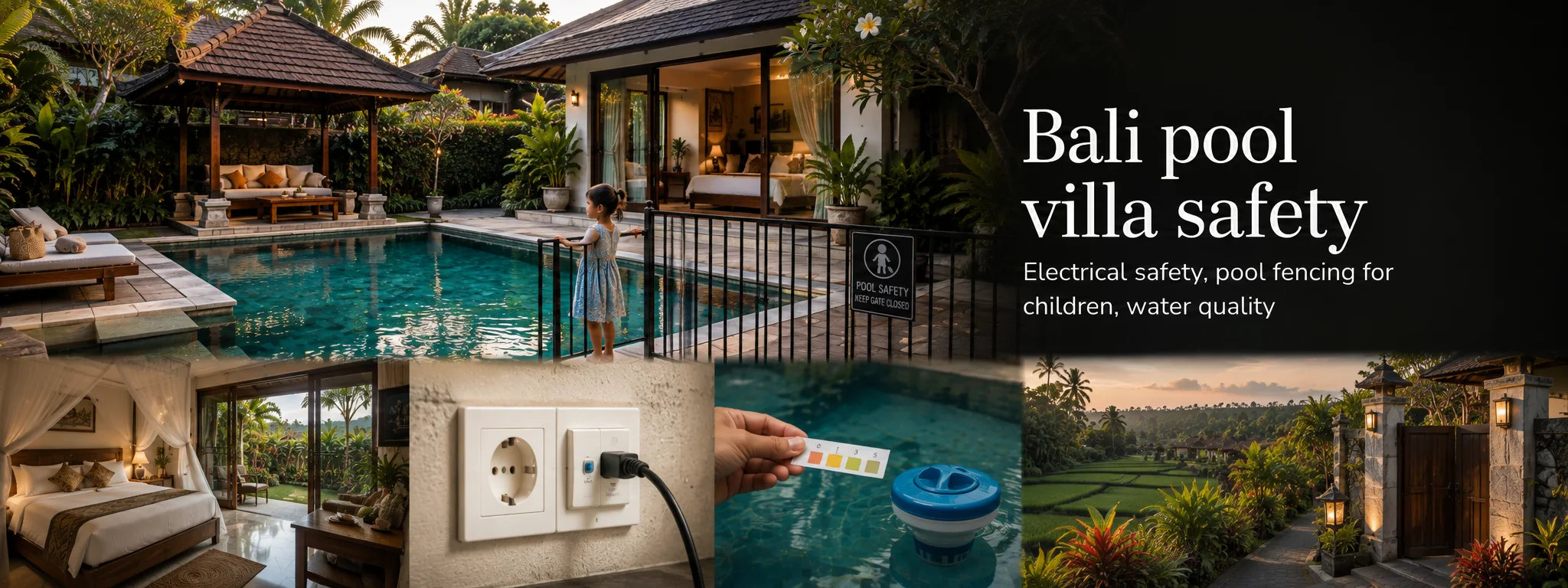
01 Private pool does not mean one safety standard
Bali villas range from compact modern homes with gated pools to open-plan compounds where the bedroom doors lead straight to the water. Do not assume the barrier, gate, depth marking, lighting or slip resistance will resemble an Australian residential pool. A beautiful booking photo can hide the exact safety detail that matters to a family with a toddler.
Before booking, look specifically at the route from sleeping areas to the pool. If the photos are vague, ask the property whether there is a physical barrier that a young child cannot independently open. “The pool is outside” is not an answer. For families with very young children, the ability to restrict unsupervised access should carry real weight in the accommodation choice.
02 Ask specific questions before booking
Ask whether the pool is fenced or gated, whether bedroom doors lock securely, whether there are shallow and deep zones, and whether steps or ledges are easy for a child to climb. If you are travelling with a non-swimmer, ask for current photos rather than relying on a wide-angle listing image taken years ago.
Also ask what happens at night. Some villas have open living rooms with no lockable separation from the pool. Others have bedrooms in separate pavilions, meaning children cross outdoor areas to reach parents. Neither layout is automatically unsafe, but you need to understand it before arrival so you can decide whether it works for your family.
03 Active supervision is the primary control
Royal Life Saving Australia’s core advice is simple: actively supervise children around water. For young children, that means an adult within arm’s reach, focused on the child and ready to enter the water. Drowning can happen quickly and silently; a group of adults nearby is not the same thing as one adult being responsible.
At villa lunches, birthday drinks and large-family holidays, nominate the supervisor rather than assuming somebody is watching. If that adult needs the bathroom or answers a call, explicitly hand the role to another adult. Older siblings should not be treated as the safety plan for younger children.
04 Do a two-minute arrival check before anyone swims
Before luggage and cocktails take over, walk the pool area. Test any gate and latch. Check that children cannot simply slide open a bedroom door. Move chairs, daybeds or pot plants that create easy climbing steps near a barrier. Find the pool steps and identify obvious depth changes, drains, broken tiles or sharp edges.
Check the lighting after dark as well. Pool edges that are obvious at midday can disappear visually at night. If something is genuinely unsafe — a faulty gate, exposed electrical fitting or damaged tile — report it to the manager immediately and keep people away from the hazard until it is fixed.
05 Night-time changes the risk
Private villas encourage late dinners, drinks and relaxed indoor-outdoor living. That is exactly when supervision can weaken and dark water becomes harder to see. Keep doors that provide pool access secured when adults are not actively using the outdoor area, particularly overnight and during naps.
Alcohol adds another layer of risk for adults as well as children. Do not swim alone when heavily affected by alcohol or drugs, and do not make the adult who has been drinking most the designated child supervisor. If the villa has a pool party atmosphere, decide supervision roles before the party starts.
06 Never assume a pool is deep enough to dive
Villa pools are designed in all shapes and depths, often without the clear depth signs you would expect at a public facility. A long infinity edge can look deep from a photograph while much of the pool is shallow. Do not dive unless the property clearly confirms that a designated area is designed and deep enough for diving.
Children also need a no-running, no-pushing rule around wet tiles. Stone decks, steps and polished surfaces can become extremely slippery after rain or sunscreen. A holiday pool does not become safer because it is small.
07 Floaties and pool toys are not safety devices
Inflatable rings, wings and novelty floats are fun, but they are not substitutes for active supervision or properly fitted lifejackets where a lifejacket is appropriate. Toys can also attract a child back to the pool after adults think swimming time is finished.
Royal Life Saving recommends removing pool toys from the water and storing them away when they are not being used. At a villa, that has another advantage: the pool is visually “closed” for the day, making it clearer to children that swimming only happens when an adult is actively supervising.
08 Look beyond drowning hazards
Pool areas combine water with electricity, glass, outdoor furniture and sometimes steep drops. Keep portable speakers, chargers and extension leads away from water unless the equipment is expressly designed and installed for that environment. During lightning or severe storms, get out of the water and follow local safety advice.
Infinity pools deserve a specific look at the far side. Some have a safe catch basin; others are built on slopes or elevated platforms where climbing over the visual edge could create a fall risk. Children should never play on infinity edges, overflow channels or decorative water features.
09 Know what you will do in an emergency
Save the villa’s exact address or map pin in every adult’s phone. Know how to contact the manager and how to open the front gate for emergency responders. Indonesia’s current emergency numbers include 118 for ambulance/rescue and 119 for medical emergencies, but response pathways can vary locally; your accommodation should also know the nearest appropriate clinic or hospital.
Parents and carers are strongly encouraged to know CPR. If somebody is unresponsive after a water incident, getting them out safely, calling for emergency help and starting appropriate resuscitation immediately can be critical. Do not delay urgent care while searching online for advice.
10 The booking and daily checklist
Before booking: verify the barrier and bedroom-to-pool layout. On arrival: test gates and locks, check depth and edges, remove climbable furniture and identify emergency contacts. Every swim: nominate the supervising adult and keep young children within arm’s reach. After swimming: remove toys and secure access.
None of this is meant to make a Bali villa holiday stressful. It is the opposite. A few deliberate checks let everyone relax without relying on luck. The best private pool is not merely the one that looks spectacular in photos; for a family, it is the one you can enjoy while keeping unsupervised access under control.