

You can travel through most of tourist Bali with English and a phone, but I still reckon learning a few Indonesian words is one of the cheapest upgrades you can make to the trip. You do not need fluency; you need enough language to greet people politely, confirm the important details and show that you are making an effort.
Bahasa Indonesia is the practical visitor language. Balinese is a separate local language with its own cultural context and social registers, so I would rather use a small amount respectfully than throw formal Balinese phrases into every transaction because a phrase list told me to.
01Three languages, roughly
The language picture is easier once you stop treating “Balinese” and “Indonesian” as the same thing. Bahasa Indonesia is the national language used in schools, government and media across the country and is the practical language most visitors will use; Balinese is a distinct local language used in family, community and cultural life, with different registers depending on context and relationship.
02How much English you'll actually encounter
In South Bali, Ubud and anywhere with meaningful tourism infrastructure, English is spoken well enough that language is rarely a real barrier — hospitality staff, drivers, and most shop and restaurant workers in these areas communicate comfortably. Head further into North, East or West Bali, or off the main tourist routes generally, and English becomes noticeably patchier, though basic transactions are still usually manageable with patience and gestures.
03A quick note on Balinese's social registers
Balinese traditionally uses different vocabulary levels depending on the relative social status of speaker and listener — a system that reflects the island's traditional caste-influenced social structure. This is a genuinely distinctive linguistic feature worth knowing about even if you're not learning the language yourself, since it shapes a lot of how Balinese people relate to each other day to day.
04A handful of useful Indonesian phrases
- Terima kasih — thank you
- Permisi — excuse me
- Berapa harganya? — how much is this? (genuinely useful at markets — see our shopping guide)
- Enak! — delicious! (a small phrase that goes a long way at a warung)
- Tidak, terima kasih — no, thank you (useful for politely declining touts)
05Practical tips
A few words of Indonesian, attempted sincerely, tend to land well and are genuinely appreciated even though they're not remotely necessary given how good English is in tourist areas. Translation apps handle anything more complex easily enough if you head somewhere more remote — see our maps & navigation guide for connectivity tips in those areas.
06 Indonesian and Balinese are different
My recommendation for visitors is simple: learn Indonesian first. Balinese, or Basa Bali, is a distinct local language, and many Balinese people move naturally between Balinese, Indonesian and English. A respectful Balinese greeting can be warmly received, but pronunciation and social level matter, so do not use the local language as a performance.
Learn Indonesian first. A respectful Balinese greeting can be warmly received, but pronunciation and social level matter.
07 Pronunciation
Indonesian spelling is consistent. C sounds like “ch”, j like English j, ng as in “singer”, and vowels stay clear. Calm intelligible speech matters more than performing an accent. If misunderstood, simplify rather than speaking English louder.
08 High-value polite words
- Terima kasih — thank you.
- Sama-sama — you’re welcome.
- Permisi — excuse me.
- Maaf — sorry.
- Tolong — please/help.
- Boleh? — may I?
- Bisa? — can/is it possible?
Pak and Bu are useful respectful forms of address for adult men and women.
09 Directions and transport
- Di mana…? — where is…?
- Kiri / kanan — left / right.
- Lurus — straight.
- Berhenti di sini — stop here.
- Tolong kirim lokasi — please send the location.
Drivers often use landmarks and pins. Save the destination name and telephone number.
10 Eating and dietary needs
- Saya mau… — I would like…
- Tidak pedas — not spicy.
- Air putih — plain water.
- Bungkus — take away.
- Enak — delicious.
- Minta bon — the bill, please.
For a severe allergy, carry a written translation explaining the ingredient and cross-contact risk.
11 Shopping
- Berapa harganya? — how much?
- Bisa kurang? — can it be less?
- Terlalu mahal — too expensive.
- Saya lihat-lihat saja — just looking.
- Tidak, terima kasih — no, thank you.
Bargaining belongs in some markets, not everywhere. Keep it friendly.
12 Greetings and time
Selamat pagi is good morning, selamat siang midday, selamat sore later afternoon and selamat malam evening. Useful time words include sekarang (now), nanti (later), besok (tomorrow), sudah (already) and belum (not yet).
13 A little Balinese
Om Swastiastu is a formal Balinese Hindu greeting. Suksma or matur suksma expresses thanks. Follow local usage rather than dropping formal phrases into every transaction.
14 When something is wrong
- Tolong! — help!
- Saya perlu dokter — I need a doctor.
- Saya tidak mengerti — I do not understand.
- Bisa ulangi? — repeat that?
- Pelan-pelan — slowly.
Save your address, insurance contact and medical information offline.
15 How to practise
Choose ten expressions and use them repeatedly rather than memorising fifty once. Begin politely, listen for numbers and directions, and accept correction cheerfully.
16 Numbers you will actually hear
Numbers are where a little Indonesian becomes immediately useful. Satu, dua, tiga, empat, lima are one through five; sepuluh is ten, seratus one hundred, seribu one thousand and juta one million. Rupiah prices get big quickly, so if I am unsure I would rather ask somebody to write the number or show a calculator than bluff my way through it.
Jam berapa? asks what time. For anything that matters — airport pickup, boat, tour or appointment — I confirm morning or evening and use the actual date as well as “tomorrow”. Language is there to reduce confusion, not create a more impressive version of it.
17 Translation apps and their limits
Download Indonesian for offline translation and keep important sentences in a note. Camera translation helps with menus and signs, but it can mishandle abbreviations, context and Balinese words. For medical, legal or immigration matters, use a qualified interpreter or official bilingual document where needed.
Let the other person read the translated sentence rather than attempting a long machine-generated paragraph. Short sentences, one question at a time and confirmation work best.
Most importantly, do not chase perfection. A friendly greeting, one clear request and a sincere thank you will usually take you further than an elaborate phrase delivered impatiently. I see language as a cooperation tool, not a test you have to pass before you are allowed to enjoy Bali.
18 Politeness does more than perfect grammar
Indonesian is relatively forgiving for beginners: verbs do not change for person or tense in the way many European languages do, and context carries a lot of meaning. A calm greeting, tolong (please/help), terima kasih (thank you) and maaf (sorry/excuse me) will usually take you further than a long sentence delivered impatiently.
Use Pak for an adult man and Bu for an adult woman when you want a respectful form of address. Avoid assuming that a friendly service interaction means first-name informality. Tone, patience and a smile matter, especially when neither person is using their first language.
19 Numbers and money are worth learning
Learn seribu (one thousand), sepuluh ribu (ten thousand), seratus ribu (one hundred thousand) and juta (million). Indonesian prices are often spoken without repeating rupiah, and informal speech may shorten thousands. When a price matters, type it into a calculator or phone and confirm the number before agreeing.
Useful questions include berapa harganya? (how much is it?), bisa pakai kartu? (can I use a card?) and ada uang kecil? (do you have small change?). Treat language as confirmation, not a reason to skip checking a receipt or menu.
20 Phrases for directions and problems
- Saya tersesat — I am lost.
- Tolong panggil ambulans — Please call an ambulance.
- Saya perlu dokter — I need a doctor.
- Di mana…? — Where is…?
- Kiri / kanan / lurus — Left / right / straight ahead.
- Saya tidak mengerti — I do not understand.
Download an offline Indonesian language pack and save your accommodation address in writing. Translation apps help, but a map pin, a typed destination and a few clear words are more reliable than speaking a long machine-translated paragraph beside a noisy road.
Cheers, Carpe Diem & Say Something, Smile & Have a Crack! 🍻⏳🗣️
your mildly Ocker language-learning correspondent
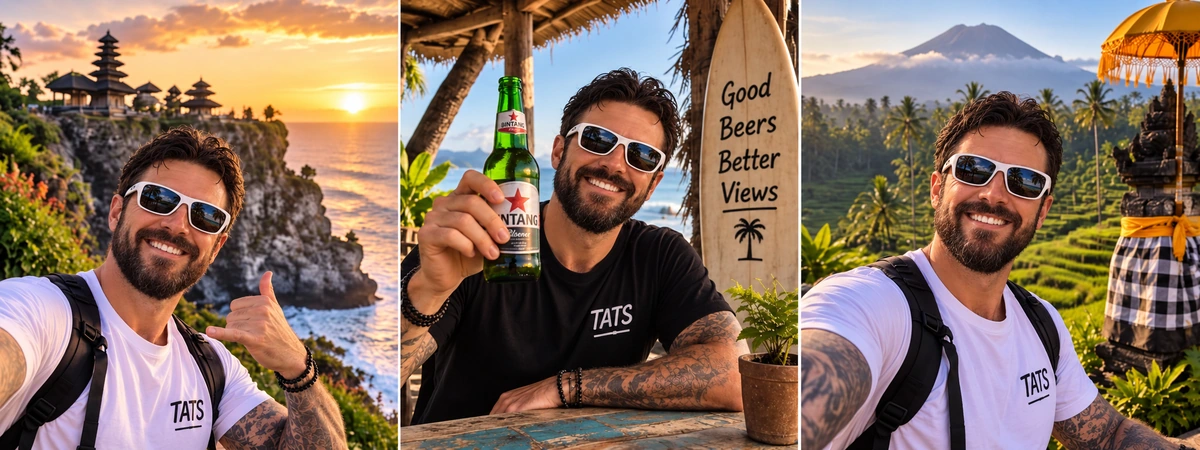
About the author
TATS Man
Travel journalist · digital nomad since 2007 · visiting Bali since 1989
TATS Man is the beer-loving cyborg travel journalist behind Totally Bali and TATS (Totally Awesome Travel Sites). He has travelled and worked remotely since 2007 and has been visiting Bali since 1989. His guides combine long-term destination familiarity with current primary-source research — and he does not claim first-hand experience where he does not have it.