
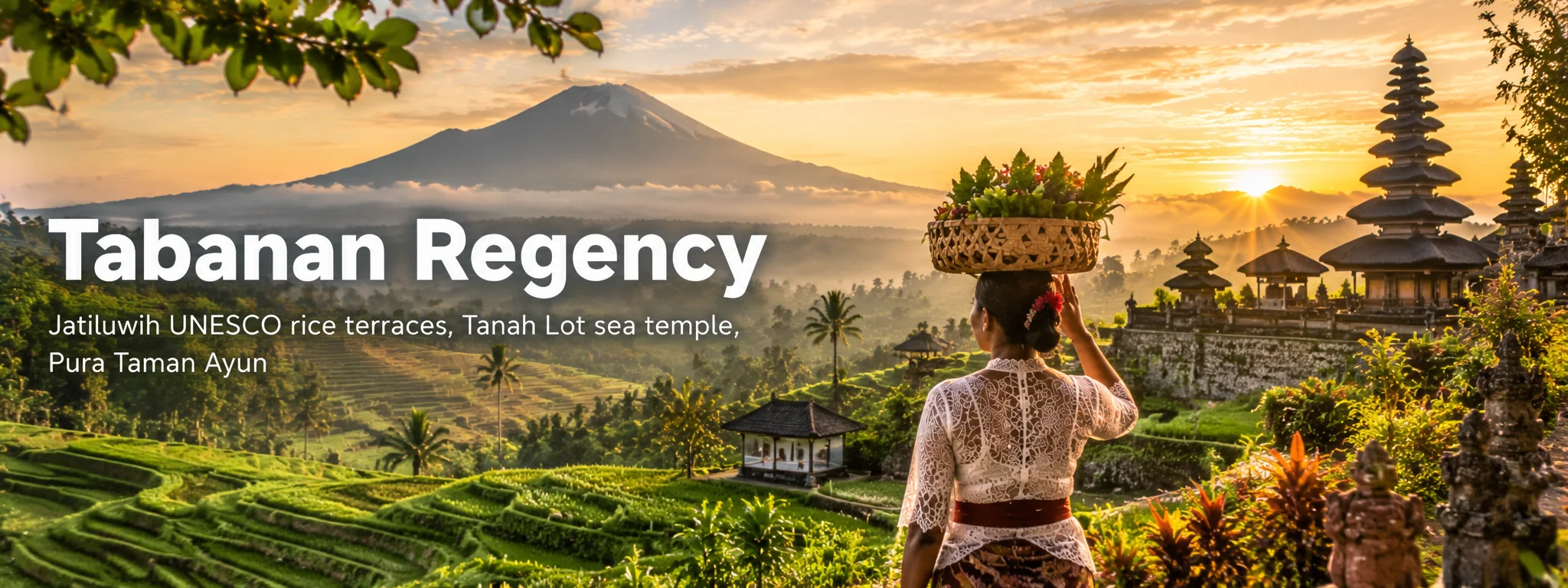
01 What Tabanan actually covers
Tabanan is one of Bali’s largest and most varied regencies, running from the busy south-west coast deep into mountain country. It includes famous names that travellers often think of as separate destinations: Tanah Lot, Jatiluwih, Mount Batukaru and Lake Beratan all sit within Tabanan.
That scale is why “doing Tabanan” in one day is not realistic. The coast, rice terraces and highlands are different travel zones with winding roads between them. Think of Tabanan as a region to build routes through, not a single attraction to tick off.
Administrative boundaries are easy to blur because popular travel names cross regencies. Taman Ayun, for example, is nearby in Badung rather than Tabanan, while Bedugul is used loosely for a wider highland area. Checking the actual location helps you avoid building a day that zigzags across mountains because three places were all described online as ‘near Ubud’ or ‘near Bedugul’.
02 Tanah Lot and the south-west coast
Tanah Lot is Tabanan’s biggest visitor magnet, famous for its offshore temple silhouette and sunset setting. The surrounding south-west coast also has surf beaches, rice-country villages and rapidly changing pockets of development.
The farther you move from the main Tanah Lot corridor, the more rural the landscape becomes. This is useful territory for travellers who like being near Canggu or Seminyak but want to see the island transition into working farmland rather than staying inside the southern urban strip.
03 Jatiluwih and the UNESCO subak landscape
Jatiluwih is the region’s defining inland landscape: broad rice terraces climbing through the foothills of Mount Batukaru. It forms part of UNESCO’s Cultural Landscape of Bali Province, recognised not simply for pretty terraces but for the living subak system of water management, temples, farmers and ritual life.
UNESCO’s listing covers five representative landscapes across Bali. In Tabanan, the Catur Angga Batukaru landscape demonstrates the long relationship between irrigation, religion and agriculture. Walk the fields rather than just photographing them from a restaurant terrace; the whole point is understanding the landscape as a working system.
04 Mount Batukaru and Pura Luhur Batukaru
Mount Batukaru anchors Tabanan’s cooler interior. Forest, cloud and steep agricultural land give this part of the regency a completely different atmosphere from the coast. Pura Luhur Batukaru, on the mountain’s slopes, is one of Bali’s important temples and feels especially atmospheric in misty weather.
This is not a place to rush between photo stops. Roads are slower, rain is more common and the appeal is largely the combination of forest, farms and sacred landscape. Jatiluwih and Batukaru make a natural pair if you start early.
05 Bedugul and Lake Beratan are also Tabanan
Many travellers use Bedugul as a general highland label and forget that the Lake Beratan side lies in Tabanan Regency. The cool climate, vegetable farming, botanical gardens and lake scenery are among the island’s most familiar upland experiences.
Pura Ulun Danu Beratan is the visual headline, but the bigger reason to include Bedugul is climate and landscape. Temperatures can feel dramatically cooler than South Bali, clouds arrive quickly and rain gear is sensible even when the coast is sunny.
06 Pupuan and the quieter western hills
West of the major Jatiluwih and Bedugul routes, Tabanan becomes much less visited. The Pupuan area is known for rolling plantation country, rice fields and long cross-island roads rather than one blockbuster attraction.
This is better suited to repeat visitors, road-trippers and travellers staying in rural accommodation. Distances look small on a map but mountain roads, village traffic and frequent stops make progress slow. The reward is a version of Bali where agriculture still dominates the view.
07 Should you stay in Tabanan?
Yes if your trip benefits from space, cooler air or rural scenery. Jatiluwih-area stays suit walkers and photographers, the Batukaru foothills suit quiet retreats, while the coast works for surfers and travellers who want sunset without staying in central Canggu.
No if your priorities are nightlife, dense restaurant choice or fast access to South Bali attractions every day. Tabanan is at its best when you stop treating travel time as dead time and accept that the region itself is the experience.
08 Build Tabanan routes geographically
A strong day might be Jatiluwih + Batukaru, or Bedugul + Lake Beratan + nearby highlands, or Tanah Lot + south-west coast. Trying to combine all three zones usually creates too much driving.
If you are travelling onward to North or West Bali, Tabanan is excellent connective territory. Use our Bali regions guide to see how the regency sits between the southern tourism belt, Buleleng and Bali’s western interior.
09 Weather changes quickly from coast to highlands
The coast can be hot and bright while Batukaru or Bedugul is cool, wet and foggy on the same day. Pack for both. Mountain cloud often builds later, so early starts improve your chances of clear terrace and lake views.
Rain also affects walking tracks and rice-field paths. The terraces remain beautiful in wet conditions, but slippery paths and low cloud change the experience. Do not judge a Tabanan day solely by a South Bali weather app.
10 Agriculture is not background scenery here
Tabanan makes more sense when you see farming as part of the destination rather than decoration between attractions. Rice, vegetables, plantations, irrigation channels and temple networks still shape the region’s roads and settlements.
That is also why responsible behaviour matters around terraces. Stay on marked paths, do not trample crops for photographs and spend locally where possible. Tabanan’s most impressive landscapes are living workplaces, not open-air film sets.
Food also reflects that agricultural base. Around the highlands you will see vegetables, coffee, cacao, fruit and rice moving through local markets and roadside stalls. A simple lunch in a village often fits a Tabanan day better than driving back toward a tourism centre just to eat somewhere famous.
For travellers with more time, Tabanan is also a good region to slow down for two nights rather than treating it as a transit corridor. Staying near Jatiluwih or Batukaru lets you walk early, watch weather move across the fields and experience the landscape after day-trip traffic has gone.