
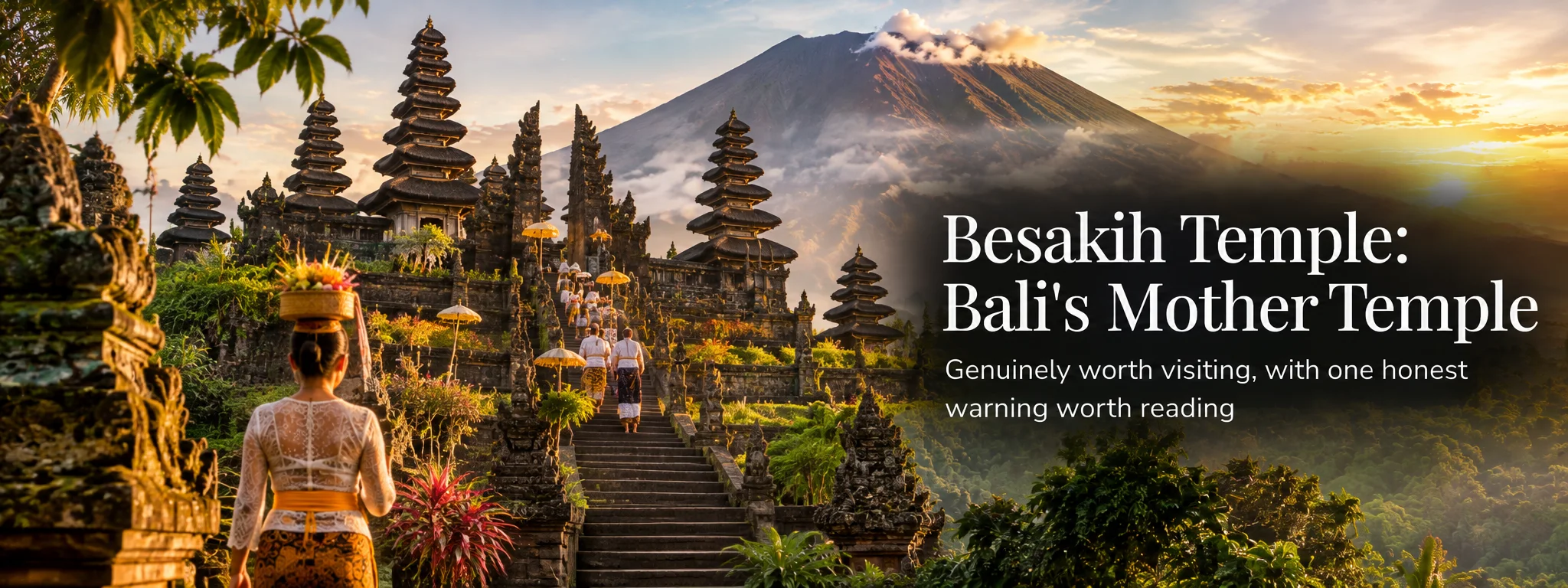
Besakih is not one temple building waiting for a clean photograph. It is a large, active sacred complex on Mount Agung, and the visit makes much more sense when you arrive expecting worship, layers of courtyards and changing ceremonial access.
I would put religious context ahead of the “Mother Temple” headline. The most useful preparation is knowing what visitors may access, how to dress and when to get out of the way of people who are there to worship.
01 Why Besakih matters
Besakih is often called Bali’s Mother Temple because it is a major centre of Balinese Hindu worship and one of the island’s most important sacred landscapes. Indonesia’s tourism ministry describes the complex as consisting of 18 temples, each with its own role and history, arranged on the slopes of Mount Agung.
The scale matters, but the living religious role matters more. I try not to describe Besakih like an abandoned monument with worship added later.
That scale is the first thing to understand. Besakih is not one courtyard with one famous gate. It is a living religious complex where ceremonies, family groups, offerings and temple activity can be more important than tourism on any given day. Visit with the mindset that you are entering an active sacred place, not a historical monument that exists mainly for visitors.
02 What you actually see
The visual centre for many visitors is Pura Penataran Agung, the large stepped complex of courtyards, gates and multi-tiered meru shrines. From different levels you get changing views across temple roofs, Mount Agung’s lower slopes and, in clear conditions, the landscape below.
Not every temple area is open to every visitor. Access can depend on religious role, ceremony and local direction. Do not treat a rope, closed gate or instruction as an inconvenience to work around for a photograph. If your guide or temple staff says an area is reserved for worshippers, that is the end of the question.
03 Architecture, courtyards and Mount Agung
Besakih’s architecture is easier to appreciate when you notice the repeated progression of gates, courtyards and meru towers rather than searching for one hero structure. The complex climbs with the mountain, so the experience is partly about movement upward through a sacred landscape.
Mount Agung is more than a backdrop. In Balinese Hindu cosmology the mountain is profoundly significant, and Besakih’s position on its slopes helps explain why the complex carries such weight. Even when cloud hides the summit, the relationship between temple and mountain remains central.
04 Ceremonies can completely change the visit
Besakih’s importance means major ceremonies can bring thousands of worshippers to the complex. That can make the site more crowded, alter traffic and parking, change which courtyards visitors can enter and create a much more powerful cultural experience than an ordinary quiet day.
A ceremony changing your route is not the attraction malfunctioning. It is evidence that the complex is still doing the job it exists to do.
If you arrive during a ceremony, give worshippers space. Do not block processions, step over offerings or position yourself directly in front of people praying. Photography should become secondary. Our Bali etiquette guide and temple guide cover the basic behaviour that applies across the island.
05 Temple dress: sarong, sash and modest clothing
Wear clothing that covers shoulders and knees and follow the current sarong and sash requirements at the entrance. Visitor systems have changed over time, so use what is supplied or directed on the day rather than relying on a ten-year-old travel forum describing a different setup.
A sarong is not a costume for a photo. Wear it securely, keep your shirt on and avoid dramatic poses in front of active shrines. If you are visiting several temples, carrying your own simple sarong is convenient; our Bali sarong guide explains buying, wearing and borrowing without overcomplicating it.
06 Tickets, visitor transport and guides
Besakih has a formal visitor system, but ticket inclusions, shuttle arrangements and guiding details can be revised. Check the official entrance information when you arrive and make sure you understand what is included before paying for anything extra. Keep the ticket until you leave.
I want the current official visitor arrangement, not a stranger’s old argument about what used to be included. Confirm what the ticket covers on the day.
A good local guide can add real value here because the complex is large and the religious structure is not obvious to a first-time visitor. What you want is interpretation, orientation and help understanding where visitors may go — not pressure to purchase unrelated services. Clarify the scope before starting.
07 Mount Agung weather and timing
The mountain setting means weather can change quickly. Clear early conditions can become cloud, mist or rain, and the temperature can feel noticeably cooler than the coast. A cloudy Besakih visit is not a failure: mist around the meru roofs can be atmospheric, and the architecture remains impressive without a postcard-perfect volcano.
Bring water, sun protection and a light rain layer. The site involves walking and steps, so footwear matters. If you are travelling with older relatives or someone with limited mobility, allow extra time and ask the entrance staff what transport assistance and shortest practical route are available that day.
08 Photography without being a nuisance
Besakih rewards wide architectural photographs, details of carved gates, rooflines and the relationship between temple and mountain. You do not need to walk into a worship area to make a good image. Long lenses are useful for isolating details while keeping respectful distance.
My camera rule is boring and useful: worshippers get priority, barriers mean no, and a better angle is never worth becoming the nuisance.
Never climb onto temple structures, sit on shrines or ask worshippers to move offerings. Drone use around sacred sites is a separate permission question, not something to assume is allowed because the airspace looks open. When in doubt, leave the drone packed.
09 How to fit Besakih into East Bali
Besakih works best as part of an East Bali or mountain itinerary rather than a return dash from the beach districts. Sidemen is a natural base or companion stop, while Tirta Gangga, Taman Ujung and the broader Karangasem region can be combined on a longer route without crossing the island repeatedly.
Use our East Bali guide and Karangasem guide to build a regional plan. Trying to add Besakih, Lempuyang, Tirta Gangga, Amed and Ubud into one day is technically ambitious and practically miserable.
10 Is Besakih worth it?
Yes, if you are interested in Balinese Hinduism, architecture, ceremony or the relationship between sacred places and landscape. The scale and religious importance are different from compact tourist favourites such as Tanah Lot or Tirta Empul.
It may be less rewarding if you only want a single famous gate for a quick photograph. In that case you will spend a lot of road time for the wrong reason. Besakih becomes much more interesting once you stop treating it as one attraction and see it as a functioning sacred complex.
11 The one rule to carry with you
At Besakih, religious life outranks your itinerary. Dress properly, follow local direction, accept that access can change and give ceremonies the space they require. That attitude makes the visit easier for everyone.
The bonus is that when you slow down, you notice much more: the sequence of courtyards, families moving through the complex, clouds on Mount Agung and the extraordinary scale of the place.
TATS Man bottom line: Besakih is worth the trip when you treat it as Bali’s major living temple complex rather than a mountain photo stop. Go with enough time, current visitor information and a willingness to let ceremonies and sacred-space rules shape the visit.
Cheers, Carpe Diem & Give the Mother Temple Some Respect! 🍻⏳🛕
your courtyard-counting, worshipper-yielding Besakih cyborg
About the author
TATS Man
Travel journalist · digital nomad since 2007 · visiting Bali since 1989
TATS Man is the beer-loving cyborg travel journalist behind Totally Bali and TATS (Totally Awesome Travel Sites). He has travelled and worked remotely since 2007 and has been visiting Bali since 1989. His guides combine long-term destination familiarity with current primary-source research — and he does not claim first-hand experience where he does not have it.