
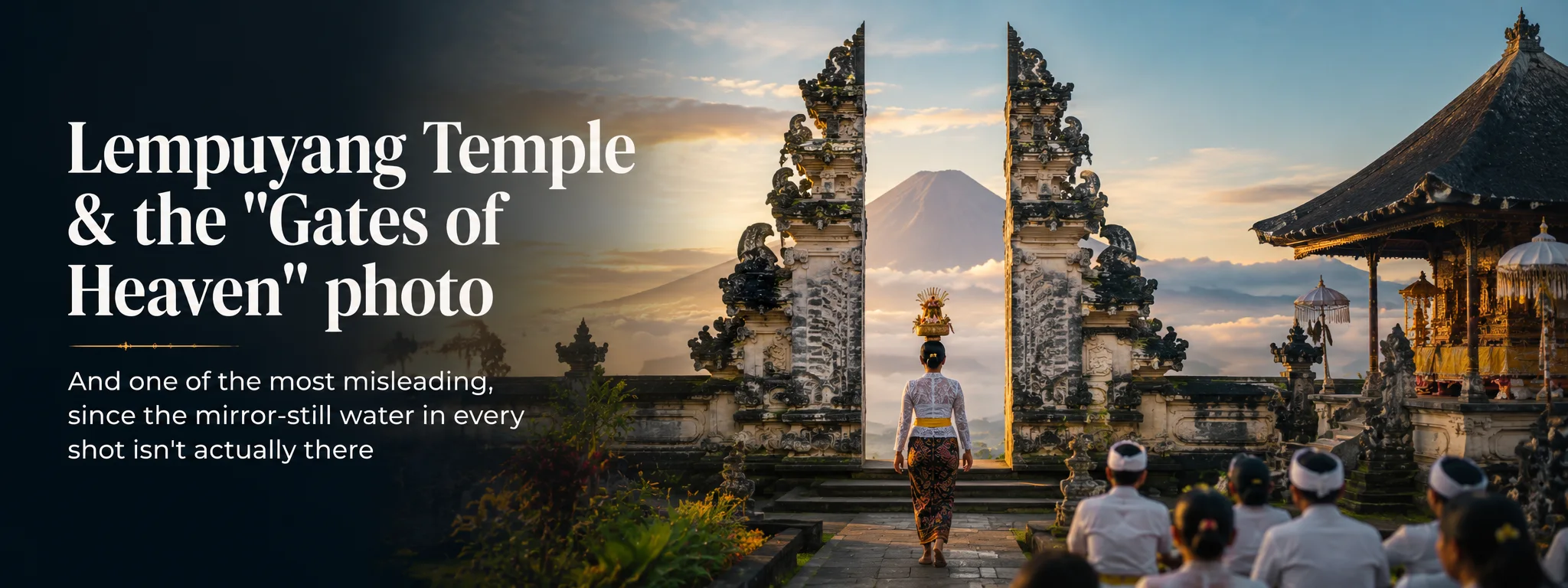
Lempuyang is one of Bali's clearest examples of a real sacred place being reduced online to one famous photograph. The split gate is photogenic; the temple complex, mountain setting, worship and practical queue are the actual visit.
I would go only if the temple itself and an East Bali route interest me. If the sole goal is the reflected 'Gates of Heaven' photo, it is worth understanding the queue and the camera trick before donating half a day to it.
01 The Gates of Heaven photo — and what it is not
Lempuyang became globally famous for the split-gate photograph framing Mount Agung. The image is beautiful when the mountain is visible, but the reflective “water” effect seen online is commonly created with a small mirror under the camera rather than a pool in front of the gate. Knowing that removes one of the most persistent sources of visitor confusion.
The reflection effect is clever photography, not a secret infinity pool. Knowing that beforehand makes it easier to judge whether the queue is worth your time.
The gate itself is real, the mountain is real and the temple setting is culturally important. The problem comes only when the entire visit is reduced to one optical trick. If you want the photograph, enjoy it. Then look around and remember where you actually are.
02 A sacred complex, not one Instagram set
Pura Lempuyang is part of a larger sacred complex on the slopes of Mount Lempuyang in East Bali. The lower temple visited by most tourists is only one part of that religious landscape. Pilgrims may continue much farther uphill through multiple temples, while ordinary visitors often spend most of their time around the first major courtyard and gate.
Treat worshippers as the primary users of the site. Ceremonies can change access, pause photography or make some areas inappropriate for sightseeing. If a section is closed or staff ask visitors to wait, that is not a service failure; it is a reminder that the temple exists for religious life first.
03 The photo queue can dominate your visit
At busy times, the numbered queue for the split-gate photo can take a long time. This is the biggest practical issue at Lempuyang and the reason opinions about the attraction vary so wildly. One traveller arrives early with clear Mount Agung views and waits briefly; another arrives later, gets cloud and spends a large part of the day waiting for a few seconds at the gate.
A long photo queue can become the whole day if you let it. I would set my own limit and remember there is an actual temple complex around the camera line.
Decide beforehand how important the photo is to you. If it is the main goal, start early and build time into the itinerary. If it is merely a bonus, set a personal limit: if the wait is excessive, explore the temple and continue your East Bali day instead.
04 Shuttle and access logistics
Visitor transport arrangements around Lempuyang have changed over time as local management has tried to control traffic on the steep approach roads. Expect to follow the current parking and shuttle system rather than assuming a private driver can always take you directly to the temple entrance. Listen to staff on arrival and keep small cash available for local arrangements if required.
This is another reason to avoid scheduling the day too tightly. Parking, shuttle transfer, ticketing, temple dress and the photo queue all add time before you have actually explored. A realistic East Bali plan leaves generous margins.
05 Temple dress and behaviour
Wear clothing that covers shoulders and legs appropriately, and use the sarong or sash required by the temple’s current visitor rules. Even when garments are available locally, arriving already dressed respectfully makes the process easier. Avoid revealing outfits designed solely for the photograph; you are in a place of worship.
This is a temple visit before it is a photo stop. I follow the dress and behaviour rules as religious rules, not as props for the image.
Do not climb temple structures, step over offerings or pose in ways that mock religious gestures. Keep voices down around worshippers and follow restrictions on inner courtyards. Our Bali sarong guide explains the practical basics if temple clothing is unfamiliar.
06 Mount Agung is not guaranteed to appear
The classic image depends on Mount Agung being visible through the gate. It often is not. Cloud forms around Bali’s highest volcano quickly, especially later in the day and during wetter periods. An early arrival improves your odds but cannot guarantee a clear mountain.
Do not let cloud turn the entire temple into a disappointment. The stonework, mountain setting, ceremonies and views across East Bali still give the visit context. If your only acceptable outcome is a crystal-clear Agung photograph, you are handing the weather too much power over your day.
07 Should you climb to the upper temples?
The full Lempuyang pilgrimage is a very different undertaking from the lower-temple photo stop. It involves a substantial uphill journey with many steps and should be approached with appropriate fitness, time and respect. Do not tack it onto a packed sightseeing day because somebody online called the complex “seven temples” and made the route sound casual.
If you genuinely want the full religious and hiking experience, research the current access arrangements locally and dedicate the time it deserves. Most tourists are better served by visiting the lower complex properly and then exploring other parts of Karangasem.
08 Build Lempuyang into an East Bali route
Lempuyang combines naturally with Tirta Gangga, Amlapura, Amed or other East Bali stops. The key is not to overfill the day. If your Lempuyang photo queue runs long, you should be able to drop a minor stop without wrecking the schedule.
Lempuyang makes far more sense beside Tirta Gangga, Amed or another East Bali stop than as a heroic return run from the south.
A driver familiar with Karangasem is useful because the distances look short on a map but mountain roads, village traffic and attraction logistics add time. Staying in Amed, Candidasa or Sidemen makes the temple far easier to visit than doing a rushed return trip from the south.
09 Is Lempuyang worth it?
It is worth it for travellers who want the iconic gate and understand the queue and temple context. It can also be rewarding for culturally curious visitors who ignore the social-media pressure and spend time observing the complex. It is less appealing if you hate queues, staged photography or very early starts.
If the gate is your only reason for going and the queue is enormous, skipping the photo may be the best decision you make all day. East Bali has water palaces, coastlines, villages and mountain scenery that deserve more than the leftovers of an exhausted itinerary.
10 The best Lempuyang visit is the least entitled one
Arrive with flexible expectations: the mountain may be cloudy, a ceremony may alter access, the shuttle may take time and the photo queue may be longer than you hoped. None of those things means the temple owes you a better outcome. You are a guest at an active sacred site.
That mindset improves the experience immediately. Take the photo if it works, dress properly, follow local instructions and leave enough time to notice the place beyond the frame. Lempuyang is much easier to appreciate when you stop treating the gate as the entire destination.
TATS Man bottom line: Lempuyang can be rewarding when the temple and East Bali context matter to you. If all you want is the gate photograph, understand the queue, the reflection trick and the travel time before deciding it deserves the day.
Cheers, Carpe Diem & Look Beyond the Famous Gate! 🍻⏳🛕
your queue-aware, temple-first East Bali cyborg
About the author
TATS Man
Travel journalist · digital nomad since 2007 · visiting Bali since 1989
TATS Man is the beer-loving cyborg travel journalist behind Totally Bali and TATS (Totally Awesome Travel Sites). He has travelled and worked remotely since 2007 and has been visiting Bali since 1989. His guides combine long-term destination familiarity with current primary-source research — and he does not claim first-hand experience where he does not have it.