
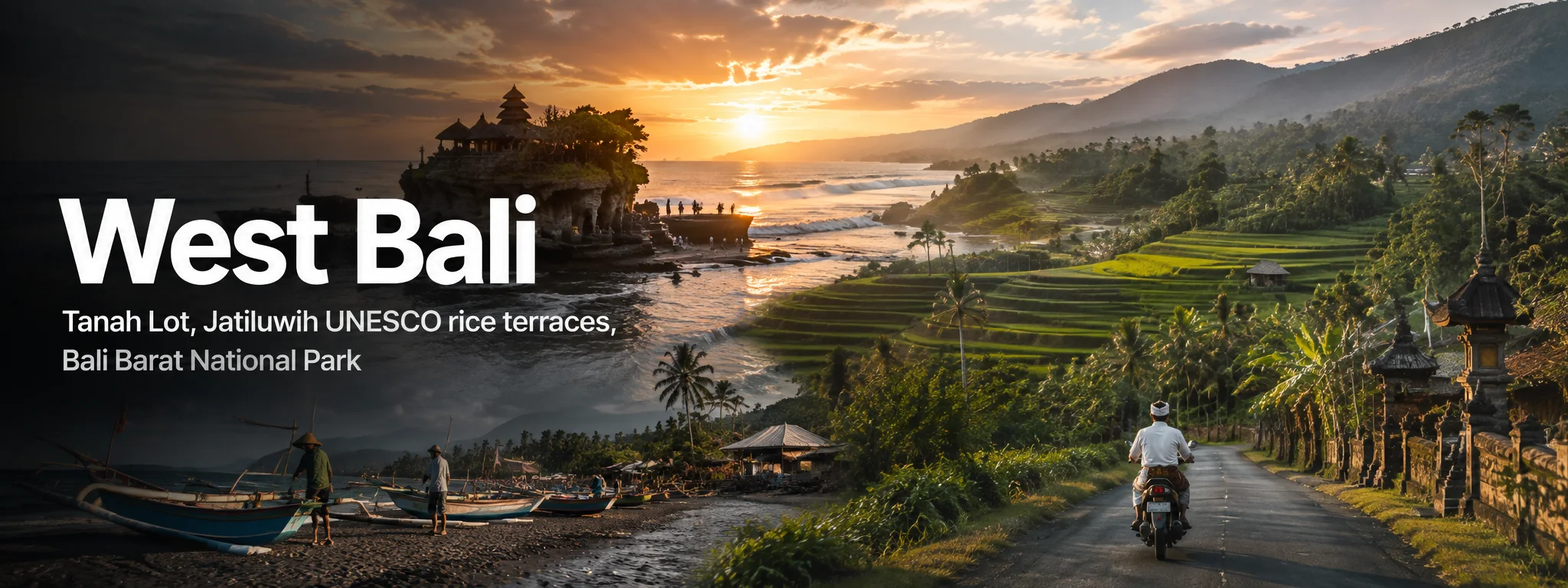
West Bali is what happens when the island stops behaving like one neat holiday destination. Tanah Lot, Jatiluwih, Medewi, Jembrana, Gilimanuk and the national park all sit in “the west”, but they are not one convenient sightseeing loop.
I would plan this part of Bali by zones and reasons for going: rice landscapes, surf, regional culture, national-park wildlife or the Java crossing. The farther west you go, the more overnight stays beat heroic return drives.
01 West Bali is not one destination
For trip planning, West Bali is best understood as a long corridor of very different places rather than one destination. The near-west begins in Tabanan, where Tanah Lot and the rice-growing interior can be reached on day trips from South Bali or Ubud. Continue west and the landscape becomes quieter around Balian, Medewi and the Jembrana coast. At the far end are Negara, Gilimanuk and the southern approaches to West Bali National Park.
My mental map splits the west before I plan a single stop. Near-west Tabanan, the south-west coast/Jembrana and the far west each deserve different timing.
The north-west adds another wrinkle. West Bali National Park crosses both Jembrana and Buleleng regencies, while the easiest visitor base for Menjangan Island is usually Pemuteran on the north coast. So a traveller’s “West Bali” often spills beyond the neat Tabanan–Jembrana boundary used on maps.
That geography matters because an itinerary that works for Tanah Lot does not work for Gilimanuk. The biggest mistake is treating everything west of Canggu as a single day-trip loop.
02 Think in three travel zones
The easiest way to plan the region is in three zones. Tabanan is the most accessible: Tanah Lot, Taman Ayun on the eastern edge, Jatiluwih, Batukaru and rural mountain roads. Jembrana is the long south-west coast: Medewi, Rambut Siwi, Negara, Makepung country, Pengambengan and Gilimanuk. The north-west national-park corridor wraps around Cekik, Labuan Lalang, Menjangan and Pemuteran.
The zone matters more than the label “West Bali”. A day that works beautifully for Tanah Lot and Jatiluwih is not a sensible template for Menjangan or Gilimanuk.
You can combine parts of those zones, but not all of them comfortably in one day. If you have one free day from Seminyak or Ubud, stay in Tabanan. If you want Medewi, give the west coast at least one night. If Menjangan diving, birdlife or the national park is the priority, treat the far north-west as a separate stay.
03 Tanah Lot is West Bali — but it is not the quiet West Bali
Tanah Lot is the most obvious contradiction in the “untouristed west” stereotype. The sea-temple complex is one of Bali’s headline attractions and can be extremely busy around sunset. It belongs geographically in Tabanan, but its visitor experience has little in common with the empty stretches of Jembrana coast farther west.
That makes southern Tabanan useful as a transition zone. You can pair Tanah Lot with quieter beaches, village roads or an overnight farther inland rather than assuming West Bali automatically means solitude. If avoiding crowds is your goal, arrive away from the sunset peak and continue deeper into Tabanan instead of judging the whole region by Beraban.
04 Jatiluwih and the mountain interior: the strongest first West Bali trip
For many first-time visitors, Jatiluwih is the best reason to spend a full day in western Bali. The terraces are part of UNESCO’s Cultural Landscape of Bali Province: the Subak System as a Manifestation of the Tri Hita Karana Philosophy. Jatiluwih is an important component of that World Heritage property; it is not technically a stand-alone UNESCO site.
Jatiluwih is the strongest first taste of the west for many travellers because the landscape rewards time on foot, not just a viewpoint stop.
The surrounding Penebel and Batukaru area is also where West Bali begins to feel substantially different from the southern resort belt: cooler roads, working rice landscapes, temples and scattered village accommodation. Our subak guide explains what you are actually looking at beyond the green-terrace photograph.
There is a current conservation reason to visit thoughtfully. UNESCO’s 2025 review raised concern about tourism and development pressure in the Jatiluwih area. Stay on designated routes, do not trample planted fields for photographs, and remember that the terraces are an agricultural system first and an attraction second.
05 Medewi and the south-west coast: slow travel rather than a sightseeing circuit
West of Tabanan the coastal road becomes the spine of the trip. Medewi is the most established visitor base in Jembrana, largely because of its long left-hand surf break and small surf-stay economy. It is a better overnight stop than a rushed detour if surfing is your reason for coming.
Medewi makes more sense to me as a place to stay and settle into the coast than as a quick surf-photo detour on a long drive.
Our updated Medewi surf guide covers the wave in more detail. Non-surfers should come for a slower coastal atmosphere rather than a long list of attractions. The beaches are often dark-sand or rocky, the villages are working communities, and the appeal is the change of pace.
Continue west and you pass Rambut Siwi, fishing settlements and agricultural country before reaching Negara. This is where the old claim that West Bali has “little accommodation” becomes misleading. There are places to stay, but they are scattered and purpose-specific rather than concentrated in one resort strip.
06 Jembrana: Makepung, Negara and a genuinely mixed western Bali
Jembrana Regency deserves more than being described as a road to Java. Negara is a functional regional centre, Medewi has a real surf scene, the coast supports major fishing activity, and Makepung buffalo racing is one of Bali’s most distinctive regional traditions.
Jembrana is also culturally more diverse than many resort-area summaries suggest. It has a substantial Muslim population, particularly in parts of Negara and Melaya, alongside Hindu, Christian and other communities. That diversity is real — but calling the regency “predominantly Muslim” is simply wrong. Current Jembrana government data shows a clear Hindu majority.
If your interest is local culture rather than headline attractions, Jembrana can be more rewarding with time: Makepung events, Blimbingsari’s Balinese Christian history, Bunut Bolong, the Gilimanuk archaeological museum and the working fishing coast around Pengambengan and Perancak all make more sense when you are not racing a day-trip clock.
07 Gilimanuk, West Bali National Park and Menjangan: plan this as the far west
West Bali National Park is Bali’s only national park and spans land and sea across both Jembrana and Buleleng. Its visitor geography is confusing if you look only at regency borders: the park headquarters is near Cekik/Gilimanuk, while boats for Menjangan Island commonly depart from Labuan Lalang on the north-coast side.
The national park and Menjangan are far enough from South Bali that I treat them as their own travel chapter. Staying nearby is part of the plan, not a luxury add-on.
Menjangan is primarily famous for diving and snorkelling, while the park itself protects dry forest, savanna, mangroves, marine habitat and the Bali starling. If the underwater side is your priority, Pemuteran is normally the more convenient base. If you are arriving from Java, Gilimanuk is the obvious gateway.
Do not plan the national park as a quick add-on after Tanah Lot. Indonesia’s tourism authority estimates roughly four to five hours by road from Denpasar to the park area in normal planning terms, and real travel times can move sharply with traffic, weather and ferry-related congestion.
08 Where to stay: match the base to the reason you came
Choose the Jatiluwih/Penebel area if rice landscapes, Batukaru and mountain roads are the point. Choose Medewi for surfing and a slower south-west coast stay. Choose Negara or nearby Jembrana if you are exploring local culture, Makepung or the fishing coast. Choose Pemuteran for Menjangan, reef time and north-west national-park access.
Staying in South Bali and driving west each day wastes the strongest part of the experience. One overnight dramatically changes what is practical, and two or three nights lets you combine coast, culture and national-park activities without spending half the trip in a vehicle.
09 Driving reality: the west is long, and the main road is a logistics route
The Denpasar–Gilimanuk road is not a scenic tourist lane all the way west. It is a major logistics corridor connecting Bali with the Ketapang–Gilimanuk ferry, so trucks, buses, village traffic and bottlenecks are part of the journey. During major holiday movements or ferry disruption, queues can become severe.
The west-coast road carries real regional and freight traffic. I budget time conservatively and do not build tight boat, ferry or flight connections around an optimistic map.
If you are self-driving, allow more margin than the map suggests and avoid building an itinerary around exact arrival minutes. If you are using a driver, the long distances can make an overnight cheaper in energy even when it is not cheaper in rupiah. Our Bali transport guide covers the broader driving and driver options.
Travelling onward to Java adds another variable: ferry operations can be adjusted for weather and, around Nyepi, suspended for the island-wide shutdown. Treat the ferry as transport infrastructure, not a guaranteed clockwork connection.
10 Who West Bali suits — and a realistic first itinerary
West Bali suits travellers who want landscapes, surfing, road-trip variety, diving, birdlife or regional culture more than nightlife and dense restaurant choice. It is also one of the easiest ways to add a very different Bali experience without leaving the island.
For a first taste, spend a day around Jatiluwih and Batukaru. With two nights, add Medewi or Jembrana. With three or four nights, continue to Pemuteran and Menjangan rather than trying to drive back and forth from the south.
Bottom line: the west is not “empty Bali”. It is a chain of working regions with very different levels of tourism. Plan by distance and purpose, and it becomes one of the island’s strongest slow-travel routes.
TATS Man bottom line: West Bali rewards travellers who respect its scale. Pick a zone, give it enough time and stay overnight when the distance says you should. The west gets better as the itinerary gets less ambitious.
Cheers, Carpe Diem & Keep Driving Past the Obvious Bit! 🍻⏳🚗
your westbound, itinerary-uncluttering road-trip cyborg

About the author
TATS Man
Travel journalist · digital nomad since 2007 · visiting Bali since 1989
TATS Man is the beer-loving cyborg travel journalist behind Totally Bali and TATS (Totally Awesome Travel Sites). He has travelled and worked remotely since 2007 and has been visiting Bali since 1989. His guides combine long-term destination familiarity with current primary-source research — and he does not claim first-hand experience where he does not have it.