
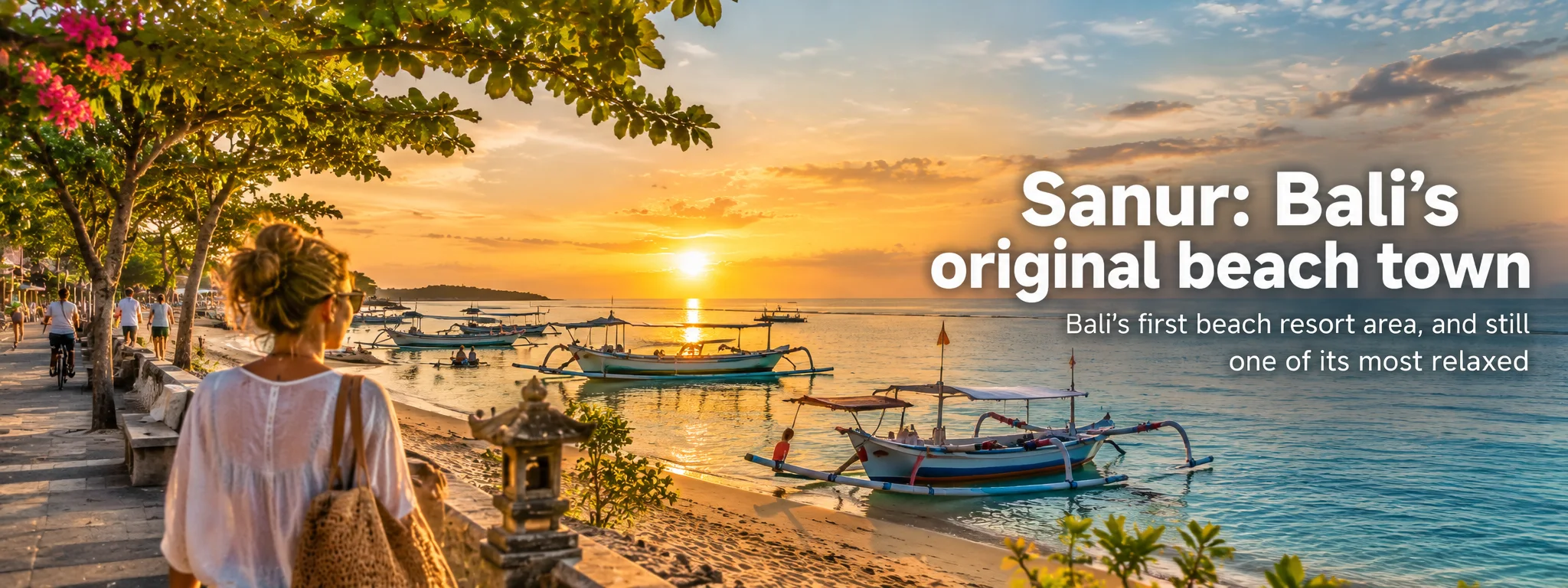
Sanur is the Bali base I would choose when ease matters more than bragging rights. The beach is calmer-feeling, the waterfront path is genuinely useful, evenings are civilised and the Nusa boats are right there when island-hopping is part of the plan.
That does not make Sanur boring; it makes it practical. Families, older travellers, first-timers and anyone who values walking to breakfast without negotiating a nightclub queue can get a lot out of staying here.
01 Sanur is a long coastal strip, not one compact centre
The visitor area stretches for kilometres along South Denpasar's east coast. The useful mental model is north Sanur around the harbour/Hang Tuah side, central Sanur around Jalan Danau Tamblingan and the main hotel/restaurant zone, and southern Sanur toward Mertasari. Each has beach access, but atmosphere and convenience vary.
I would decide between central, north and south Sanur before looking at individual hotels. The harbour, the main dining strip and the quieter southern stretches solve different problems.
Central Sanur is the safest all-round choice for a first stay because dining and the beachfront path are close. North Sanur makes sense for an early boat and has a more local/transport feel around parts of the harbour side. South Sanur can feel quieter and more residential/resort-like.
02 Beach, tides and calm-water expectations
Indonesia Travel describes Sanur's waters as protected by offshore reefs, creating broad shallow lagoons that are generally calmer than Bali's open west coast. That makes the area popular for swimming, paddling and family beach time, although tide matters: at very low tide the water can retreat a long way and swimming quality changes.
Sanur faces east, so sunrise is the daily event. The classic routine is simple: walk or cycle the beachfront before the heat builds, stop for breakfast, then use the beach later according to the tide. Sunset lovers should understand that the sun sets behind the island rather than into the sea.
The lagoon supports kayaking, stand-up paddling and various water-sports operators. Snorkelling can be enjoyable in suitable conditions but Sanur is not Bali's premier destination for reef quality; serious snorkellers and divers should look toward Amed, Tulamben, Menjangan or the Nusa Islands.
Surf does occur on offshore reef breaks in the right season/conditions, but those breaks are not the casual beginner beach experience implied by the calm lagoon. Speak to local surf operators about tide and access if that is your purpose.
03 The waterfront path changes how Sanur feels
Indonesia Travel describes a paved beachfront cycle path running for roughly 5 km along the coast. That continuous waterfront connection is something Canggu and Seminyak simply do not offer. You can walk between beaches, hotels, restaurants, cafés and small shops without spending the whole day beside traffic.
Cyclists should still share the path politely — it is a promenade, not a race track. Early morning is best for a longer ride. For families with prams and travellers who dislike negotiating scooters, this one piece of infrastructure can be the reason Sanur feels much easier than other Bali beach districts.
04 Sanur Harbour and Nusa-island connections
Sanur is Bali's main passenger gateway for fast boats to Nusa Lembongan, Nusa Penida and Nusa Ceningan connections. Modern harbour infrastructure has made the process more organised than the old beach-wading era, but you still need the exact operator, check-in instructions and departure time.
If a Nusa boat matters, I treat the departure like an airport movement: confirm the operator and harbour instructions, allow check-in time and do not build a tight international-flight connection around an optimistic sea crossing.
Do not book an international flight too tightly after an island boat. Sea conditions and operational delays are less predictable than airport rail. An overnight Sanur stay before an early Nusa departure is often smarter than leaving Canggu before dawn and gambling on traffic.
Sanur is reasonably close to Ngurah Rai Airport by Bali standards, but that does not make road time fixed. For a departure day, leave more margin than the map suggests and avoid scheduling a final massage, lunch or shopping stop so tightly that one slow junction creates stress. The practical advantage of Sanur is that you can have a relaxed last morning and still be on the airport side of the island; preserve that advantage by keeping the schedule loose.
For airport days, keep the advantage you paid for
05 Food and evenings are relaxed rather than sleepy
Sanur has a mature restaurant scene rather than a trend-cycle scene. Jalan Danau Tamblingan and side streets hold everything from local warungs to international restaurants, while the beach path adds waterside dining. The night market/market area in northern Sanur remains useful for travellers wanting inexpensive Indonesian food rather than a resort dinner every evening.
Nightlife exists, but “nightlife” here usually means dinner, drinks and live music rather than clubs until dawn. If that sounds boring, stay in Seminyak or Canggu. If it sounds like exactly how you want to sleep before a sunrise walk, Sanur is doing its job.
06 Where to stay — and who Sanur suits
Sanur contains historic resort properties, modern hotels, small guesthouses, villas and serviced accommodation. The low-rise coastal form feels different from Nusa Dua's larger resort enclave and from Canggu's villa/café sprawl.
For families, prioritise a beach-adjacent property with easy path access and appropriate pool safety. For seniors, ask about lift/ramp access and room distance from reception rather than assuming an established resort is automatically easy. For a one-night island connection, proximity to harbour transport may matter more than a beachfront pool.
This is one of Sanur's strongest niches. Calmer reef-protected water, flatter terrain, established hotels and the promenade reduce several common Bali frustrations. Families still need to watch tide, sun exposure and open water, while older travellers should select accommodation carefully, but the district is comparatively forgiving.
It is also a useful multi-generational compromise: grandparents can walk the path, children can use a resort/beach, and adults still have good restaurants without forcing the whole group into a nightlife district.
07 Getting around Sanur and beyond it
Sanur is among Bali's easier districts to manage without a scooter. The beachfront path handles local walking/cycling, taxis and ride-hailing cover longer hops, and current public-bus services include the Sanur area. The bypass road provides direct north–south access around the western edge of the district.
Airport journey times remain traffic-dependent; do not turn a best-case map estimate into a flight plan. Sanur is geographically better than Canggu for East Bali, Ubud and the Nusa boats, while the Bukit/Uluwatu side requires more south-coast driving.
08 Sanur beyond the resort strip
Sanur is one of Bali's older tourism areas, but it remains embedded in Denpasar communities rather than functioning as a resort-only bubble. Temples, ceremonies, local markets and fishing/boat activity coexist with hotels. Respect beach ceremonies and offerings, particularly around sunrise when visitors are most likely to encounter local activity.
For museums and broader city culture, Denpasar is close; for traditional village/rice-field landscapes, move inland rather than expecting the beachfront to represent the whole island.
09 Sanur vs Nusa Dua and Seminyak
| Sanur | Nusa Dua | Seminyak | |
|---|---|---|---|
| Water | Calmer reef lagoon | Resort beaches, generally calm in suitable conditions | Open west-coast surf beach |
| Atmosphere | Established, relaxed, walkable | Contained resort enclave | Dining, shopping, nightlife |
| Sun | Sunrise | East/southeast coastal light | Sunset |
| Best for | Families, seniors, Nusa boats | Resort holidays | Couples, food, nightlife |
Sanur is a year-round base because much of its appeal — walking, dining, swimming in appropriate tide/conditions and island connections — is not dependent on one season. The drier months make sunrise and outdoor days more reliable, while wet-season mornings can still be excellent.
Three to five nights suits a relaxed beach holiday. One or two nights works extremely well around a Nusa Island connection. Longer stays make sense for retirees, families and travellers who prefer a real neighbourhood routine over constantly changing hotels.
For a split Bali itinerary, Sanur also makes a useful “buffer night”. Sleeping here before an early island boat removes a cross-island dawn transfer; staying after returning from the Nusas gives you somewhere easy to shower, eat and reset before flying or heading inland. That is often a better use of Sanur than forcing a same-day boat-to-airport connection with no margin for sea or road delays.
The same practical thinking applies to Sanur’s beach. The reef makes the shoreline look consistently gentle, but the usable strip of water changes markedly with the tide. At very low tide, swimming can become awkward and exposed reef/sea-grass areas dominate; at a higher tide the lagoon feels more like the easy beach people imagine from hotel photographs. If swimming matters to you, ask the hotel about the day’s tide rather than judging the beach from one morning walk.
Sanur is often used as a launch pad for Nusa Penida or Lembongan, but a boat day works best when you treat it as a transport day rather than squeezing it around a full resort schedule. Confirm the operator’s exact check-in point and departure time the day before, allow margin for traffic to the harbour, and keep valuables/electronics in a splash-resistant bag. Boat procedures and sea conditions can change, so the harbour is one place where yesterday’s blog timetable should never outrank your operator’s current instructions.
10 How to use Sanur well
Sanur's reputation for being “quiet” is accurate but incomplete. What it really offers is ease: easier walking, calmer mornings, easier family logistics, easier Nusa connections and less pressure to chase the newest venue. For many travellers, especially after a few days in Canggu or Ubud, that becomes a feature rather than a compromise.
I like Sanur because it does not demand much from you. It is one of the easiest places in Bali to wake up, walk, eat, swim when conditions suit and get on with the day without turning every outing into transport logistics.
Sources checked
- Indonesia Travel — Sanur overview and beachfront path
- Indonesia Travel — current Sanur visitor information
TATS Man bottom line: Sanur is a strong choice precisely because it is easy to use well. Pick the right stretch, respect the tides and enjoy a Bali base that does not need to shout to be useful.
Cheers, Carpe Diem & Enjoy the Easy Side of Bali! 🍻⏳🌊
your sunrise-loving, no-fuss Bali correspondent

About the author
TATS Man
Travel journalist · digital nomad since 2007 · visiting Bali since 1989
TATS Man is the beer-loving cyborg travel journalist behind Totally Bali and TATS (Totally Awesome Travel Sites). He has travelled and worked remotely since 2007 and has been visiting Bali since 1989. His guides combine long-term destination familiarity with current primary-source research — and he does not claim first-hand experience where he does not have it.