
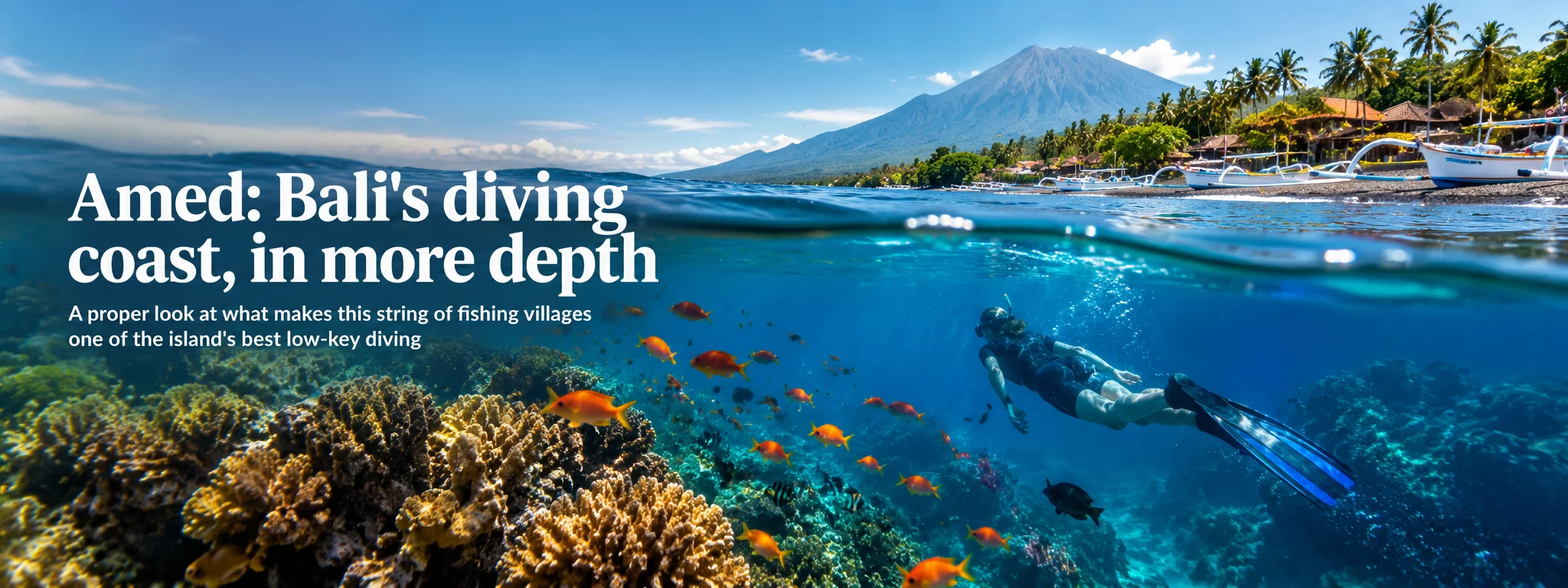
Amed is not one single beach or one single dive site. It is a long ribbon of fishing villages on Bali's north-east coast, with dive centres spread around Amed village, Jemeluk, Bunutan, Lipah and nearby bays. That geography is the key to understanding the area: you can base yourself in one quiet coastal strip and choose between easy shore diving, short boat rides, wall dives, artificial reef structures, macro-focused volcanic sand and wreck sites.
Newly certified divers, mixed-experience couples or groups, underwater photographers, travellers who want to combine diving with shore snorkelling, and anyone who prefers a low-key multi-night base rather than a rushed day trip from South Bali.
01 Why Amed works so well as a diving base
Amed's biggest advantage is variety without complicated logistics. PADI currently describes the area as known for easy shore dives, generally calm conditions, volcanic-sand slopes, coral gardens and a mix of reef and artificial structures. Some sites can be entered directly from shore; others are reached in a few minutes by traditional jukung outrigger boat.
That does not mean every Amed dive is easy. Currents can develop around exposed points, deeper walls demand proper buoyancy and gas management, and sea conditions can change quickly. But compared with Bali's more current-sensitive offshore diving, Amed gives operators a broad menu of sites that can often be matched to experience level.
The water is diveable year-round. PADI's current destination guidance says visibility is often best from roughly April to November, with water commonly around 26–29°C. Treat that as a seasonal tendency rather than a promise: rain, swell, wind, plankton and local runoff can all change visibility from one day to the next.
02 Jemeluk Bay and the Amed Wall
Jemeluk Bay is the easiest place to understand Amed's appeal. The bay combines shore-accessible reef with deeper sections reached by a short swim or boat ride, and it is one of the places where snorkellers and divers can enjoy the same general coastline at different depths.
The Amed Wall at Jemeluk is not one giant vertical drop. It is a sequence of reef slopes and wall-like sections with sponges, sea fans, hard and soft corals and plenty of smaller reef life. PADI's current site description highlights trevally, triggerfish, snapper, fusiliers, butterflyfish, nudibranchs, scorpionfish and other macro subjects. Larger animals are possible, but they should be treated as bonuses rather than guaranteed sightings.
Jemeluk is particularly useful for photographers and newer divers because there is interesting life at relatively modest depths and a dive can be shaped around the group's comfort level. It is also a sensible place to work on buoyancy before moving to more exposed sites.
03 Amed Pyramids and artificial reef structures
One of Amed's distinctive underwater features is a collection of artificial reef structures commonly called the Pyramids. These structures have become habitat for reef fish, moray eels and smaller marine life, while the surrounding volcanic-sand terrain can reward slow, observant diving.
Do not expect the Pyramids to look like a pristine natural coral garden. The interest is the combination of human-made structure, colonising marine life and nearby reef. It is a useful contrast with Jemeluk's wall and with the wreck-oriented diving farther north.
For photographers, the lesson is to slow down. Amed is not only about wide-angle coral scenes. Macro subjects can be easy to miss if a group races from landmark to landmark.
04 Bunutan and more current-sensitive diving
Bunutan sits farther along the Amed coast and is often approached by boat. It can offer excellent reef life and drift-style diving when the current is moving. This is where the idea that “Amed has no current” falls apart: some Amed sites can be calm, while others are chosen specifically because a current creates a good drift.
That is why operator judgement matters. A good dive centre should ask about your certification, recent dives, comfort in current and what you actually want to see. If a site is too energetic for the group, there are usually other choices along the coast.
05 The Japanese Shipwreck near Banyuning
South-east of central Amed, near Banyuning, is the small wreck commonly called the Japanese Shipwreck. It is much smaller and shallower than Tulamben's USAT Liberty and is often visited by both divers and snorkellers when sea conditions are suitable.
Indonesia's official tourism site currently lists it as a World War II relic and highlights it as an Amed snorkelling and diving attraction. Online stories about the vessel's exact identity and history are not always consistent, so it is better to treat it as an underwater reef-and-wreck site than to repeat an elaborate historical backstory without documentary evidence.
The shallower setting can make the site visually rewarding, but shallow does not automatically mean safe: surge, boat traffic, entry conditions and reef contact still matter. Follow local guidance rather than swimming out solely because the wreck looks close from shore.
06 Amed versus Tulamben
Amed and Tulamben are close enough to combine, but they are not interchangeable. Tulamben's headline attraction is the USAT Liberty and its exceptionally convenient shore-access wreck diving. Amed's strength is broader: multiple villages, reef and wall sites, snorkelling from shore, small-boat diving and a larger choice of places to eat and stay along the coast.
If the Liberty is your main goal, staying in Tulamben can make early-morning or repeat dives easier. If you want a more varied coastal base and plan to dive several different sites, Amed often makes more sense. Many Amed operators also run Tulamben trips, so you do not necessarily need to change hotels.
07 Is Amed good for beginners and training?
Yes — with an important qualification. Amed has enough sheltered and relatively forgiving water that many dive centres use the area for introductory dives and certification training. It also has enough variety that a newly certified diver can continue with genuinely interesting fun dives rather than repeating the same training site.
But “beginner-friendly destination” should never be interpreted as “every site is beginner-friendly”. Weather, current, depth and entry conditions should drive the site choice on the day. A professional operator should be willing to change the plan rather than forcing a named site because it was advertised in advance.
If you are learning, ask where confined-water skills are conducted, how many students are assigned to one instructor, whether rental equipment is serviced locally, and whether the centre separates very experienced divers from entry-level groups where appropriate.
08 Choosing a dive operator
Amed has a large number of dive centres, including PADI-affiliated operators, but certification-agency branding alone does not tell you everything about the day-to-day experience. Look for clear answers on group size, guide ratios, equipment condition, emergency oxygen, boat procedures and how the centre handles divers who have been out of the water for a long time.
- Be honest about experience. Number of logged dives matters less than recent, relevant experience in current, shore entries or reef environments.
- Ask what is included. Equipment, computer, nitrox, transport, lunch and marine fees may be packaged differently.
- Do not choose only on price. A very cheap dive is poor value if it means rushed briefings, oversized groups or badly maintained rental gear.
- Listen when the operator changes the site. A last-minute switch can be a sign of good judgement if wind, swell or current has changed.
09 Diving with non-divers
Amed is one of Bali's better choices for a group in which not everyone dives. Jemeluk and Lipah have well-known shore snorkelling, and several dive sites sit close enough to snorkel areas that a couple or family can spend the morning doing different activities without travelling to opposite sides of the island.
See our beginner snorkelling guide for practical safety advice. Calm-looking water still deserves caution: fins, a properly fitted mask, awareness of boat lanes and local advice about current make a big difference.
10 How many days to allow
Amed is much better as a two- or three-night minimum than as a rushed South Bali day trip. Road travel across Bali is unpredictable, and a long transfer followed by two dives and another long transfer wastes the main advantage of staying here: easy mornings and flexible site choice.
For a dedicated dive trip, three to five nights gives you room for multiple Amed sites, a Tulamben day, a surface interval afternoon and weather flexibility. Divers planning to fly soon afterwards must also leave appropriate no-fly time after scuba diving; follow your training agency and dive computer guidance rather than trying to squeeze one last dive into departure day.
11 What Amed is like above water
Amed is quiet by Bali standards. There are beachside restaurants, small hotels, villas, yoga spaces and sunset viewpoints, but this is not a nightlife base. Roads are narrow, villages stretch over a long distance and walking between every bay is not practical.
That slower rhythm is part of the attraction. Traditional fishing and salt-making remain part of the local economy, Karangasem scenery surrounds the coast, and Mount Agung dominates many inland views. If you want a dive destination that still feels like a place rather than a resort compound, Amed is one of Bali's strongest options.
12 Bottom line
Choose Amed if you want variety, easy access and a relaxed dive base. Choose Tulamben if repeated Liberty dives are the entire point of the trip. Choose Nusa Penida if your priority is bigger, more current-sensitive offshore diving and manta encounters. For many visitors — especially newer divers or mixed diving/snorkelling groups — Amed is the easiest place to turn two dives into a genuinely enjoyable multi-day stay.