
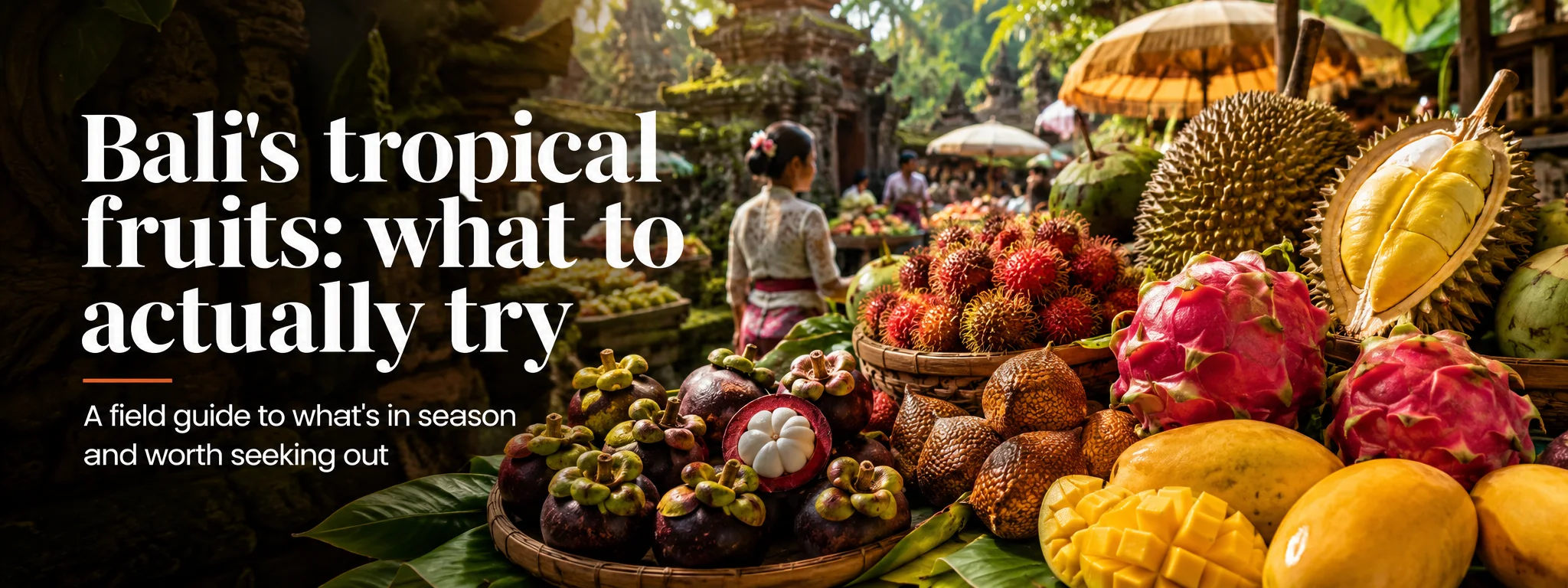
01 How fruit seasonality really works
Fruit calendars are useful until they pretend nature has read the calendar. Indonesia’s harvest periods shift with rainfall, altitude, variety and growing region, and Bali markets also sell fruit brought from other islands. That means “available in Bali” is not the same thing as “harvested in Bali this week”.
National agriculture sources show broad seasonal patterns — for example, mangosteen is commonly harvested around the wetter end of the year into early months, while mango becomes more abundant in drier periods — but the exact window can move. The practical traveller rule is simple: look at what is piled high, smells ripe and is priced attractively today, then ask the vendor what is best.
Some fruits such as banana, papaya, coconut and pineapple are easy to find through much of the year. Others arrive in visible waves. That is part of the fun: the fruit that dominates a market on your trip may be completely different on your next visit.
02 Salak Bali and Sibetan
If you try only one fruit because you are in Bali, make it salak — snake fruit. Its brown overlapping skin looks reptilian; inside are firm pale lobes around hard seeds. The texture is crisp rather than juicy, with flavour ranging from sweet to pleasantly tart depending on variety and ripeness.
Salak is not unique to Bali, but Salak Bali from Karangasem has a real local story. Karangasem’s tourism office identifies Sibetan village in Bebandem as the island’s major traditional salak-growing area, and Bali government research continues to work with producers there. The official Karangasem material describes a main natural harvest around January to March and another smaller gadon harvest around August to September, while noting that fruit can still be available in Sibetan through the year.
That makes salak a much better Bali food souvenir to eat while you are in Bali than a generic imported tropical fruit. Peel the scaly skin from the pointed end, remove the thin membrane if you prefer, and do not bite the hard seed in the centre of each segment.
03 Mangosteen
Mangosteen (manggis) is an easy convert: thick purple rind, soft white segments and a sweet-tart flavour with none of durian’s confrontation. Indonesian agriculture guidance places the main national harvest broadly from November to March, though local availability varies.
Choose fruit that feels heavy for its size and whose rind has some give rather than being rock-hard and dried out. Press gently; you are opening a fruit, not testing a cricket ball. The purple rind can stain clothes, so open it over a plate or sink. The white flesh is eaten; the tough rind is not.
Some segments contain seeds. Eat around them rather than crunching through. If mangosteen is abundant and cheap at a market, that is a better indicator of a good moment to buy than an online calendar written for all of Southeast Asia.
04 Rambutan
Rambutan is the hairy red or yellow fruit whose name comes from rambut, Indonesian for hair. Split the skin with your thumbnail or a small knife and the inside looks a little like a large lychee: translucent, juicy flesh around one seed.
National harvest data often shows rambutan becoming plentiful around the wet-season fruit glut, but supply can come from different islands and varieties, so avoid treating one exact month as law. Buy clusters whose fruit still looks lively rather than shrivelled and dry. The flesh should be juicy; the central seed is not the part you are trying to eat.
Rambutan is ideal for a first market purchase because you can buy a small bunch, it travels well for a day out, and you do not need a hotel knife to open it.
05 Durian
Durian deserves a try if you are curious, but not a macho challenge. The spiked shell contains soft custard-like lobes whose aroma can be sweet, savoury, fermented, onion-like or all of those at once depending on your nose. Indonesia’s harvest stretches across different regions for much of the year, with strong abundance commonly appearing from late year into the early months.
For a first taste, buy a small opened portion from a vendor rather than an entire fruit. You can see the flesh, avoid wrestling with the shell and stop after one lobe if it is not for you. Vendors who specialise in durian can also tell you which fruit is milder, sweeter, bitter-sweet or very ripe.
The smell is the practical issue. Many hotels, vehicles and enclosed venues restrict durian, so ask before carrying it inside. Eat it at the stall or outdoors and dispose of the shell where the vendor directs you.
06 Mango and the easy favourites
Mango (mangga) is familiar, but Indonesia grows many varieties and ripeness styles. Some are best soft and intensely aromatic; others are eaten firm and sour with chilli-salt or rujak dressing. Mango tends to become more abundant through the drier-to-transition part of the year nationally, but variety and origin make exact Bali dates slippery.
Papaya, banana, pineapple and coconut are the dependable workhorses. They may not feel exotic after three hotel breakfasts, but a properly ripe local papaya or a fresh young coconut can be better than hunting a rare fruit purely for novelty.
Dragon fruit is also common, with white- and red-fleshed varieties. It is mild rather than dramatic and useful in juices, fruit plates and breakfast bowls. If a vendor offers you a taste, colour alone does not tell you which one will be sweetest.
07 Jackfruit, soursop and other fruit worth knowing
Jackfruit (nangka) produces large yellow pods with a sweet tropical aroma when ripe; the seeds are also edible when cooked. Young unripe jackfruit is used as a vegetable in savoury dishes, so “jackfruit” on a menu does not automatically mean dessert.
Soursop (sirsak) has soft white pulp with a sweet-acid flavour and is often easier to encounter as juice than as a whole fruit. Passionfruit (markisa), guava (jambu biji), water apple (jambu air), sapodilla (sawo), pomelo and star fruit also appear depending on season and market.
Do not obsess over ticking every fruit off a list. Ask “yang matang?” (which one is ripe?) or simply ask the vendor which is good today. That one question often produces a better tasting session than buying the strangest-looking object on the table.
08 Where to buy fruit
Traditional markets and dedicated roadside fruit stalls usually give you the widest view of what is in season. Pasar Badung in Denpasar is a strong example: Indonesia’s official tourism site lists fresh fruit and vegetables among the market’s core goods. In Sanur, Pasar Sindhu functions as a produce market earlier in the day before the evening food-stall phase.
Supermarkets are easier when you want fixed prices, air-conditioning and labelled produce. Roadside stalls can be excellent when you are travelling through growing areas, especially in East Bali and Karangasem, but stop somewhere safe rather than making a sudden turn across traffic because you saw a pile of rambutan.
For a specifically Bali-grown experience, Sibetan and surrounding Karangasem are the natural home of salak. Pairing a fruit stop with an East Bali trip makes more sense than driving across the island solely to buy one kilo of fruit.
09 How to choose ripe fruit
Let the vendor help. Fruit sellers handle these varieties every day and can often choose for “eat now”, “tomorrow” or “take back to the hotel”. Say when you plan to eat it rather than squeezing every fruit on the pile yourself.
As general clues, avoid fruit with obvious mould, leaking splits or a fermented smell when that fruit should smell fresh. Mangosteen should not be completely dried and rock-hard; rambutan should not be deeply shrivelled; ripe mango should smell fragrant near the stem; durian selection is best left to a vendor unless you already know what style you like.
Prices vary with season, origin and neighbourhood, so we do not publish a fake island-wide “fair price per kilo”. If a market price is not shown, ask first. Buying a small amount of unfamiliar fruit is sensible: you can always return for more.
10 Washing, cut fruit and food safety
Indonesia’s health guidance and the World Health Organization both support the simple basics: choose fresh produce, wash fruit and vegetables with clean running water, and peel where practical if you want an extra margin. Wash the outside before cutting fruit so a knife does not drag surface contamination into the flesh.
Pre-cut fruit is convenient, but you are relying on somebody else’s water, knife, hands, storage and temperature control. That does not make every fruit cup unsafe; it means whole fruit you wash and peel yourself gives you more control when you are being cautious.
Do not wash fruit in tap water if you would not drink that water. Use water you trust, keep cut fruit cool, and discard anything that smells or looks spoiled rather than trying to rescue a bargain.
11 Taking fruit home
Fresh fruit is subject to biosecurity rules in many destination countries. Do not assume that because you bought a mango or salak legally in Bali you can carry it through customs at home. Rules depend on the country, fruit, treatment and sometimes the exact origin.
The low-stress approach is to eat fresh fruit in Indonesia and check your destination country’s official biosecurity rules before packing any plant product. Processed, commercially packaged fruit may have different rules, but “sealed” does not automatically mean “permitted”.
12 The bottom line
Start with salak because it gives you a genuine East Bali agriculture story, then add mangosteen and rambutan when they are abundant. Try durian by the portion rather than by the whole spiky football. After that, let the market decide: whatever is fragrant, plentiful and being recommended by the seller is probably the right fruit for that week.
For more food context, continue with our Balinese cuisine guide, warungs guide and street-food guide.