
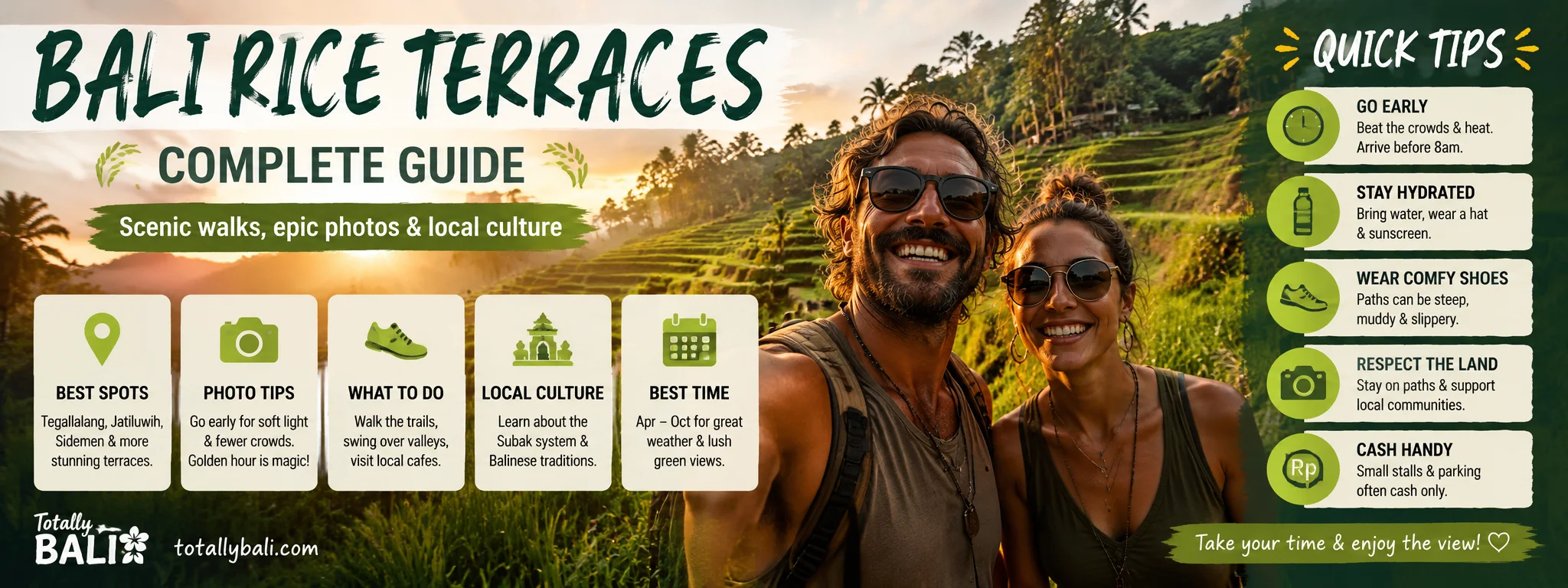
01 What Tegallalang actually is
Tegallalang is a steep rice-terrace valley north of Ubud where paddies step down both sides of a narrow drainage line. The top edge is lined with cafés, shops, swings and photo businesses, while paths descend through working agricultural land. The contrast between farming and tourism is part of modern Tegallalang, not something you can completely avoid.
The view from the roadside is attractive, but the place makes more sense when you walk down into the terraces. From below, you see irrigation channels, narrow paths, retaining walls and the physical effort required to farm steep ground. That perspective is far more interesting than treating the valley as a single selfie backdrop.
02 Important correction: Tegallalang is not itself the UNESCO World Heritage site
Bali’s subak system is recognised by UNESCO, but the inscribed World Heritage property consists of specific cultural landscapes and water-temple sites, including the Pakerisan watershed and Catur Angga Batukaru landscape. Tegallalang’s tourist rice terraces are not one of those listed components. Many travel pages blur that distinction.
That does not make Tegallalang unimportant. It is still part of Bali’s broader rice-growing culture and illustrates the kind of terraced irrigation shaped by subak practices. It simply deserves accurate language. If you specifically want a UNESCO-listed rice landscape, Jatiluwih is the obvious visitor destination.
03 Rice terraces are farms, not permanent green scenery
Rice fields change through the agricultural cycle. At one visit the terraces may be vivid green; at another they may be newly planted, golden, muddy, harvested or partly fallow. That variation is normal. Farmers are producing food, not maintaining a permanent photo set for tourists.
This is why promises of the “greenest month” should be treated cautiously. Planting schedules differ between plots and can shift with water and farming decisions. Go for the shape of the landscape and the walk, then treat bright green rice as a bonus rather than a guarantee.
04 Go early for cooler walking and fewer people
Early morning is the best all-round time. The valley is cooler, paths are quieter and low-angle light gives the terraces more depth. By late morning the exposed slopes become hot, and popular photo zones can feel crowded. Afternoon can produce nice light too, but rain and traffic are more likely to complicate the return to Ubud.
If you only want the roadside view and a coffee, timing matters less. If you plan to descend and climb through the terraces, avoid the hottest part of the day. The walk is not technically difficult, but steep steps and humidity make it more tiring than the photos suggest.
05 Entry charges and the fragmented visitor setup
Tegallalang does not always operate like a single fenced attraction with one simple universal price. Access routes, local checkpoints, private photo areas and swing businesses can have separate charges. The setup has changed over time, which is why fixed fee lists become outdated quickly. Carry small cash and ask what each payment covers before agreeing.
A polite local contribution is different from feeling pressured into repeated unexplained payments. If a route seems unclear, choose a well-used entrance or ask your driver where the current main access is. Do not wander through private fields simply because a map shows a path.
06 Walking the terraces: what the photos hide
The valley floor means down first and up later. Paths can be narrow, uneven and muddy after rain, with improvised steps and small bridges. Wear shoes with grip and keep both hands free when sections are slippery. A lightweight bottle of water is more useful than carrying a heavy camera bag.
Stay on established paths and respect signs around planted fields. Rice paddies are working plots, not lawns. Avoid trampling bunds or stepping into crops to create a cleaner photograph. If a farmer is moving equipment or water through the path, give way.
07 Swings, nests and photo parks
The greater Tegallalang area has become one of Bali’s main hubs for large swings and staged photo installations. Some visitors love them; others find the commercial layer overwhelms the agricultural setting. Both reactions are reasonable. The useful point is that the swing experience is optional and usually separate from simply seeing the terraces.
If you want a swing, choose a reputable operator, check how safety restraints are handled and confirm the price before changing into costumes or adding photo packages. If you do not want one, ignore the sales pitch and focus on the walk. You are not missing the rice terraces by skipping the props.
08 Tegallalang versus Jatiluwih
Tegallalang is close to Ubud, compact and easy to fit into half a day. Jatiluwih is farther away, broader, less compressed and part of the UNESCO-listed cultural landscape. Tegallalang is better for convenience and dramatic steep-valley views; Jatiluwih is better for long walks and understanding the scale of rice agriculture.
If your itinerary includes only Ubud and the south, Tegallalang makes practical sense. If rice terraces are a major interest and you have a full day, Jatiluwih is the stronger destination. There is no need to visit both unless you genuinely enjoy rural landscapes.
09 How to fit Tegallalang into an Ubud day
Tegallalang pairs well with northern Ubud-area stops such as Tirta Empul or Gunung Kawi. Start at the terraces early, then move to a temple before midday heat and finish with lunch away from the busiest roadside strip. That gives the day landscape, culture and breathing room.
Avoid adding Lempuyang, Kintamani, three waterfalls and a sunset on the same itinerary just because a tour listing says it is technically possible. Bali days are better when you stop pretending driving time does not exist.
10 Is Tegallalang worth it?
Yes, if you are staying in Ubud and want an accessible introduction to terraced rice landscapes. The valley remains genuinely striking despite the tourism development, and walking below the roadside viewpoints gives the place more depth. It is also easy to combine with other Ubud-region sights.
Skip it if you are already visiting Jatiluwih and dislike commercial photo attractions, or if the thought of swings, shops and busy paths will irritate you more than the landscape will impress you. Tegallalang is neither a pristine hidden valley nor a fake attraction; it is a working landscape heavily shaped by tourism. Go with that reality in mind.