
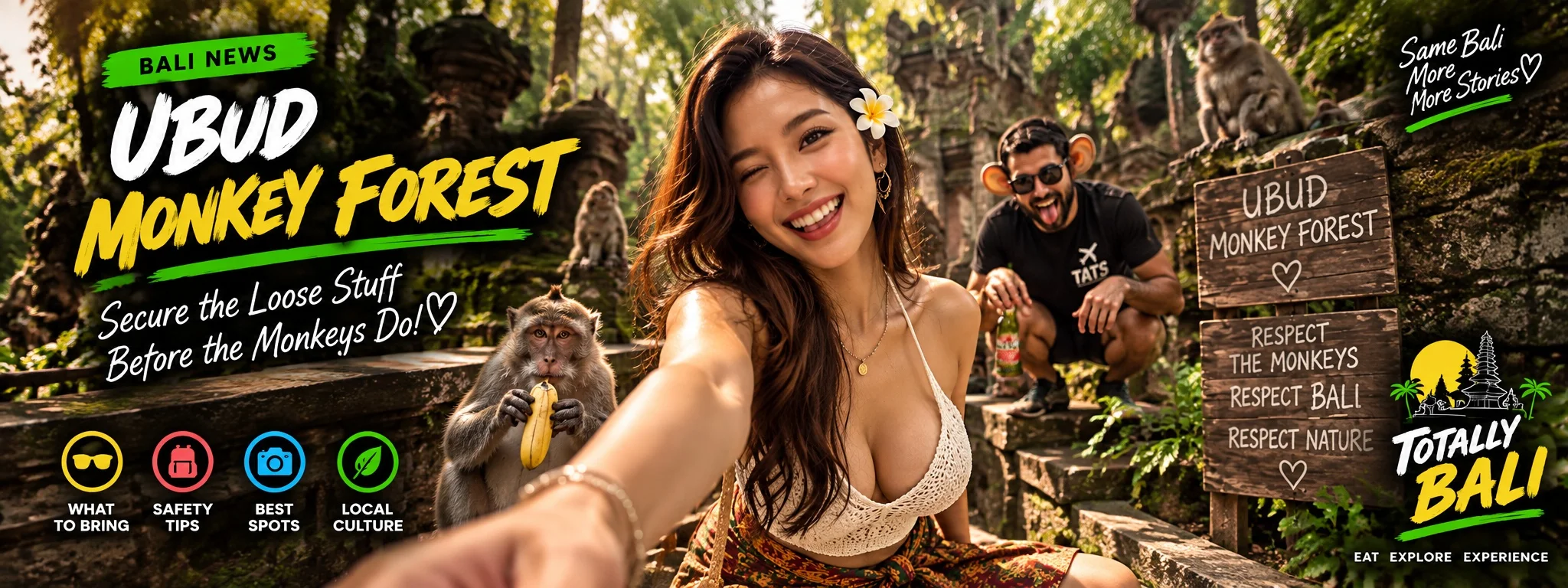
Ubud Monkey Forest is not a petting zoo with better landscaping. It is a sacred forest complex where hundreds of semi-wild macaques happen to be extremely comfortable around people — and occasionally far too interested in whatever you brought with you.
I do not try to outsmart macaques. The sanctuary’s current rules are far more useful than old travel folklore: keep food away, secure loose belongings, stay calm, do not tease or touch the monkeys and follow staff instructions if one gets too close.
01 What the Monkey Forest actually is
The Sacred Monkey Forest Sanctuary — often simply called Ubud Monkey Forest — is one of central Ubud’s most visited places, but it makes much more sense when you see it as a living Balinese sacred landscape rather than a monkey attraction with temples attached. The sanctuary combines forest, long-tailed macaque habitat, village-managed conservation and active religious spaces associated with Padangtegal.
The official sanctuary describes a 12.5-hectare forest with more than a thousand macaques and 186 tree species. Exact monkey counts vary across current official pages and naturally change over time, so there is little value in treating one number as permanent. The useful point for visitors is that the macaques are numerous, free-moving and accustomed to people while still remaining wild animals.
That combination is what makes the place memorable. You can move from busy monkey activity to stone bridges, shaded forest paths, temple walls and quieter corners within a few minutes. It is also why the visit deserves more respect than a quick photo stop.
02 Current tickets, opening hours & how long to allow
As checked on 30 August 2026, the sanctuary’s official visitor page lists opening hours of 9:00am–6:00pm, with last entrance at 5:00pm. Current listed admission is Rp130,000 for adults and Rp100,000 for children. These are live attraction details rather than timeless facts, so re-check the official site before a future visit.
The sanctuary also offers an official online-ticket system. Buying ahead can be useful during busy periods because the e-ticket can be scanned at the designated gate instead of joining the ordinary ticket-counter queue. It is not essential for every visit, but it is a sensible option if your Ubud day is tightly scheduled.
For most visitors, 90 minutes to two hours is a comfortable allowance. A fast circuit is possible, but it misses the point. Give yourself enough time to stop when a macaque troop blocks a path, look at the forest and temple architecture, and avoid rushing the final section because you arrived close to last entry.
Morning is usually the easiest time for cooler walking and a calmer start to the day. Late afternoon can also be attractive, especially if you are already in central Ubud, but arriving after 4:30pm leaves little buffer if the forest is busy or you want to explore slowly.
03 Sacred spaces, temples & cultural context
The forest contains important sacred areas and temple structures used by the local community. Visitors can appreciate the architecture, statuary, bridges and forest setting, but some inner sacred spaces are not open for casual tourist entry. Follow signs and barriers even if another visitor does not.
The sanctuary’s own interpretation places the forest within the Balinese idea of Tri Hita Karana: harmony between people and the divine, people and one another, and people and nature. That framing helps explain why the monkeys, trees, temples and community management are presented as one connected place rather than separate attractions.
Dress with the same basic respect you would use at other sacred sites in Bali. You do not need to turn the visit into a formal temple tour, but very revealing clothing is discouraged by the sanctuary, and restricted religious areas should be treated as genuinely restricted.
If this is one of your first cultural stops in Bali, our Balinese etiquette guide and Bali temple guide give useful wider context.
04 The monkey rules that actually matter
The most important thing to understand before entering is that the macaques are semi-wild, not pets. Their familiarity with people can make them look relaxed and predictable right up until they are not. The sanctuary’s current guidance is clear:
My approach is deliberately boring: no feeding, no reaching, no staring contest and no clever “monkey whisperer” behaviour. They are quick, strong and much better at being macaques than visitors are.
- Keep a respectful distance. Do not touch, grab or pick up monkeys.
- Do not feed them yourself. Any interaction should be under trained-staff supervision.
- Avoid direct eye contact. A fixed stare can be interpreted as aggression.
- Do not run or panic if a monkey jumps onto you. Stay calm, move slowly and ask staff for help.
- Do not bring food or drinks into the forest. Food can trigger grabbing and competition.
- Secure small objects. Jewellery, loose toys, dangling accessories and similar items can attract attention.
- Do not bring plastic bags inside. The sanctuary says lockers are available in the lobby.
This is better guidance than old internet advice about carrying snacks, trading food for stolen belongings or deliberately attracting a monkey for a photo. If something is taken, get a staff member rather than escalating the situation yourself.
05 What to do after a bite or scratch
If you are bitten or scratched, go immediately to the Monkey Forest first-aid clinic. The sanctuary says its nurse will provide treatment according to the case. Do not simply wash the wound later at your hotel and assume everything is fine because the animal appeared healthy.
If a bite or scratch happens, I would treat it as a medical issue rather than an embarrassing holiday story. Clean it promptly, tell sanctuary staff and seek proper medical advice about rabies and tetanus risk.
The sanctuary states that it works with Udayana University’s Primate Research Center to monitor monkey health and says its long-running research has not found rabies in the sanctuary monkeys. That is useful context, but it should not be misread as permission to ignore a wound. Animal bites and scratches still deserve prompt professional assessment.
Parents should explain the no-touching and no-running rules before entering. Younger children can find a close macaque encounter exciting until an animal suddenly moves towards them. Keep children close enough that you can intervene calmly without chasing or shouting.
06 Monkey selfies, photos & valuables
The sanctuary currently advertises a supervised monkey-selfie activity for Rp50,000. If a close photograph matters to you, the staff-run activity is the sensible route; it is very different from trying to coax a macaque onto your body for an unsupervised social-media shot.
For ordinary photography, give the animals space and use zoom rather than moving too close. Avoid blocking pathways while taking photos, and remember that a monkey sitting still is not an invitation to touch it.
Before entering, put sunglasses you are not wearing, loose jewellery, snacks, toys and dangling accessories into a properly closed bag. If you are carrying something especially valuable or difficult to secure, use the available locker rather than spending your visit worrying about it.
07 How to approach the visit
There is no need to race towards whichever part of the forest currently has the biggest crowd. A better visit is a loose loop: let the forest paths, bridges and temple viewpoints set the pace, pause when monkeys are active nearby, and move on when a section becomes congested.
Footpaths can be damp, uneven or busy, and the official guidelines specifically warn visitors to stay aware of natural hazards such as falling branches. Wear shoes you are comfortable walking in and pay attention to your surroundings rather than watching only the monkeys.
If you have limited mobility, the combination of slopes, steps, crowded paths and unpredictable animals can matter more than the total distance. Contact the sanctuary directly before visiting if you need current route-specific accessibility information.
08 Getting there from Ubud
The sanctuary sits on the southern side of central Ubud, making it unusually easy to visit without organising a dedicated sightseeing driver. From many central hotels and guesthouses, walking is practical and can be faster than sitting in traffic on Jalan Monkey Forest.
Ride-hailing and local drivers are useful from outlying Ubud villas, but allow a traffic buffer. Central Ubud congestion can turn a short map distance into a surprisingly slow road trip, particularly around busy afternoon periods.
If you are staying outside Ubud, treat Monkey Forest as part of an Ubud day rather than a standalone cross-island journey. It pairs naturally with the palace/market area, galleries, cafés and other central stops. Our Ubud guide explains how the town’s different areas fit together.
09 What to combine with Monkey Forest
The easiest same-day pairing is central Ubud itself. Walk north towards the palace and market area, add a gallery or long lunch, or save the Campuhan Ridge Walk for a cooler part of the day.
Avoid cramming Monkey Forest, Tegallalang, several temples, a waterfall and a distant dinner into one heroic checklist. Ubud traffic and attraction dwell times make that kind of plan brittle. One or two major stops plus time in town usually produces a much better day.
If monkeys are the main attraction but you are uncomfortable with close animal encounters, consider whether you actually need to visit. You can still have an excellent Ubud day built around temples, rice landscapes, museums, food and walking.
10 Is Ubud Monkey Forest worth it?
One final practical point: Ubud weather changes quickly. In heavy rain, stone and forest paths can become slick, while umbrellas and loose ponchos can be awkward around curious animals. If conditions are poor, do not force the visit simply because you pre-planned it; the sanctuary is centrally located enough to swap with an indoor Ubud stop and return later.
I think the forest is worth visiting for most first-time Ubud travellers if they want the temples and landscape as well as the animals. If somebody in the group is genuinely frightened of monkeys, skipping it is completely reasonable.
Yes for most first-time Ubud visitors, provided you want the full forest-and-sacred-site experience rather than only a staged animal encounter. It is visually distinctive, culturally significant, easy to reach from town and very different from Bali’s beach attractions.
It is less suitable if you are frightened of monkeys, dislike busy attractions or know that a child in your group will struggle to follow calm no-touch/no-running rules. In that case, skipping it is a perfectly reasonable choice.
The best mindset is simple: arrive with little loose gear, follow the sanctuary’s rules rather than old travel folklore, keep children close, and spend as much attention on the forest and sacred spaces as on the macaques. That turns a potentially chaotic photo stop into one of Ubud’s more memorable visits.
TATS Man bottom line: Go for the forest, temples and atmosphere, not for forced contact. Keep your gear secure, follow the sanctuary rules and the visit is much more likely to stay memorable for the right reasons.
Cheers, Carpe Diem & Keep Your Snacks to Yourself! 🍻⏳🐒
your macaque-respecting jungle correspondent
About the author
TATS Man
Travel journalist · digital nomad since 2007 · visiting Bali since 1989
TATS Man is the beer-loving cyborg travel journalist behind Totally Bali and TATS (Totally Awesome Travel Sites). He has travelled and worked remotely since 2007 and has been visiting Bali since 1989. His guides combine long-term destination familiarity with current primary-source research — and he does not claim first-hand experience where he does not have it.