
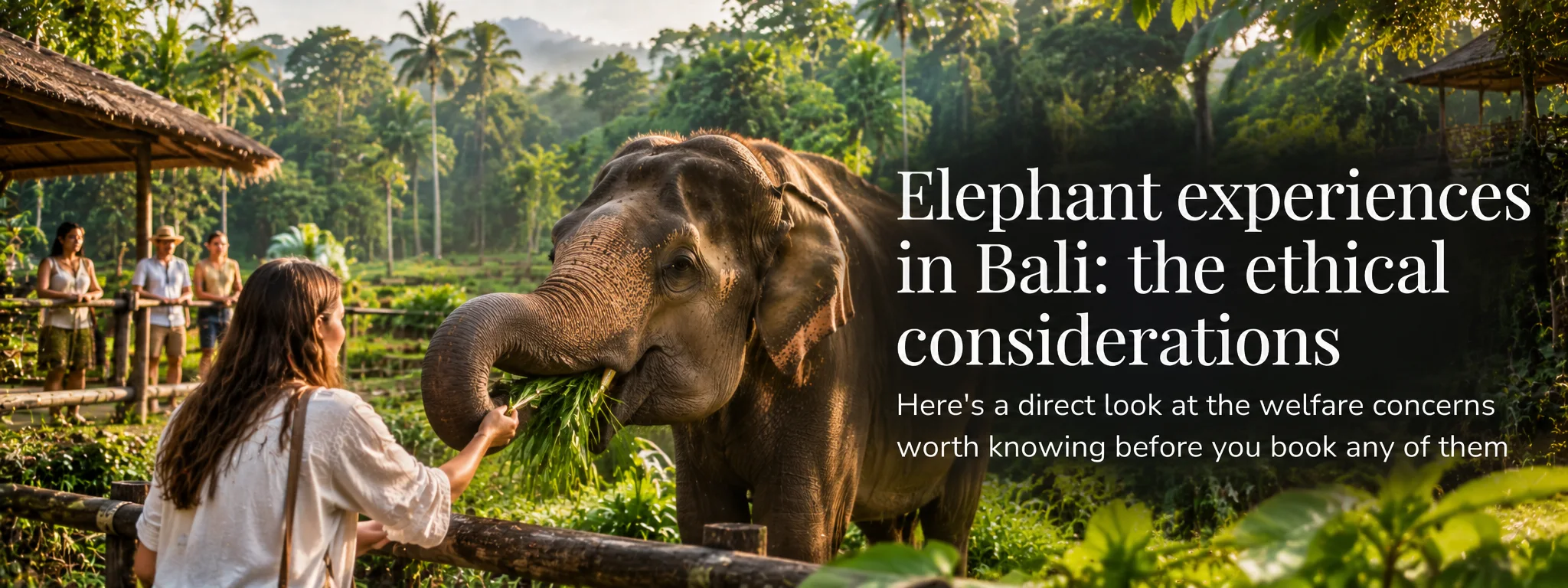
Elephant tourism is one of those Bali subjects where a glossy word such as sanctuary can hide more than it explains. I first came to Bali in 1989 and I have watched the island's tourism industry change enormously since then. Ending elephant rides is real progress. It does not automatically make every replacement activity ethical.
I have not personally audited every elephant venue on the island, and I am not going to pretend I have. For current venue practices and welfare standards, this guide combines Bali's 2026 government action with current operator information and independent elephant-welfare research. My job here is to help you read the marketing with your eyes open.
01 The big 2026 change: elephant rides are ending
Bali’s elephant-tourism landscape changed significantly at the end of 2025 and beginning of 2026. Indonesian authorities directed tourism operators away from elephant riding, and major Bali venues including Bali Zoo and Mason Elephant Park subsequently announced that rides would stop.
That is meaningful progress, but it does not settle the ethical question. A venue can remove saddles while continuing to sell bathing, washing, hand-feeding, selfies or other close-contact encounters. Those activities still require elephants to be managed around crowds and can restrict normal behaviour.
02 What “ethical” should mean
I put very little weight on the word sanctuary by itself. There is no single legally protected tourism definition of an “ethical elephant sanctuary”, so I judge the actual practices rather than the label on the booking page.
A strict welfare-first standard prioritises observation: elephants have space to move, socialise, forage and choose where to spend their time while visitors watch from a respectful distance. World Animal Protection’s current guidance specifically advises against riding, bathing and touch-based encounters, arguing that elephants made available for routine close human contact have undergone intensive training and management.
That standard is stricter than what many Bali attractions currently offer, which is why “we stopped rides” should be treated as a starting point, not the finish line.
03 What Bali venues currently offer
As of 2026, Bali Zoo has publicly ended elephant riding, yet its visitor information still promotes an Elephant Mud Fun programme. Mason Elephant Park has also stopped rides following government pressure, while its own current website continues to advertise hand-feeding, washing and bathing experiences.
That does not mean every aspect of those facilities is identical, and visitors should avoid making welfare judgements from a single photo. It does mean that travellers seeking a genuinely hands-off experience need to read the activity description carefully rather than assuming every post-riding product is observation-only.
04 Red flags when comparing attractions
- Riding or performances: a clear reason to choose somewhere else.
- Bathing, washing or mandatory touching: still a direct-contact entertainment product.
- Selfie lines: especially where elephants must stand in one place for repeated photos.
- Constant chaining or tiny holding areas: particularly when elephants cannot move or socialise normally.
- Baby elephants used as an attraction: ask why breeding is occurring and what conservation purpose it serves.
- Handlers using force: emergency safety tools are one thing; routine intimidation is another.
- Vague “rescue” claims: ask where the elephants came from and whether the venue publishes credible welfare information.
05 Questions worth asking before you pay
If I were booking, I would want the operator to explain exactly what visitors do, how elephants are housed, how much time they spend free from tourist contact, whether breeding occurs and what veterinary care is available. If the answer is mainly about how close you can get for photos, that tells me where the priorities sit.
Ask whether the elephant can choose to leave the visitor area. Choice and control are important welfare indicators. An animal that must remain in position while a continuous queue touches, washes or feeds it has very little control over the interaction.
06 This is also a human-safety issue
Elephants are enormous, intelligent wild animals. Close-contact tourism is not risk-free even when handlers are experienced. Animal-welfare organisations have also highlighted serious injuries and deaths during elephant bathing activities outside Bali.
For me, distance is a feature, not a disappointment. A viewing format that does not require you to stand beside, sit on or climb into water with an elephant reduces pressure on the animal and also reduces the physical risk to visitors.
07 Better wildlife choices in Bali
If your goal is to see wildlife rather than specifically touch an elephant, Bali offers better ways to build a nature-focused day. Birdwatching, reef snorkelling with responsible operators, mangrove visits and conservation-focused experiences can deliver memorable wildlife encounters without demanding direct contact with large captive mammals.
If you are considering zoos or wildlife parks more broadly, read our Bali animal parks guide and judge each activity separately. Avoid any package built around performances, forced contact or “once-in-a-lifetime” selfies with wild animals.
08 The bottom line
My simplest rule is also the most useful: the less an elephant has to do for you, the better. Ending rides is a major improvement in Bali, but I would still choose an observation-led experience over replacing the saddle with a bath, wash or touching session.
If welfare matters to you, do not let the words “sanctuary”, “rescue” or “ethical” do the thinking for you. I look at what the elephant is actually required to do — that is usually the more revealing part.
09 Read the booking page like an auditor
Do not rely on a venue's homepage photograph or the first paragraph of a reseller listing. Open the detailed itinerary and look for every verb describing what visitors do. Observe and walk at a distance are different products from bathe, wash, touch, pose or feed by hand. Resellers sometimes soften the wording, so compare their description with the operator's own current programme.
Check recent visitor photographs as supporting evidence, not proof. They can reveal hooks, short chains, repeated posing stations or crowds that polished marketing omits, but a single image may lack context. If the activity remains unclear, ask the operator in writing whether any direct contact is expected and whether guests can opt out without being separated from the rest of their group.
10 Plan the day without rewarding poor welfare
Many elephant packages bundle transport, lunch and other stops, which makes an unsuitable encounter harder to decline once the day has started. Book transport separately where practical, confirm cancellation terms and avoid prepaid combinations that make the elephant activity the unavoidable centrepiece. Families should explain the no-touch rule to children before arriving rather than negotiating it beside an animal.
Heat and heavy rain matter too. An ethical-sounding programme is not improved by keeping animals or visitors on a fixed timetable in difficult conditions. Ask whether elephants can retreat from the public area and whether the venue changes or cancels interactions during extreme weather.
11 Conservation claims need evidence
Captive-elephant tourism is not automatically wild-elephant conservation. A credible conservation claim should identify the programme, its independent partners, what the money funds and how results are measured. General statements about “raising awareness” are not the same as protecting habitat or reducing human-elephant conflict in places where wild Sumatran elephants actually live.
You can still care about an individual captive elephant's lifetime welfare while questioning the tourism model around it. The practical traveller decision is to favour the least intrusive activity available, spend less time chasing contact and direct conservation donations toward organisations with transparent field work.
Sources checked & how I approached this guide
This is an editorial travel guide, not a veterinary assessment. I have retained the page's existing Bali reporting and refreshed the authorship/methodology layer on 6 September 2026. For current elephant-tourism practice, the most important checks are the Bali conservation authority's 2026 enforcement action, current operator activity descriptions and independent welfare guidance.
- Balai KSDA Bali — 2026 enforcement and end of elephant riding at Mason Elephant Park
- World Animal Protection — 2026 elephant-friendly tourist guidance
- Mason Elephant Park — current activity descriptions
Editorial principle: where I have first-hand Bali experience, I say so. Where a current fact comes from research rather than personal experience, I source it instead of pretending I was there.
Cheers, Carpe Diem & Look After the Elephants! 🍻⏳🐘
your favourite beer-loving cyborg travel journo
About the author
TATS Man
Travel journalist · digital nomad since 2007 · visiting Bali since 1989
TATS Man is the beer-loving cyborg travel journalist behind Totally Bali and TATS (Totally Awesome Travel Sites). He has travelled and worked remotely since 2007 and has been visiting Bali since 1989. His guides combine long-term destination familiarity with current primary-source research — and he does not claim first-hand experience where he does not have it.