
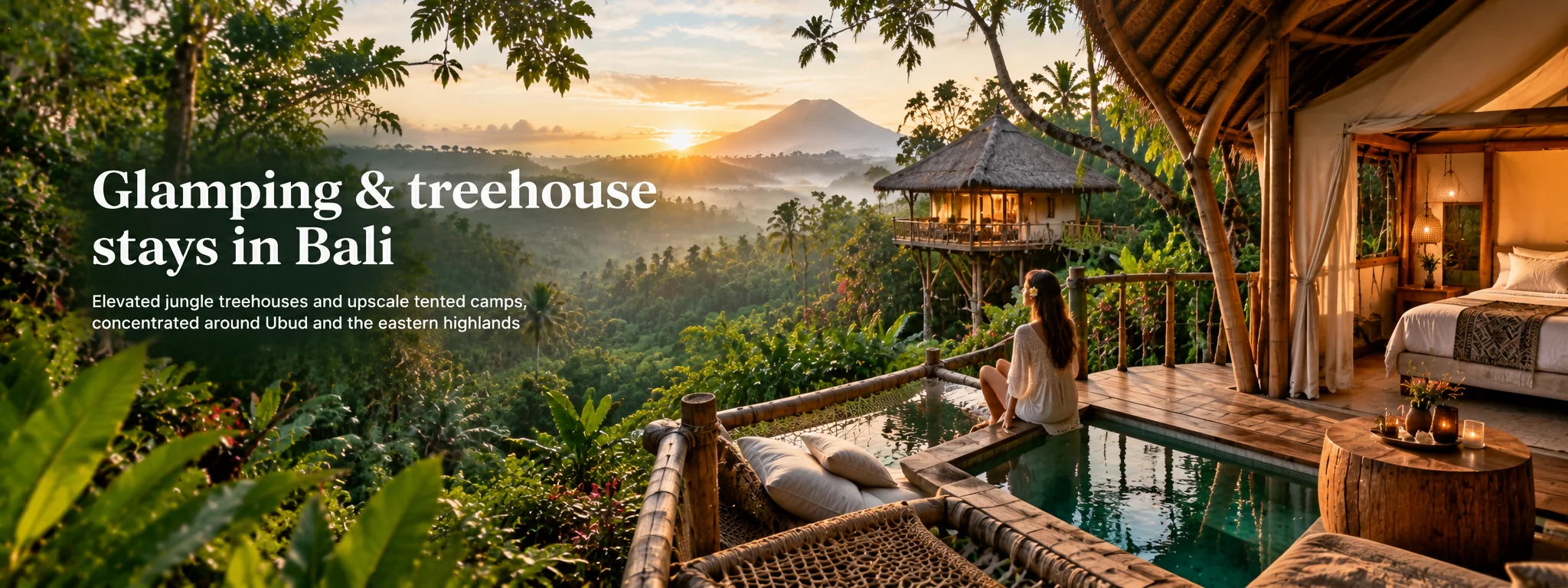
01What Bali glamping actually looks like
Despite the "camping" in the name, Bali's glamping scene generally means proper beds, en-suite bathrooms and real furniture inside a canvas or timber structure designed to feel immersed in the jungle or rice-field setting around it — not sleeping bags and a shared toilet block. It's closer to a boutique hotel room with a tent-like aesthetic than actual camping in any traditional sense.
02Treehouse stays
A specific and popular version of this trend, elevated treehouse-style accommodation set among jungle canopy or overlooking river valleys has become one of Bali's most photographed accommodation styles — often built with striking open-air designs that blur the line between indoors and out. These tend to book out well ahead, particularly the more architecturally distinctive ones with strong social media followings.
03Where they cluster
Ubud's surrounding valleys and East Bali's highland areas — particularly around Sidemen — are where most of Bali's glamping and treehouse properties concentrate, taking advantage of the jungle, river gorge and rice terrace scenery that doesn't exist in the same way along the coast.
04What to expect (and what it doesn't mean)
Don't assume "glamping" automatically means budget pricing — many of these stays position themselves at a genuine premium precisely because of the unique design and setting, sometimes costing more than a comparable standard hotel room. Check specifically what's included (meals, activities, air conditioning versus fans) since it varies significantly between properties marketed under the same broad label.
05Booking tips
- Book well ahead for the most distinctive, photogenic properties — they're genuinely limited in room count and sell out.
- Treat it as a 1–2 night add-on to a longer trip rather than a full-stay base, given the more limited on-site amenities compared to a standard hotel.
- Check reviews specifically for bug/insect exposure and noise if open-air design matters to your comfort — it's part of the appeal for some, a dealbreaker for others.
06Read past the label
“Glamping” can describe anything from a canvas tent with a shared bathroom to a permanent air-conditioned suite shaped like a tent. “Treehouse” may mean a room genuinely elevated among trunks, a conventional building on stilts, or simply a timber cabin with a forest view. Neither word guarantees luxury, privacy or sustainability.
Study construction, bathroom type, wall materials, bed protection and access. Guest photographs and recent reviews often reveal more than stylised marketing images taken in dry weather.
07Climate, altitude and weather
Highland and forest stays can be cool at night, humid in the morning and much wetter than South Bali. Canvas and open timber structures transmit temperature and sound more directly than sealed hotel rooms. Ask whether bedding, fans, heating or dehumidification suit the location.
Heavy rain affects paths, views and outdoor bathrooms. Wind moves branches and tent fabric. These sensations may be part of the appeal, but travellers wanting controlled indoor comfort should choose a conventional building.
08Insects and wildlife
Open structures admit mosquitoes, ants, geckos and other wildlife. Effective bed nets, screens and housekeeping matter. Repellent and closed food containers help, but no forest property can promise a completely insect-free room.
Do not feed monkeys or other animals, and secure food and medication. Ask staff how to respond to snakes or stinging insects rather than attempting to handle them. Travellers with severe allergies should discuss remoteness and emergency access before booking.
09Bathrooms, water and privacy
Bathrooms may be private, shared, open-air or separated from the sleeping structure. Confirm hot water, roof coverage, nighttime lighting and the number of steps. An outdoor shower can be memorable but uncomfortable in rain or cold upland air.
Check sightlines from neighbouring rooms, paths and drones; foliage is not the same as a privacy wall. Water pressure and supply can fluctuate in remote areas, so use water conservatively.
10Steps, ladders and luggage
Treehouses often require steep stairs or ladders and may sway slightly. Glamping sites can involve gravel, mud, suspension bridges or long paths from parking. Ask for exact access photographs and whether staff carry luggage.
These stays may be unsuitable for young children, travellers with vertigo, reduced mobility or recent injuries. Railings, gate spacing and deck edges should be assessed directly; a beautiful photograph does not establish safety.
11Sound and sleep
Thin walls carry rain, animals, farms, temples, road traffic and conversations. Earplugs can help with normal rural sound, but not with an event venue or construction. Check whether rooms share decks or stand close together.
Some properties provide sunrise experiences, which means early vehicle and guest movement. Ask about quiet hours and nearby ceremonies while recognising that village life cannot be scheduled around hotel guests.
12Structural and fire safety
Elevated and lightweight buildings require good maintenance. Look for solid handrails, non-slip steps, emergency lighting and clear evacuation routes. Ask how staff inspect structures after storms and whether damaged decks or roofs are taken out of service.
Canvas, timber and bamboo require careful electrical and fire management. Avoid candles, smoking and overloaded adaptors. Locate exits and extinguishers on arrival, particularly when doors or zips operate differently from a normal room.
13Electricity, signal and Wi-Fi
Remote sites may have limited sockets, weaker mobile reception and occasional power interruptions. Confirm whether charging, refrigeration and Wi-Fi are available in the room. Bring a charged power bank and download directions before leaving a service area.
These properties are rarely ideal for critical video meetings unless they specifically provide tested work facilities. A scenic deck is not necessarily weatherproof or ergonomic.
14Food and isolation
Some stays include a restaurant; others are far from any evening meal. Check operating hours, dietary capability, drinking water and how guests obtain food after dark. Remote delivery may not be available.
For allergies, ask about ingredients and shared preparation equipment. Bring essential snacks, but store them securely to avoid attracting animals.
15Getting there and leaving
Mountain roads can be narrow, steep and foggy. Arrange a capable driver and provide the property's directions rather than relying entirely on a map pin. Confirm whether the final access road suits cars and whether a shuttle meets guests elsewhere.
Do not learn to ride a scooter on rural roads. Anyone self-riding must be licensed, insured, experienced and properly helmeted. After heavy rain, ask the property about current road conditions.
16Checking sustainability claims
Natural materials and forest views do not automatically make accommodation environmentally sound. Useful questions concern wastewater, rubbish, water sourcing, energy, local employment, land use and building maintenance. Imported décor in a concrete structure may still be marketed as eco-glamping.
Look for specific practices rather than vague “green” language. Guests can contribute by conserving water, avoiding single-use items and staying on established paths.
17Families and accessibility
Parents should ask about deck barriers, locks, water features, fireplaces, stairs and supervision around forest edges. A minimum-age rule may apply. Never assume a net suspended over a drop is designed for play.
Accessible glamping exists in principle, but many Bali sites involve uneven natural terrain. Request measurements and photographs of the entire arrival route, bathroom and bed platform.
18Final booking checklist
Confirm structure type, private or shared bathroom, weather protection, insects, access, meals, electricity, signal, cancellation terms and emergency procedures. Read wet-season reviews as well as dry-season ones. Ask about nearby building work shortly before arrival.
Book for the experience rather than an assumption of conventional luxury. The best glamping and treehouse stays create closeness to landscape while handling safety, sanitation and hospitality professionally.