
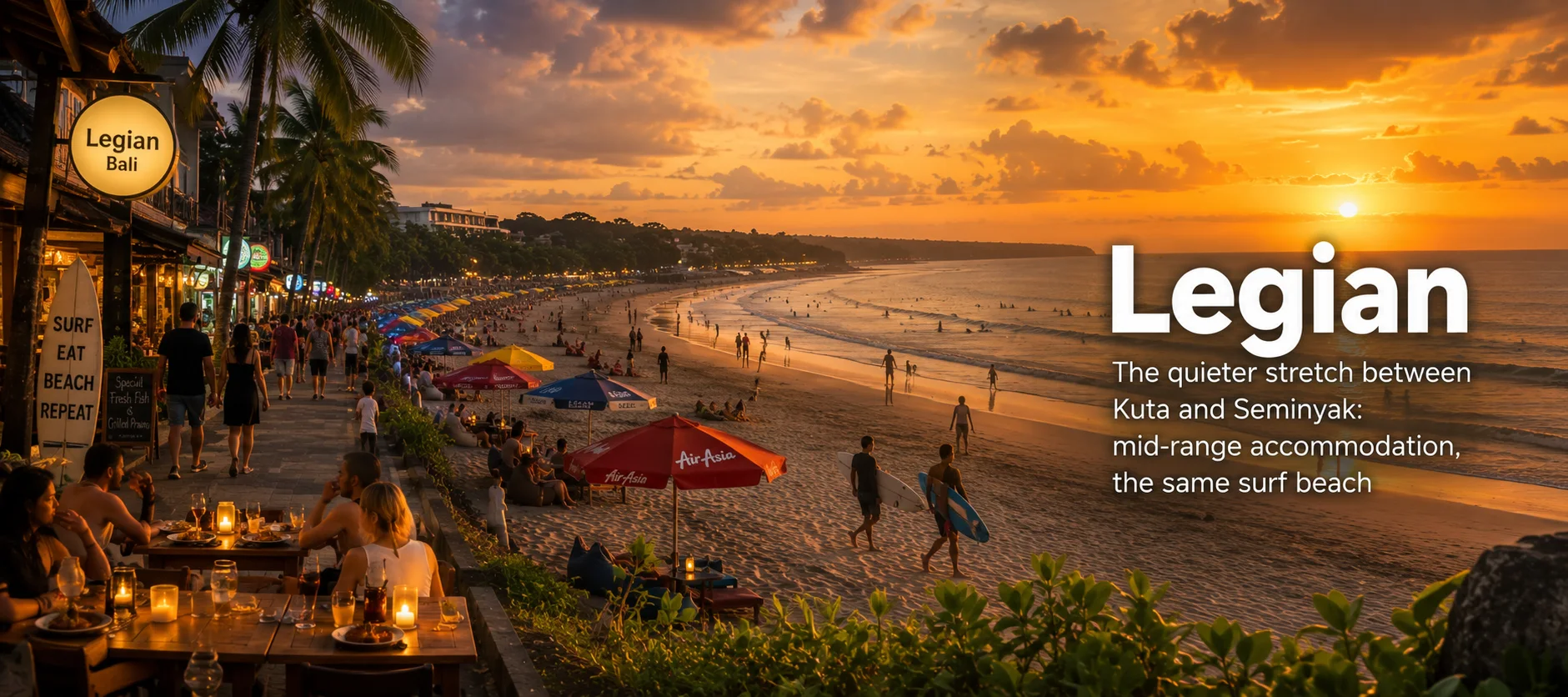
Legian is the useful middle child of South Bali: less frantic than central Kuta, less polished and pricey than parts of Seminyak, and close enough to both that you can borrow whichever mood you want.
I would pick Legian for a straightforward beach holiday where walking to food, bars, surf and sunset matters more than having the trendiest postcode. It is not mysterious, but holidays do not earn bonus points for being difficult.
01 What Legian is — and why the location matters
Legian occupies the South Bali coastal strip between Kuta to the south and Seminyak to the north. The boundaries blur in everyday use, especially around Double Six, but the practical point is simple: you can stay in a lively beach area without committing fully to Kuta’s intensity or Seminyak’s higher-end identity.
I think Legian makes more sense when you stop asking whether it is “really Kuta” or “basically Seminyak”. The blurred boundary is part of the advantage.
That middle position is Legian’s strength. It suits travellers who want a walkable holiday core, surf and sunset nearby, lots of mid-range accommodation and easy access to neighbouring districts. It is not a quiet village escape, and traffic can still be heavy once you leave the compact beach-and-shopping grid.
02 Who Legian suits compared with Kuta and Seminyak
First-time Bali visitors often find Legian easy because the essentials are close together: accommodation, beach access, restaurants, convenience stores, spas and shopping. Families can choose resort-style properties around Padma, while couples and groups can still reach busier evening areas without travelling across the island.
Choose Kuta if you actively want the busiest budget-tourism core and its shopping/nightlife concentration. Choose Seminyak if your priority is a more polished dining, boutique and beach-club scene. Choose Legian when you want to borrow from both while keeping a slightly more relaxed, often better-value base.
03 Legian Beach: surf, sunset and swimming reality
Legian shares the same long west-facing sand strip that continues through Kuta and Seminyak. It is popular for sunsets, beach walks and beginner surf lessons. Conditions vary by day and season, so judge swimming and surfing by the actual sea rather than by how calm the beach looks from a café.
Treat Legian Beach as open west-coast surf water first and a swimming beach second. Sunset is reliable as an idea; sea conditions are not.
Many Indonesian beaches are not patrolled to Australian standards, and strong currents can occur. Ask local lifeguards or reputable surf operators about conditions, obey flags where present and do not overestimate swimming ability. For beginner surfing, choose an instructor who provides a proper briefing, suitable board and clear operating area.
04 Where to stay: Padma, central Legian and the Double Six edge
The Padma area is a strong all-round base for families and travellers who want resort facilities, restaurants and beach access close together. Central Legian around Jalan Legian is busier and more commercial, with shops, bars and traffic. The northern edge toward Double Six blends into the Seminyak scene and gives easy access to both areas.
For me, the Padma/central/Double Six choice is more important than star rating. The right micro-location can save more holiday time than a fancier lobby.
Do not book solely from the neighbourhood label. Check the exact street, distance to a usable beach entrance, whether the route is comfortable on foot and what sits beside the property. A hotel described as ‘Legian’ can be much more convenient — or much noisier — than another with the same area name.
05 Food, bars and evenings
Legian’s strength is range rather than one defining food scene. You can find Indonesian food, casual international restaurants, hotel dining and bars without much planning. For a more destination-led restaurant evening, Seminyak is close; for a louder late-night scene, parts of Kuta remain within reach.
If you drink, use the same precautions you would anywhere unfamiliar: keep control of your drink, use reputable venues and plan transport home before the night gets late. Current Australian travel advice warns about drink spiking and methanol poisoning in Indonesia, including Bali, so sealed branded drinks and reputable venues are the safer choice.
06 Shopping, spas and low-effort holiday days
Jalan Legian and surrounding streets mix surf shops, souvenir outlets, clothing, convenience retail and informal market-style shopping. Prices and quality vary, so compare rather than assuming a fixed ‘tourist price’. Bargain politely where bargaining is clearly part of the transaction; do not haggle aggressively in fixed-price shops.
Legian also has a large concentration of massage and spa businesses. That makes it easy to build a low-effort day around beach, lunch and a treatment. For choosing a provider, use our Bali spa and massage guide, especially for hygiene, consent and treatment expectations.
07 Walking, accessibility and traffic
Within the beach-side core, Legian is one of the easier South Bali districts to explore on foot by local standards. Distances between beach access, restaurants and shops can be short. Footpaths, however, can be uneven, interrupted or occupied, and major road crossings demand attention.
Travellers with mobility needs should inspect the exact route between hotel, beach and main streets rather than relying on a ‘walkable’ label. Beach access can involve sand, steps or uneven paving. Traffic congestion also means a five-minute map distance can become a longer vehicle trip at busy times.
08 Airport transfers and getting around
Legian is geographically close to Ngurah Rai Airport, but transfer times are traffic-dependent. Avoid publishing or planning around a guaranteed 15- or 20-minute airport run. Leave generous time for departures, particularly around peak road periods, rain, ceremonies or major events.
For day-to-day transport, walking works for the immediate area; app-based cars, taxis or private drivers are useful for longer trips. Scooters are not a sensible default for inexperienced riders. See our getting around Bali guide for current transport choices and safety considerations.
09 Using Legian as a base for day trips
Legian is convenient for South Bali beaches, Seminyak, Kuta, Jimbaran and the Bukit, but central and east-Bali day trips can involve substantial road time. Ubud, temples and highland attractions are better treated as full days rather than casual detours between meals.
Legian is a good base for South Bali, not a magical teleport to North or East Bali. If your wishlist lives on the other side of the island, move hotels instead of proving a point.
Start longer excursions early and group sights geographically. The convenience of Legian is strongest when you do not spend half the holiday repeatedly crossing the same congested corridors. If culture and inland scenery dominate your itinerary, consider splitting the stay rather than using Legian for every night.
10 A simple two-day Legian plan
Day one can be deliberately local: beach or surf lesson in the morning, lunch nearby, an afternoon spa or shopping session and sunset on the sand before dinner. Day two can explore Seminyak or Kuta on foot and by short transfer, or use Legian as the pickup point for a planned South Bali excursion.
Legian works best when you use its compact convenience rather than treating it as a checklist of attractions. For accommodation decisions, compare our best area to stay in Bali, Kuta guide and Seminyak guide.
TATS Man bottom line: Legian is the sensible compromise that often works better than either extreme. Pick it when you want beach, value and easy evenings without needing the destination itself to be the headline.
Cheers, Carpe Diem & Stay in the Middle, Not the Traffic! 🍻⏳🌅
your Kuta-to-Seminyak middle-ground correspondent

About the author
TATS Man
Travel journalist · digital nomad since 2007 · visiting Bali since 1989
TATS Man is the beer-loving cyborg travel journalist behind Totally Bali and TATS (Totally Awesome Travel Sites). He has travelled and worked remotely since 2007 and has been visiting Bali since 1989. His guides combine long-term destination familiarity with current primary-source research — and he does not claim first-hand experience where he does not have it.