
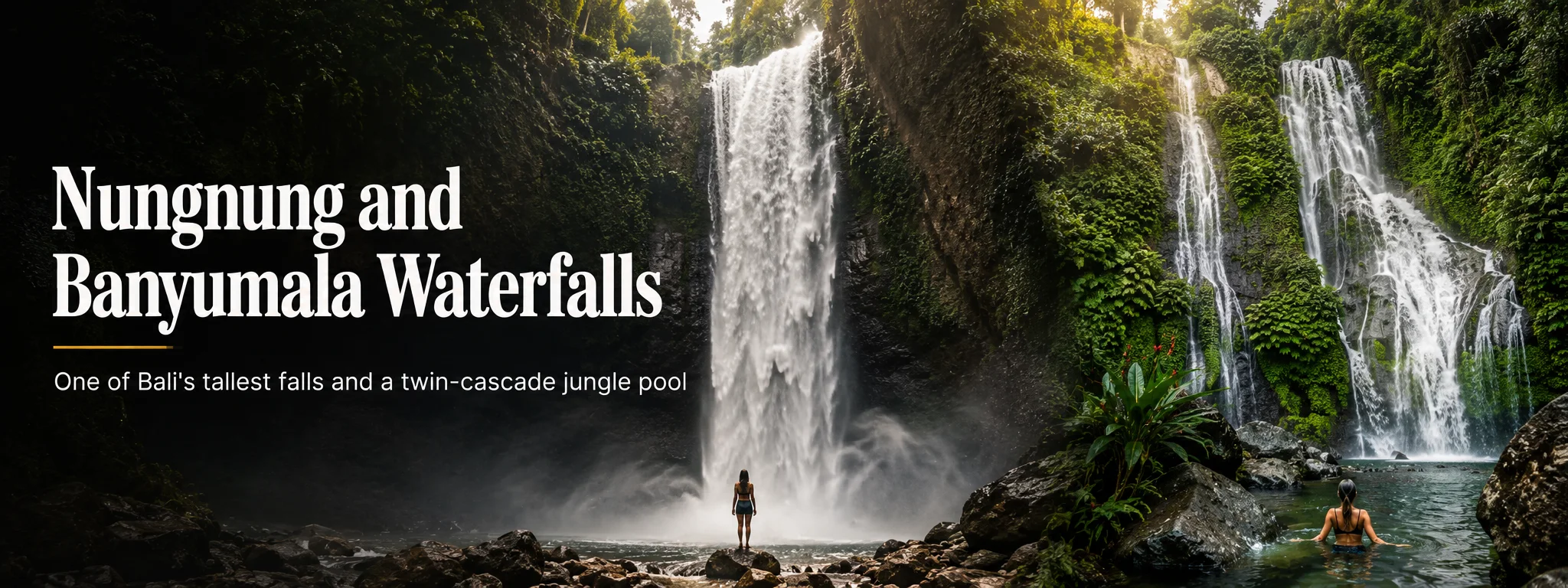
01 First: these waterfalls are not neighbours
Nungnung and Banyumala are often grouped together because both sit in Bali’s cooler highlands, but they belong to different travel days. Nungnung is north of Ubud in the central mountains, while Banyumala is closer to the Munduk–Wanagiri–twin-lakes area in North Bali. Trying to visit both simply because they appear on one list creates unnecessary driving.
Choose based on where the rest of your day is headed. Nungnung pairs naturally with a central-highlands route from Ubud or southern Bali. Banyumala fits far better with North Bali, Munduk, Wanagiri or Lake Buyan and Tamblingan. This one decision improves the trip more than arguing about which waterfall is objectively prettier.
02 Nungnung: big water and a serious staircase
Nungnung is the more forceful experience. The waterfall drops into a steep, green gorge and throws enough spray to soak the viewing area when the flow is strong. Indonesia’s tourism authority describes a drop of roughly 50 metres, but the number matters less than the feeling when you reach the bottom: it is loud, wet and enclosed by jungle.
The price of that drama is the staircase. You descend hundreds of steps, which means you must climb them again when you are tired and damp. The route is straightforward rather than technically difficult, but heat, humidity and slick steps make it harder than the distance suggests. Take your time on the return and do not plan Nungnung immediately before a long flight or dressed-up dinner.
03 Who Nungnung suits — and who may hate it
Nungnung suits travellers who enjoy physical stops and want a waterfall that feels powerful rather than manicured. It is also good for photographers who like scale, mist and dark jungle rather than a neat swimming pool. Go early for cooler conditions and a quieter staircase, especially if you are visiting in a busy period.
It is a poor choice for anyone with knee problems, limited mobility or a strong dislike of steep steps. Parents should think carefully about carrying very young children on a wet staircase. Swimming conditions change with rainfall and flow; never assume that because people swam in an old photo the pool is safe today. Keep back from heavy falling water and slippery rock.
04 Banyumala: twin cascades and a gentler atmosphere
Banyumala has a softer visual character. Multiple streams fan down a green rock face into a broad pool, creating the twin-waterfall look that made it famous. The setting feels more open and, when conditions are calm, more inviting for a swim than Nungnung. That does not mean effortless access: you still descend into a valley and you still need to climb back out.
The approach road and parking arrangements can feel more rural than visitors expect, which is part of the experience. Conditions change after rain, so a driver familiar with the highlands is useful if you are not confident on narrow roads. Once on foot, wear shoes with grip and assume muddy patches are possible even when the weather in your hotel area is dry.
05 Swimming at Banyumala
Banyumala is often chosen specifically for the pool, but natural-water safety still applies. Rain upstream can alter flow and water quality quickly. Enter gradually, stay away from the strongest falling water and do not jump from rocks unless a responsible local operator explicitly says conditions are safe. There is no reason to turn a beautiful swim into a dare.
Bring a towel, dry bag or waterproof pouch and a change of clothes if the waterfall is not your final stop. The highlands are cooler than the south, and sitting in wet clothing during a long drive is miserable. If the water is turbulent or brown after heavy rain, enjoy the view and skip the swim.
06 Dry season, wet season and waterfall reality
Waterfalls are most photogenic when there is plenty of water, but more water also means more spray, stronger currents and slipperier access. Dry season generally makes paths easier and swimming more predictable, while wet season can create impressive flow and lush vegetation at the cost of more mud and weather uncertainty.
Do not rely on conditions from the previous day, let alone from a viral video. Highland rain can be very local. If there has been sustained heavy rain, ask locally before descending and be willing to change plans. Bali has enough waterfalls that missing one dangerous day is not a disaster.
07 Which one should you choose?
- Choose Nungnung for scale, spray and a more physical descent.
- Choose Banyumala for a beautiful pool and a North Bali highlands day.
- Choose neither if heavy rain has made access unsafe.
- Choose by route rather than trying to force both into the same itinerary.
If you only have one waterfall day from Ubud, Nungnung is usually the cleaner fit. If you are staying in Munduk or Lovina, Banyumala is the obvious choice. Travellers crossing the island can sometimes fit either one into a transfer day, but leave luggage securely with your driver and avoid arriving at a steep trail exhausted after hours in traffic.
08 Build a sensible Nungnung day
From Ubud or South Bali, Nungnung combines well with highland scenery rather than another remote waterfall. You might continue toward Bedugul, Ulun Danu Beratan or a coffee stop, depending on your route. Keep the schedule loose because the staircase and drive can take more energy than expected.
Avoid stacking Nungnung with a late-afternoon commitment on the opposite side of the island. A waterfall stop is much nicer when you can walk slowly, cool down, change clothes and have lunch rather than rushing up the steps because a sunset booking is waiting two hours away.
09 Build a sensible Banyumala day
Banyumala fits naturally with Wanagiri, the twin lakes, Munduk and parts of North Bali. It can also be included on a transfer between Ubud and Lovina if your driver is comfortable with the mountain roads. Pick two or three highland stops rather than collecting every viewpoint between Bedugul and the coast.
If you also want Handara Gate, remember that the gate is a short photo stop while Banyumala is the physical part of the day. Do the waterfall while you still have energy and daylight, then use easier roadside attractions later.
10 What to bring
Wear shoes with grip, not smooth sandals. Carry water, insect repellent, a small towel and a waterproof pouch for your phone. A light rain layer is useful even in dry season because the highlands can change quickly. If you swim, bring clothes you can change into without depending on elaborate facilities.
Most importantly, bring enough time. The common mistake is not inadequate equipment; it is an overfilled itinerary. Both waterfalls are better when you can descend carefully, stop for photos, sit by the water and climb back without checking the clock every five minutes.