
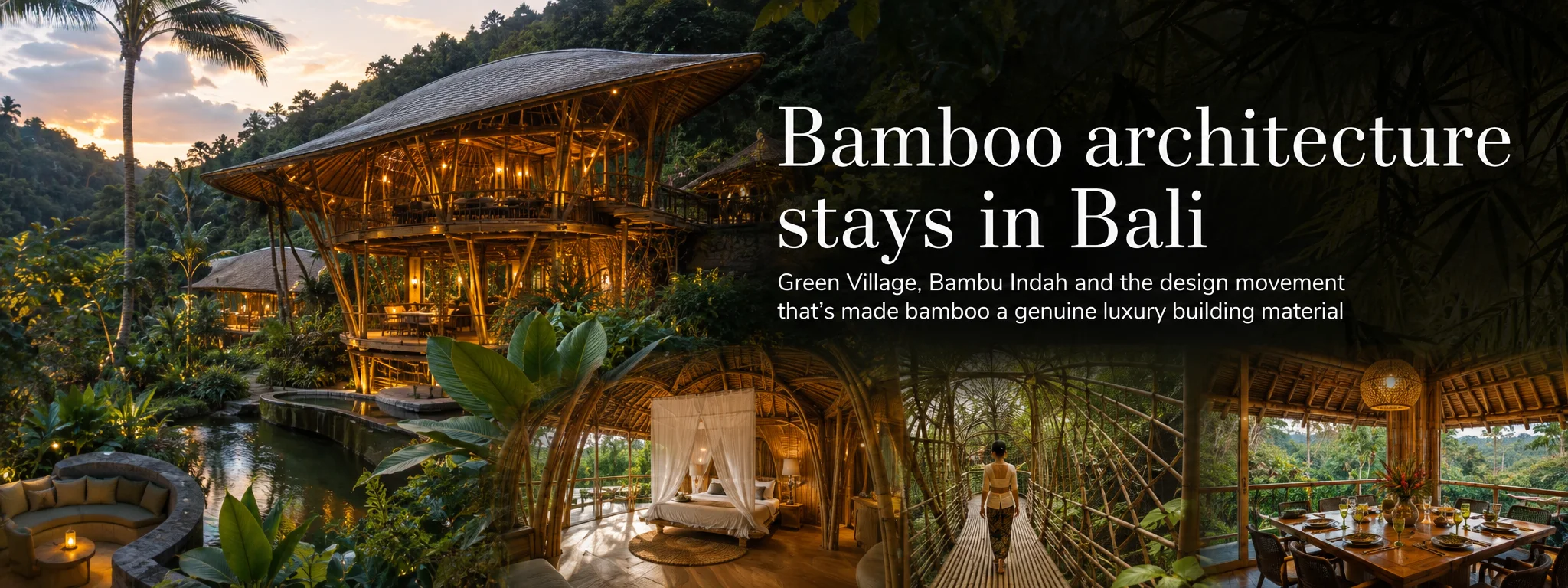
01 Bali's bamboo architecture movement
Over the past 15 years, a design movement centred around Ubud has transformed bamboo — a traditional, humble Southeast Asian building material — into a genuine luxury architecture medium, producing striking, curved, cathedral-like structures that have become internationally recognised design landmarks in their own right. This grew from the same circle that founded the Green School near Ubud, extending the material's use from education into hospitality.
02 Green Village
Green Village, in Sibang near Ubud, is a community of privately owned bamboo villas along the Ayung River — several available for short-term rental, each an individually designed structure showcasing different bamboo construction techniques, from soaring open-plan living pavilions to multi-storey curved forms that look more like sculpture than conventional building. Staying here is as much an architectural experience as an accommodation choice.
03 Bambu Indah
Bambu Indah, a boutique hotel property near Ubud founded by the same people behind the Green School, offers a range of bamboo structures alongside restored antique Javanese joglo houses relocated to the site — a genuinely distinctive combination of traditional and contemporary approaches to sustainable, natural-material architecture. The property includes a well-regarded restaurant sourcing from its own organic gardens.
04 Why this design movement matters
Beyond the aesthetic appeal, Bali's bamboo architecture movement represents a genuine sustainability statement — bamboo grows far faster than timber, sequesters carbon effectively, and the structures demonstrate that natural materials can achieve genuinely dramatic, high-end architectural results rather than being limited to rustic or budget applications. For design-focused or sustainability-minded travellers, a stay at one of these properties offers something meaningfully different from Bali's more conventional luxury villa aesthetic.
05 Practical notes
Both properties are a short drive from central Ubud, allowing easy access to the town's restaurants and cultural sites while staying somewhere architecturally distinctive. Book well ahead given the relatively limited number of units at each property and their strong design-tourism appeal.
06 Why bamboo appears so often in Bali
Bamboo grows rapidly in tropical climates, has a high strength-to-weight ratio and can form dramatic curves with relatively light structural systems. Bali’s craft skills and experimental hospitality market have made the island a showcase for bamboo pavilions, schools, villas, bridges and interiors.
That popularity has also produced imitation. A photogenic woven roof or bamboo bed does not mean the building is structurally bamboo, environmentally exemplary or designed for the climate. Judge the whole building and its operation.
07 Bamboo is not one uniform material
Different bamboo species, culm ages and wall thicknesses suit different structural roles. Selection, harvesting time, drying and grading influence performance. Designers may use large-diameter culms for primary frames and smaller elements for battens, screens or furniture.
Natural variation is part of the material. It also means builders need experienced detailing rather than treating every pole as an interchangeable steel tube.
08 Treatment is essential
Untreated bamboo is vulnerable to insects and decay. Durable construction depends on harvesting mature material, reducing starch attractive to pests, appropriate preservative treatment, thorough drying and protection during storage.
Visitors cannot verify treatment by appearance. For an accommodation booking, evidence of competent professional design, a well-maintained structure and an operator able to explain inspections matters more than a vague “natural” claim.
09 The central design rule: keep it dry
Wide roof overhangs, raised bases, drainage, ventilation and details that prevent water collecting at joints are fundamental. Bamboo ends should not sit in soil or remain exposed to splash. Leaks that seem minor can create serious deterioration when ignored.
Bali’s humidity makes airflow valuable, yet fully open buildings also admit wind-driven rain. A successful design balances openness with protection rather than assuming tropical weather is always gentle.
10 Connections and engineering
Bamboo culms are hollow and can split when bolts or joints are poorly designed. Skilled structures use connection systems that distribute forces and accommodate the material’s form. Complex arches and sweeping roofs require engineering, prototyping and disciplined construction.
Do not assume an organic shape grew intuitively. The apparent freedom of the best buildings usually rests on careful geometry, load paths and repeated craftsmanship.
11 Fire and electrical safety
Bamboo is combustible. Responsible buildings need fire planning appropriate to their use: safe electrical installation, protected kitchens, extinguishers, alarms, clear exits and staff procedures. Treatments and finishes may influence fire behaviour but do not remove risk.
Guests should know the exit route, avoid candles or smoking where prohibited and report damaged wiring. Decorative extension leads and overloaded adaptors are poor companions to any natural-material building.
12 Thermal comfort, insects and sound
High roofs and cross-ventilation can make bamboo spaces comfortable without sealing every room. Open design, however, allows insects, humidity, animal sounds and neighbouring noise. Mosquito nets, screens, fans and thoughtful bedroom enclosures determine whether romance survives the night.
Rain on lightweight roofs can be loud. Privacy may be limited where walls are woven or open. Read reviews for sleep and weather performance, not just architecture photographs.
13 Maintenance is part of the architecture
Bamboo buildings require inspection for moisture, insect activity, cracking, loose connections, roof leaks and finish breakdown. Individual components may be replaceable, which is an advantage only when an operator actually maintains them.
Fresh coatings can conceal rather than solve a water problem. Accommodation managers should respond clearly when guests report movement, leaks or damaged rails.
14 Sustainability claims need context
Rapid renewability is a genuine advantage, but a building’s impact also includes land use, treatment chemicals, transport, concrete foundations, imported fittings, energy, water, wastewater, waste and eventual repair. “Made from bamboo” is not a complete environmental assessment.
Better projects explain sourcing, treatment, local employment, water systems and operational performance. Beware of claims that turn one visible material into proof that every part of a resort is sustainable.
15 Craft, innovation and cultural respect
Bali’s bamboo movement draws on Indonesian material knowledge while also involving contemporary engineers, designers and international clients. Avoid presenting every curved building as an untouched ancient Balinese tradition. Many celebrated forms are modern experiments.
Credit craftspeople and communities rather than only a famous designer or owner. If visiting a school, workshop or private project, follow access rules and do not interrupt work for photographs.
16 What to check before booking a bamboo stay
- Is the bedroom enclosed, screened or fully open?
- How are valuables secured?
- Are bathrooms private and weather-protected?
- What are the stairs, rails, bridges and night lighting like?
- Are smoke alarms, extinguishers and exits evident?
- Can children reach pools, ponds or unguarded drops?
- How does the property handle heavy rain and power outages?
- Can a car or emergency vehicle reach the site?
17 Accessibility and family suitability
Dramatic bamboo accommodation often uses stairs, split levels, hanging nets, steep paths and open edges. This can be unsuitable for toddlers, guests with limited mobility or anyone uncomfortable with heights. Ask for an unedited access video and exact stair count.
“Eco retreat” should not be used to dismiss accessibility. Some properties integrate ramps and level routes intelligently; others are genuinely constrained. Choose based on verified design, not hopeful assumptions.
18 Visiting architecture responsibly
Many buildings seen online are operating schools, homes, hotels or private venues rather than public attractions. Confirm visitor access and any tour arrangements. Do not enter, fly drones over or photograph residents through open walls without permission.
When a legitimate tour is available, focus on how the building works: water shedding, ventilation, connections, maintenance and use. The most interesting feature is rarely just the curve visible on Instagram.
19 The sensible verdict
Well-designed bamboo architecture can be beautiful, efficient and deeply suited to tropical life. Poorly detailed bamboo can deteriorate quickly, feel uncomfortable and hide behind environmental language. The difference lies in treatment, engineering, protection, operation and care.
Book the experience for its complete design and management—not merely because the roof is photogenic.