
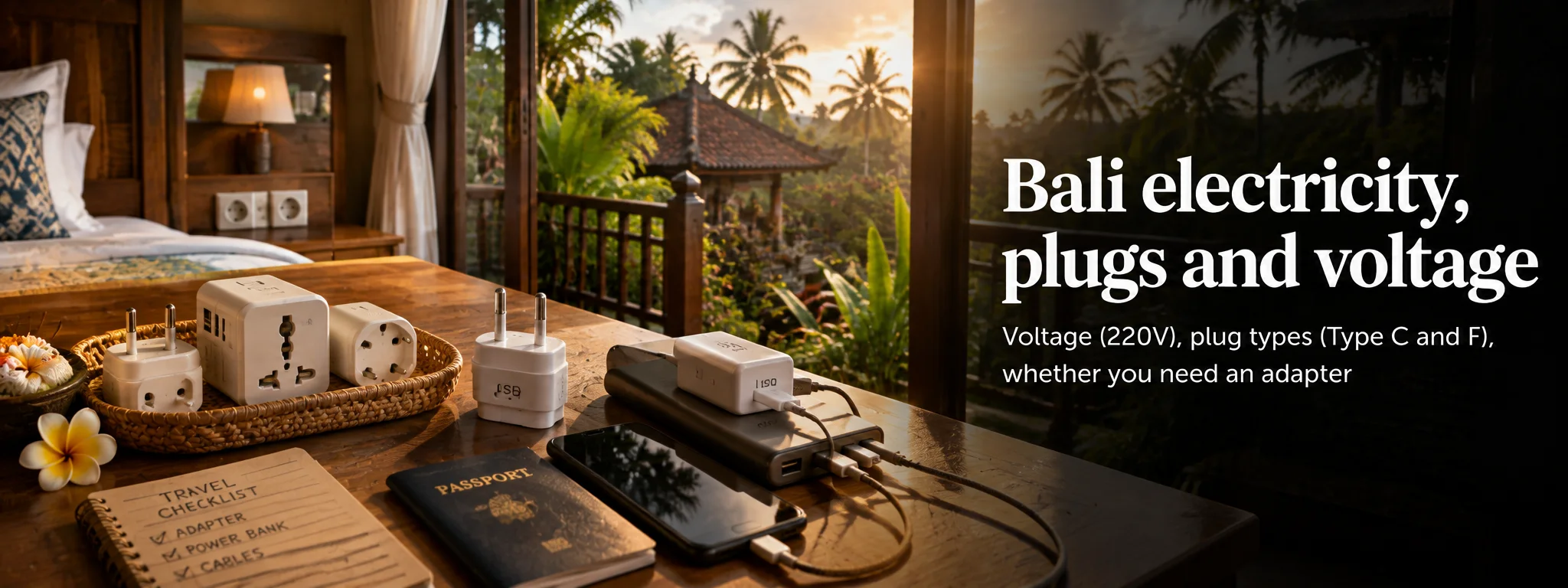
01 Indonesia’s electricity standard: 230V, 50Hz
Indonesia Travel lists the national supply as 230 volts at 50 hertz. Older Bali guides often say 220V; for practical travel advice, 230V is the current standard you should use when checking equipment.
Voltage matters for devices that connect directly to mains power. Frequency matters mainly for certain motors, clocks and specialised equipment. Most phone, camera and laptop chargers are designed for a wide input range.
The distinction between 220V and 230V rarely changes what a modern dual-voltage charger does, but it matters when you are checking older or specialised equipment. Use the rating printed on the device, not a ten-year-old travel blog.
02 Bali mainly uses Type C and Type F sockets
Type C is the familiar two-round-pin Europlug. Type F also uses two round pins but adds grounding contacts. Many Bali hotels, villas, cafes and coworking spaces use one or both of these European-style sockets.
Do not assume every outlet in an older building is grounded just because your plug physically fits. If grounding matters for expensive or specialised equipment, ask the accommodation.
Type C plugs are ungrounded. Type F sockets can provide grounding when used with compatible earthed plugs, but adapters vary widely. A cheap two-pin adapter may remove the earth connection from equipment that was designed to have one.
03 Adapter and voltage converter are different things
A plug adapter changes the shape of the pins. It does not change the electricity. A voltage converter changes the voltage supplied to a device that cannot safely accept 230V.
Check the label on the charger or appliance. If it says something like INPUT 100–240V, 50/60Hz, you usually need only the correct plug adapter. If it is rated only for 110–120V, do not plug it directly into Bali mains power.
Do not buy a converter purely because a product page tells every American traveller they need one. First check the device input label. Most USB chargers are already universal; many hair tools and older appliances are not.
04 Quick guide for common home countries
Australia/New Zealand: 230V is compatible with most normal devices, but Type I plugs need a Type C/F adapter. United Kingdom: voltage is broadly compatible; Type G plugs need an adapter. Continental Europe: many Type C/F plugs fit directly.
United States/Canada: Type A/B plugs need an adapter and single-voltage 110–120V appliances may also need a converter. Japan: check voltage carefully because many appliances are designed for lower supply voltage.
For mixed-country travel, a compact high-quality universal adapter can be useful, but large universal blocks sometimes fit loosely in recessed Indonesian sockets. A simple dedicated Europlug adapter is often more stable.
05 Phones, laptops and cameras are usually easy
Modern USB phone chargers, laptop bricks and camera chargers commonly accept 100–240V, making them suitable for Bali with only a plug adapter. Still read the tiny print on the charger rather than assuming.
A compact multi-port USB charger can reduce the number of adapters you need. Avoid cheap, loose multi-plugs that spark or sag out of the wall under the weight of several chargers.
USB-C Power Delivery simplifies travel further: one capable charger can often handle a phone, tablet and laptop. Match the charger’s wattage to the laptop requirement, especially for larger MacBooks, gaming laptops or other high-power devices.
06 Hair tools and high-watt appliances deserve extra caution
Hair dryers, straighteners, kettles and other heating appliances are the classic voltage problem. Dual-voltage travel models are easy; single-voltage 110V appliances are not. A tiny “travel converter” may not safely handle a high-watt dryer even if the packaging looks convincing.
The simplest option is often to use the hotel’s appliance or buy a locally compatible one rather than carrying a heavy transformer.
Never use a device that becomes unusually hot, smells burnt or makes an adapter crackle. Disconnect it immediately. High humidity and loose sockets are a poor combination with overloaded travel gear.
07 Power cuts and surges can happen
Bali’s electricity is generally reliable in developed visitor areas, but outages still happen during faults, maintenance, storms and local network problems. Remote areas may experience longer interruptions or rely partly on generators.
If you work online or carry expensive electronics, a quality surge-protected power board and a charged power bank are sensible. Unplug sensitive gear during obvious electrical trouble rather than trusting a bargain adapter.
A power bank is also useful during long road transfers and boat days. Airlines generally require spare lithium batteries and power banks to travel in cabin baggage rather than checked luggage; check your airline’s current watt-hour limits before flying.
08 Hotel and villa sockets are not all equal
Newer hotels may offer universal sockets, USB-A or USB-C charging, while older villas may have only a few Type C/F outlets in awkward locations. Universal sockets are a convenience, not something to depend on.
Remote workers should ask how many usable outlets are near the desk and whether the property has backup power. Families should keep loose adapters and power boards away from children.
If you need bedside medical charging, hair tools or several work devices, ask for a room photo showing outlets. “Universal sockets available” can mean one socket behind the television.
09 Medical equipment and remote-work gear need a backup plan
For CPAP machines, mobility-device chargers or other medically important equipment, confirm voltage, plug type and battery backup with the manufacturer before travel. Do not rely on a hotel receptionist to determine electrical compatibility.
For work, keep critical files synced and enough battery to survive a short outage. If uninterrupted power is essential, choose accommodation or coworking with generator or UPS backup and verify it directly.
Bring manufacturer contact details or a screenshot of the device’s input requirements if the equipment is critical. For anything irreplaceable, carrying a second compatible adapter is cheap redundancy.
10 What to pack
- One good Type C/F travel adapter for each cluster of devices.
- A multi-port charger rated for 230V.
- A power bank for phones and travel days.
- Voltage confirmation for any high-watt or medical appliance.
- Optional surge protection for expensive electronics.
For most Australian travellers, the practical answer is simple: bring a European-style plug adapter; you normally do not need a voltage converter for modern electronics.