
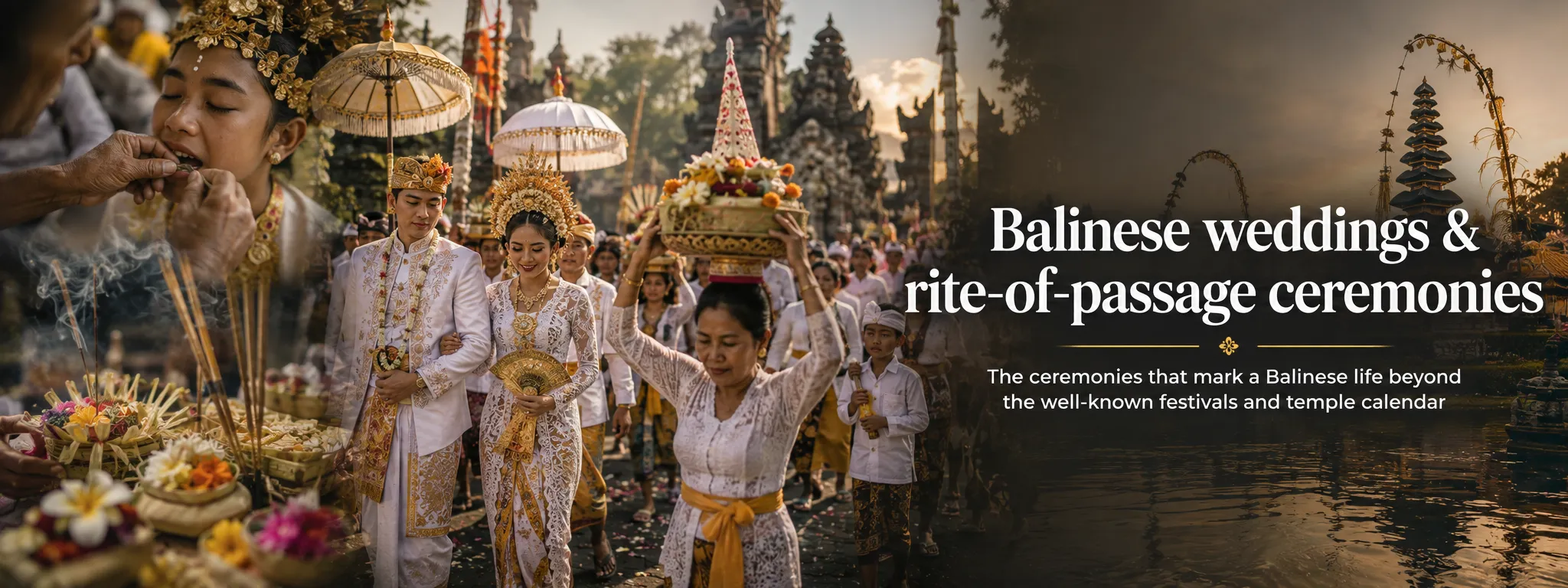
01 Life in Bali is marked by ceremonies, not just festivals
Visitors quickly notice temple festivals, processions and offerings, but some of Bali’s most important ceremonies happen around family life. Birth, a child’s first months, calendrical birthdays, tooth filing, marriage and death all sit within a wider religious cycle.
That is why a Balinese wedding cannot be understood as simply a local version of a Western wedding. It is a family, religious and community event with ritual obligations that may begin before the visible celebration and continue after it.
The scale can range from a relatively contained household rite to an event involving large numbers of relatives and neighbours. What looks extravagant to an outsider may reflect obligations accumulated through years of reciprocal help at other families’ ceremonies.
02 Pawiwahan: Balinese Hindu marriage
Pawiwahan is a commonly used term for Balinese Hindu marriage. The ceremony establishes the couple within family and religious relationships as well as recognising their marriage. Offerings, prayers, purification and blessings may form part of the sequence.
There is no single script that every couple follows. Family tradition, village custom, lineage, priestly guidance and the circumstances of the marriage all matter. Commercial “Balinese wedding packages” at hotels should not be treated as a blueprint for a household pawiwahan.
For the couple, marriage can also affect where they live and how they participate in household temples and customary obligations. Those social consequences are one reason the ceremony cannot be reduced to clothes, decorations and a reception meal.
03 Formal proposal and elopement traditions
Balinese marriage traditions include more than one pathway. A formal proposal process is commonly described as memadik or mapadik, involving negotiations and visits between families. Another traditional route, often called ngerorod or merangkat, involves consensual elopement followed by the family and ritual processes required to regularise the marriage.
These categories have legal, family and local variations, and modern couples make choices for many reasons. Avoid turning them into romantic stereotypes such as “all Balinese couples elope” or “parents arrange every marriage”. Contemporary life is more varied.
04 Why auspicious dates matter
Major ceremonies are commonly timed with reference to Balinese calendrical systems and advice from people with ritual knowledge. That can produce clusters of weddings or other ceremonies on days considered favourable.
For travellers, this explains why a road or village may suddenly be full of decorated entrances, parked vehicles and ceremonial activity. It also means a wedding date is not always chosen solely by venue availability or a Saturday-night preference.
Balinese calendrical life uses overlapping systems, including the 210-day Pawukon cycle and the Saka lunar calendar. Travellers do not need to master them, but understanding that ceremonies are scheduled within these systems explains why dates do not map neatly onto Western annual anniversaries.
05 Family, banjar and menyama braya
Large ceremonies require labour: cooking, decorating, preparing offerings, receiving guests, managing traffic and carrying out ritual tasks. Much of that work is supported by relatives and the local banjar or neighbourhood community.
Academic work on Balinese ceremonies often discusses menyama braya — the ethic of treating others as kin and maintaining reciprocal community relationships. The visible wedding day sits on top of this network of cooperation. It is one reason ceremonies can involve far more people than the immediate family.
Community help is reciprocal. A household receiving labour, food preparation or logistical support today may be expected to contribute when another family holds its own ceremony. That ongoing exchange is part of what makes ceremonial life socially sustainable despite the enormous workload.
06 Dress, offerings and visual symbolism
Balinese wedding clothing can be exceptionally elaborate, but costume is not the ceremony itself. Dress, headdresses, textiles, flowers, offerings and the family compound all carry context that a quick visitor photo may not reveal.
Bale manten — a traditional pavilion associated with newlyweds in some compounds and ceremonies — is one example of how architecture and ritual overlap. Indonesia Travel describes it as a sacred space for the couple to receive blessings and undertake important rites.
For visitors, the visual richness can be overwhelming: layered textiles, gold-toned accessories, floral decoration and carefully arranged offerings. Enjoy the detail, but remember that what looks like styling may have ritual or family significance. Ask before touching or trying on ceremonial items.
07 Tooth filing and other rites around adulthood
Mepandes, metatah or mesangih refers to the tooth-filing ceremony, an important Balinese Hindu life-cycle rite associated with maturity and spiritual refinement. It may be held before marriage or combined with other major family ceremonies for practical and ritual reasons.
Visitors sometimes hear that “every Balinese person files six teeth before getting married”. The reality is more flexible. Timing and circumstances vary, and the rite should not be reduced to a quirky dental custom.
08 If you are invited to a Balinese wedding
An invitation is a generous opportunity to see family life from inside, but follow your host’s cues. Ask about dress before arriving; modest clothing and a sarong are often appropriate, but the family can tell you what is expected in that setting. Arrive when advised rather than assuming the Western reception schedule applies.
Do not wander into shrine areas, move offerings for a photograph or interrupt prayers. Gifts and envelopes vary by relationship and local custom, so ask the person who invited you rather than relying on a universal online amount.
If the invitation comes through a hotel staff member, driver or friend, ask whether you are being invited as their guest or whether they are simply telling you where a ceremony is happening. That small distinction prevents an awkward assumption that any visible celebration is open to strangers.
09 If you simply encounter a ceremony
Many ceremonies spill into lanes, roads and shared village spaces. You may pass decorated entrances, temporary kitchens, gamelan groups or processions without having been invited. Looking from a respectful distance is usually very different from walking into the compound.
Photography should follow the same principle. Wide public scenes may be acceptable, but close portraits of the couple, priests or emotional family moments deserve permission. A camera does not create access rights.
10 The life-cycle continues after marriage
Marriage is not the endpoint of Balinese ceremonial life. Family responsibilities continue through later household and temple rites and eventually through death ceremonies such as Ngaben. The religious relationship with ancestors then continues beyond the cremation itself.
Seeing weddings in this broader cycle makes Bali’s ceremonies easier to understand: they are not isolated events staged for spectacle. They are part of how families organise relationships with one another, with community, with ancestors and with the sacred.
The same perspective helps with every ceremony you encounter in Bali. Ask what stage of life or religious obligation it marks, who is responsible for organising it and how the community participates. Those questions reveal far more than simply asking whether tourists are allowed to take photographs.