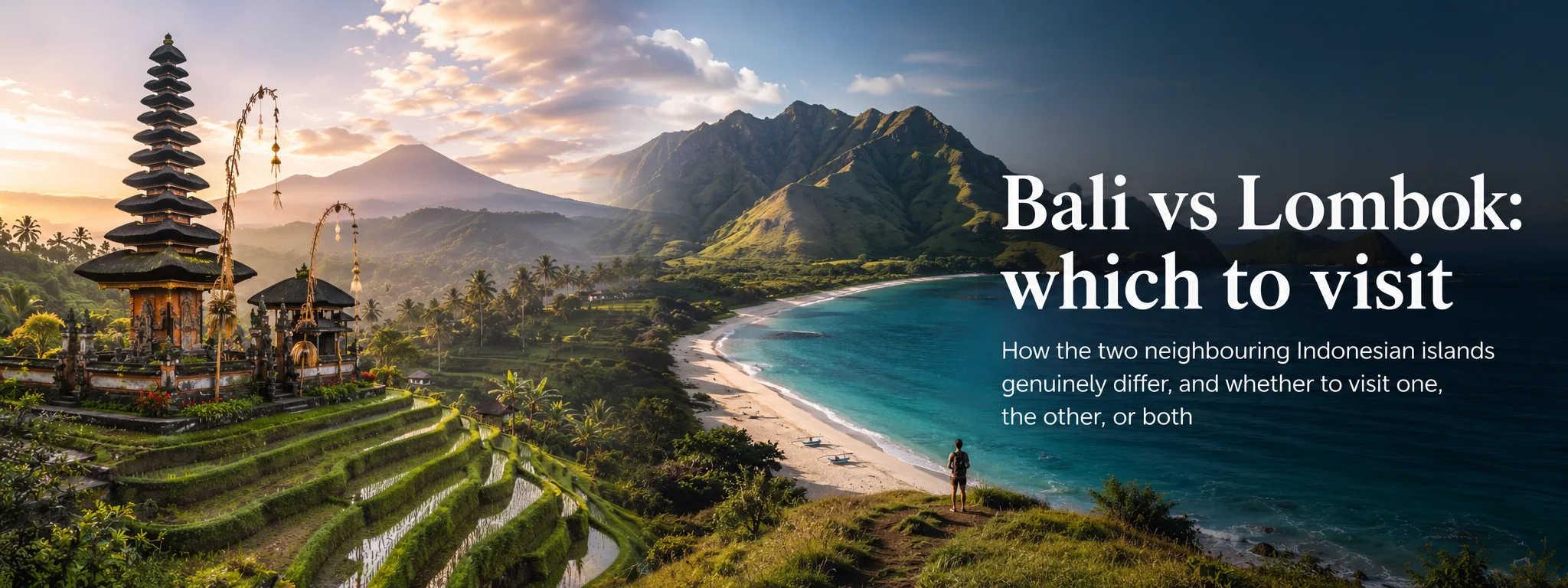
Bali or Lombok? Easy. Just decide whether you want more choice, more convenience and more going on — or more breathing room, quieter beaches and a trip that asks a little more planning from you. Neither island is the ‘better Bali’. They are neighbours with very different personalities, and that is exactly why combining them can work so well.
01 Neighbours, yes. Interchangeable, absolutely not.
Bali and Lombok sit close enough to look like obvious substitutes on a map. They aren’t. Bali has a much denser visitor economy — more accommodation at every level, more restaurants, nightlife, wellness, cultural attractions, international services and general ‘what shall we do tonight?’ choice. Lombok gives you more space, a slower rhythm and less tourism infrastructure outside the main hubs.
Neither description means better. It just means you should choose the holiday you actually want instead of asking which island wins an imaginary competition.
Trip length changes the answer. Bali is easier to make work on a short first visit because you can pile a lot of choice into one or two regions. Lombok rewards a little more settling in — Kuta Lombok, Senggigi, the north or a Rinjani-focused route — instead of trying to collect the island at speed.
02 Beaches: Lombok has space, Bali has variety
If your holiday fantasy is a long stretch of sand with fewer buildings behind it, Lombok has a genuine edge, especially around the south coast. Bali counters with far more beach variety: surf beaches, black-sand coast, manicured resort zones, reef breaks, calm-morning Sanur and a ridiculous number of different moods within one island.
Whichever island you pick, gorgeous water is not the same thing as safe swimming. Currents and exposure vary enormously. Choose with local conditions, not whichever drone shot bullied you into booking the hotel.
The Gilis complicate the comparison because they are part of West Nusa Tenggara and commonly combined with Lombok, yet many travellers reach them directly from Bali. If your priority is car-free island time, decide whether the Gilis are the main event instead of treating them as a footnote to either larger island.
03 Culture feels different because it is different
Bali’s Hindu temples, offerings, ceremonies and banjar life are woven through ordinary travel, which makes the cultural layer unusually visible even on a short visit. You don’t need to build a ‘culture day’ to notice it; it is already happening around you.
Lombok is majority Muslim with Sasak culture, mosques, weaving traditions and a different social rhythm. Away from resort areas, dress and behaviour can feel more conservative. That is not a downside; it is another reminder that you crossed to a different island with its own communities, not Bali with fewer cafés.
04 Surf, hiking and the great Rinjani temptation
Surfers can happily lose weeks on either island. Bali has the mature ecosystem — beginner beaches through to world-class reef breaks — plus waterfalls, volcano views and rice landscapes. Lombok adds superb south-coast surf and the big one for hikers: Mount Rinjani.
Rinjani is not something you casually squeeze between checkout and a sunset cocktail. Trekking rules, weather, closures and permits change, and the mountain deserves proper planning. If Rinjani is the centrepiece, build the Lombok part of the trip around it rather than treating it like another attraction pin.
Waterfalls and inland scenery exist on both islands, but access styles differ. Bali has more established visitor infrastructure around many sights; Lombok can require longer drives and more planning. That can feel either refreshing or inconvenient depending on how independent you like your travel.
05 Food and nightlife: Bali wins the numbers game
On sheer eating-and-drinking variety, Bali wins without much argument: warungs, vegan cafés, fine dining, beach clubs, bakeries, bars and international food are packed into multiple visitor hubs. Lombok still has plenty of good food — especially around Kuta Lombok and Senggigi — but it does not pretend to offer the same density.
Nightlife follows the same logic. Want ten options after dinner? Bali. Want a good meal, a beer and bed because you’re surfing at stupid o’clock tomorrow? Lombok may be exactly the point.
06 Getting between them: allow more time than the brochure says
Indonesia Travel lists the public ferry between Padang Bai and Lembar at roughly four to five hours in normal conditions, with vehicles carried aboard. Fast boats also connect Bali with Lombok and the Gilis from ports including Padang Bai and Serangan. Flights link Denpasar and Lombok as well.
Schedules, crossing times and sea conditions vary, so never build an airport connection around the most optimistic fast-boat marketing line you can find. Transfers happen at both ends, weather exists and luggage has opinions. Keep buffers.
Public ferry is slower but carries vehicles and operates as transport infrastructure rather than a tourist-only service. Fast boats are more convenient for many visitors but are more exposed to sea-state disruption. Flights avoid the crossing but add airport transfer and check-in time at both ends.
07 Getting around: Bali has more options and more traffic
Bali has more drivers, app-based transport in many visitor areas, rentals and visitor services. It also has the congestion to prove it. A short South Bali hop can take longer than a far bigger distance on an open Lombok road.
Lombok generally works best with private drivers or confident, properly licensed riders because attractions are more spread out and public transport is not designed around visitor sightseeing. On either island, riding uninsured because ‘everyone does it’ remains a terrible financial strategy.
App-based transport coverage and local pickup practices can differ by town. Do not assume the same Grab/Gojek experience you had in Canggu will work identically in a remote Lombok beach village. Ask your accommodation how guests actually move around before arrival.
08 Budget: ‘Lombok is cheaper’ is too easy
Lombok can absolutely feel cheaper in less-developed areas, but ‘Lombok is the cheap one’ is lazy advice. Bali’s huge accommodation market creates everything from bargain rooms to absurd luxury. Lombok’s remote transfers and activity costs can quietly eat the difference.
Compare the whole holiday cost: room, location, transfers, meals, activities and how often you need a driver. A cheap villa in the middle of nowhere can become a surprisingly premium transport subscription.
Activity costs also matter. A Rinjani trek, private island boat or long-distance driver can quickly outweigh savings on accommodation. Compare the trip you want to take, not generic “Bali costs X, Lombok costs Y” blog averages.
09 So which island actually suits you?
Choose Bali for a first Indonesia trip, short stays, culture, huge food choice, wellness, nightlife, family options and maximum convenience. Choose Lombok for quieter pacing, south-coast beaches, Rinjani, less-developed scenery and a trip where ‘nothing much nearby’ can actually be the selling point.
Surfers can love either. Families can love either. Couples can love either. The real separator is usually what you want surrounding the activity: lots of infrastructure and choice, or more space and less noise.
10 Can you do both without spending the whole trip in transit?
With 10–14 days, doing both can work beautifully: one or two Bali regions, then one principal Lombok base, with the Gilis only if island time genuinely matters to you. With one week, picking one island usually produces a better holiday than proving you know how to use three ferries.
And don’t count a transfer day as a sightseeing day because a spreadsheet says the boat takes two hours. Sea travel is weather-dependent, road transfers sit at both ends and delays happen. Fewer good stops beat an itinerary that spends half its life checking in.
TATS Man
the guy who keeps popping up everywhere
Got a question? Ask TATS Man · About the author