
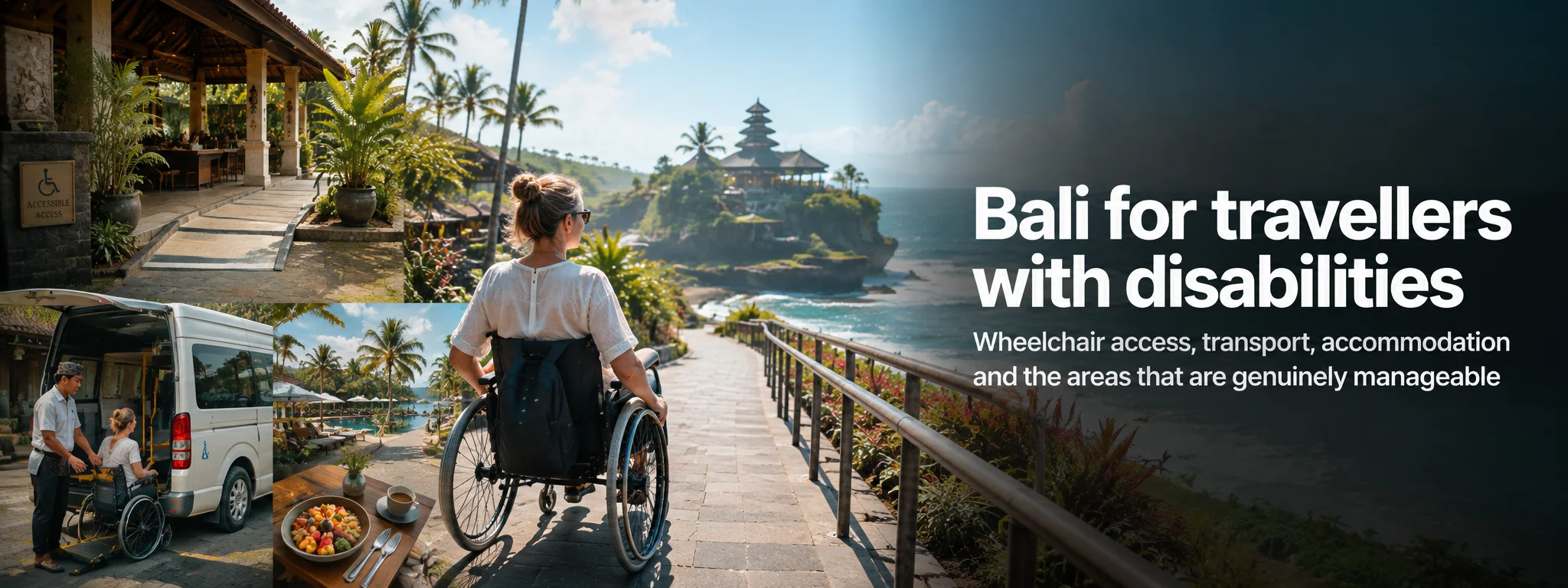
01 The honest accessibility picture
Bali can be a rewarding trip for travellers with disabilities, but accessibility is inconsistent. Newer hotels, malls, airport facilities and some large attractions may have ramps, lifts and accessible toilets, while temples, beaches, older streets and small businesses can involve steps, rough paving, steep gradients or narrow entrances.
The safest way to plan is to verify each essential part of the trip individually. Do not assume that “wheelchair friendly” on a booking site means step-free from the street to the room, or that an accessible bathroom has the grab rails, shower layout or turning space you need.
02 Airport assistance: arrange it before flying
I Gusti Ngurah Rai International Airport publishes a dedicated Special Needs Service covering assistance such as wheelchairs, accompanying staff and a special waiting area. Its current service standard also lists special-needs counters, dedicated access into check-in and staff support.
Request airline wheelchair or mobility assistance when booking and reconfirm before departure; airport support and airline handling are related but not identical. If you travel with a powered wheelchair or mobility device, confirm battery rules and how the device will be handled with the airline in advance.
For arrival, pre-book a driver who knows you are travelling with mobility equipment. A normal airport car may not have boot space for a rigid chair plus several suitcases.
03 Choose the easiest base, not just the prettiest hotel
Your neighbourhood can matter more than the room. Sanur is often one of the easier bases for flat seafront access and a less chaotic street pattern. Nusa Dua has many larger resorts with purpose-built facilities and internal buggy transport. Parts of Seminyak can work well if you choose a hotel with direct vehicle access.
Ubud is culturally rewarding but much harder for wheels: broken footpaths, drainage channels, steps, steep lanes and heavy traffic are common. Canggu has plenty of modern villas and cafés, but the road environment and fragmented footpaths can be difficult.
Choose accommodation close to the activities you most care about so you spend less time loading equipment and transferring in and out of vehicles.
04 What to ask a hotel before paying
- Is the route from street or drop-off to reception fully step-free?
- Is there a lift to the exact room floor, and what are the lift-door dimensions?
- What is the narrowest doorway between entrance, bedroom and bathroom?
- Does the shower have a step or lip? Is there a fixed or portable shower seat?
- Are grab rails installed beside the toilet and shower?
- Can the bed be approached from both sides, and what is its height?
- Is breakfast accessible without stairs?
- Can staff store or charge mobility equipment safely?
Ask for current photos or a short video of the exact room category. Generic accessibility icons are not enough when a wrong bathroom layout can make a room unusable.
05 Getting around with less friction
Bali does not have a metro or island-wide accessible public transport network that most visitors can rely on. Private drivers are usually the practical backbone of an accessible trip. Tell the driver exactly what equipment you have and whether you can transfer independently.
Ride-hailing can be useful for ambulant travellers, but vehicle type is unpredictable and pickup points can involve difficult kerbs or roadside boarding. For wheelchairs, walkers or fatigue conditions, a consistent driver and vehicle is usually worth the extra planning.
Do not overpack the day. Bali traffic can turn a simple transfer into a long period in one position, which matters for pain, pressure management and fatigue.
06 Beaches: separate the promenade from the sand
A beachfront hotel does not guarantee easy access to the actual beach. Sand, seawalls, steps and tidal conditions can all become barriers. Sanur's long paved waterfront is useful for many travellers, but access from the path down onto sand still varies by section.
Ask a resort whether it has a beach wheelchair, ramp, buggy transfer or staff assistance if reaching the water matters. For some travellers, a sea-view pool with reliable step-free access will be much more enjoyable than fighting through soft sand.
07 Temples and heritage sites
Temple accessibility varies enormously. Major sites may have vehicle drop-off areas and easier outer courtyards, but sacred architecture often includes stairs, thresholds and uneven stone. Gunung Kawi involves a large staircase; Besakih is extensive and sloped; cliff and cave sites can be physically demanding.
Choose temples for what you can comfortably experience rather than trying to complete a famous checklist. Taman Ayun and some larger visitor areas may be more manageable for a mixed-mobility group. Our Bali temples guide includes site-selection context.
08 Attractions: ask about the route, not the label
When checking an attraction, ask for the full route from vehicle drop-off to ticket desk, toilets and the main experience. A venue may technically have an accessible entrance while the best viewpoint sits up steps or across rough ground.
For Kintamani, for example, caldera-rim cafés can provide dramatic volcano views without a hike, while the Mount Batur summit trail is unsuitable for many mobility impairments. In Ubud, the Monkey Forest has paths and steps that vary by area rather than one uniformly accessible circuit.
09 Sensory, hearing and cognitive access
Accessibility is not only about wheelchairs. Bali can be intense: motorbikes, horns, music, incense, heat, crowds and unpredictable street crossings can be tiring for travellers with sensory processing differences, autism, hearing loss or cognitive disabilities.
Build quiet recovery time into the day, carry written addresses and key instructions, and favour early visits before attractions become crowded. Hotel staff can often help write destinations or instructions in Indonesian for drivers when spoken communication is difficult.
10 Fatigue, chronic illness and heat management
Heat and humidity can turn a modest itinerary into a difficult one. Plan outdoor sightseeing in the morning, protect medication from excessive heat, keep water available and identify air-conditioned fallback stops.
If you need regular rest, choose fewer attractions with better seating and toilets rather than long lists of quick stops. A driver who stays nearby can provide a useful cool, private recovery space between activities.
11 Medication and medical planning
Carry enough medication for the trip plus a buffer, keep essential medicine in cabin baggage and bring a clear medication list. If you need refrigeration, sharps disposal, oxygen or specialist equipment, confirm arrangements directly with the airline and accommodation rather than assuming they can improvise on arrival.
Travel insurance should cover your declared conditions and the activities you plan to do. Keep insurer contact details, prescriptions and a concise medical summary accessible offline.
12 Travelling with a companion or carer
Talk through transfers, bathroom support, beach access and emergency plans before the trip. Bali staff are often willing to help, but personal-care requirements should never depend on hoping an unbriefed hotel employee can safely lift or transfer someone.
If you use a hoist, transfer board or specialised cushion, bring equipment you cannot easily substitute locally. Photograph important equipment before flying in case you need to document airline damage.
13 Build the itinerary around what is essential
Start with the three or four experiences that would make the trip worthwhile. Then choose the hotel, driver and route around those priorities. This reverses the usual travel-planning process but reduces the chance that accessibility barriers erase the activities you came for.
A realistic accessible Bali trip might combine an easier coastal base, one carefully chosen temple, a scenic Kintamani viewpoint day, a spa or cultural performance and generous rest time. The island does not need to be experienced at maximum speed.
14 Toilets, restaurants and everyday access
Everyday access can be more limiting than the headline attraction. Small cafés may have a step at the entrance, tight seating and toilets reached by stairs. Larger hotels, shopping centres and newer restaurants are more likely to have level access and more spacious bathrooms, but still verify when an accessible toilet is essential.
For a full sightseeing day, identify at least one reliable accessible toilet and air-conditioned stop along the route before leaving the hotel. This is especially useful for travellers managing continence, fatigue, medication schedules or a need for private care.
15 Book important assistance in writing
Keep screenshots of hotel accessibility promises, airline assistance requests and driver arrangements. If a booking depends on a roll-in shower, lift dimensions or a specific transfer vehicle, written confirmation is far more useful than a vague phone conversation after arrival.
When using a tour operator, describe functional needs rather than only naming a diagnosis: for example, “cannot climb stairs”, “can transfer from wheelchair into a car seat”, “needs a vehicle that fits a rigid chair” or “requires a quiet break every two hours”. That gives the operator something concrete to plan around.
16 Have a low-effort backup for every major day
Bali weather, traffic and venue access can change at short notice. Build a backup that still feels like a good holiday: a scenic lunch, spa treatment, cultural performance, accessible shopping centre or hotel pool can replace a difficult outdoor attraction without turning the day into a write-off.
This matters most on mountain and temple days, where rain, stairs or crowds can make an otherwise possible outing much harder. Flexibility is not a downgrade; it is part of accessible trip design.