
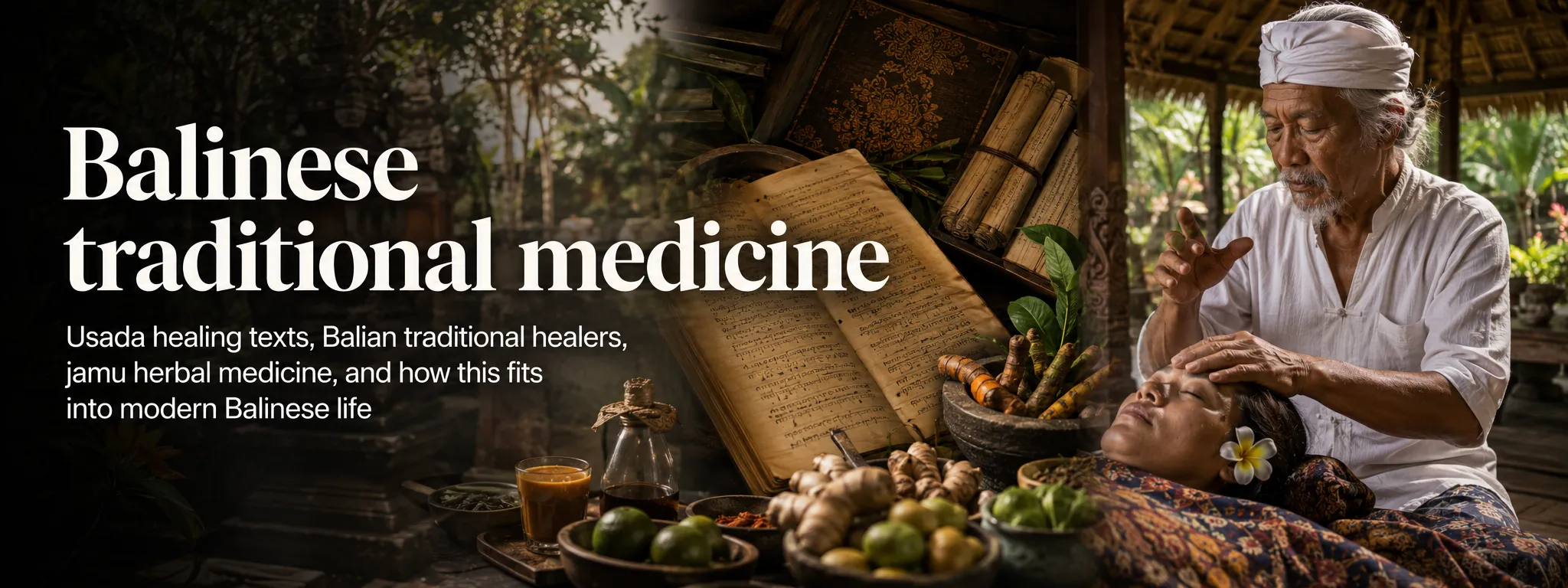
01 There is no single “Balinese medicine” system
Travel advertising often packages Balinese healing as one ancient system with a tidy set of rules. Real life is messier and more interesting. Practices can include herbal preparations, massage and manipulation, household remedies, ritual, prayer, consultation with a balian and written Usada knowledge. Different families and practitioners emphasise different parts of that picture.
Many Balinese people move comfortably between customary practice and modern healthcare. A family may use a familiar herbal drink or warming body paste for everyday comfort, seek ritual help for a problem understood spiritually, and still go to a doctor, pharmacy or hospital when medical diagnosis or treatment is needed. Tradition and clinical care are not mutually exclusive.
02 Usada: Bali’s written healing tradition
Usada is a useful word to know because it points to a body of Balinese healing knowledge rather than a tourist spa style. Some of that knowledge was recorded in lontar palm-leaf manuscripts, while other parts were passed through families and practitioners. Texts can discuss plants, preparations, massage, diagnosis, ritual and ideas about balance and illness.
The presence of old manuscripts shows an intellectual tradition with its own history, but age is not proof that every remedy is effective or harmless. Recipes, dosages and interpretations vary, and plants can interact with medicines or be unsafe in pregnancy and certain medical conditions. Treat Usada as cultural knowledge, not as automatic clinical evidence.
03 Balian healers are not all the same
Balian is a broad Balinese term for a traditional healer. One practitioner may be known for massage or bone-setting, another for herbs, another for ritual or divination, and another for a family tradition combining several approaches. Their authority may come from apprenticeship, family lineage, local reputation, religious experience or a mixture of these.
For visitors, that variety matters. A driver, hotel or friend saying “I know a balian” does not tell you what the person actually does, what hygiene standards they follow or whether their service is appropriate for your problem. Ask what will happen in a consultation, what it costs, whether touch is involved and whether you can stop at any time.
04 Jamu, boreh and spa versions of tradition
Jamu is frequently marketed in Bali as if it were uniquely Balinese, but it belongs to a much wider Indonesian herbal tradition. Fresh and bottled jamu is sold throughout Indonesia, with recipes differing by place and household. Bali has local preparations and preferences, but the broader tradition should be described honestly.
Boreh is more specifically associated with Bali: a warming herbal body preparation used in household and traditional contexts. Modern spas often turn boreh into a polished scrub or wrap. That can be enjoyable, but a spa treatment inspired by tradition is not the same thing as a medical service, and words such as “detox”, “healing” or “ancient remedy” deserve the same scepticism they would anywhere else.
05 Why spiritual practice can be part of healing
Balinese Hindu life does not sharply separate the body, family, community, environment and sacred world in the way a modern clinic does. Some problems may therefore be understood partly through spiritual or social relationships, and ritual may be meaningful even when it is not intended as a biomedical treatment.
Visitors do not need to adopt those beliefs to treat them respectfully. The sensible middle ground is neither to mock ritual as superstition nor to romanticise it as secret medicine. A ceremony or consultation can carry cultural, emotional and spiritual meaning without replacing diagnosis, antibiotics, surgery, vaccination or other evidence-based care when those are needed.
06 Health safety: know where culture ends and medicine begins
If you are seriously unwell or injured in Bali, use an appropriate clinic or hospital. Breathing difficulty, heavy bleeding, altered consciousness, severe allergic reaction, suspected poisoning, neurological symptoms, major trauma, persistent high fever or rapidly worsening illness are not situations for experimenting with an unfamiliar remedy first.
Be cautious with anything you swallow or apply to broken skin when the ingredients or hygiene are unclear. Herbal products can cause allergies and interact with prescription medicines. If you have a chronic condition, take regular medication, are pregnant or are treating a child, check with a qualified health professional before using concentrated herbal preparations.
07 Red flags around healers and wellness businesses
A respectful practitioner should be able to explain what they intend to do and allow you to decline. Walk away from anyone who guarantees a cure, tells you to stop prescribed medication without medical supervision, pressures you into repeated expensive visits, insists doctors must not know, uses sexualised touching without clear consent or makes you feel trapped.
Also separate cultural prestige from clinical competence. A beautiful setting, traditional clothing, celebrity endorsement or claims of generations of knowledge can tell you something about presentation or reputation; they do not prove a treatment works for a specific disease. The same rule applies to luxury spas using medical-sounding language.
08 If you want a traditional experience
Approach it as a cultural encounter rather than a hunt for a miracle. Ask your accommodation or a trusted local contact what kind of practitioner they are recommending and why. Find out whether the session is primarily massage, spiritual consultation, herbs or ritual. Agree on price and boundaries before it starts.
Photography should never be assumed. Some consultations are private, some ritual spaces are sensitive and some families may welcome visitors only through personal connections. Dress modestly if you are entering a family compound or sacred area, follow instructions and do not turn another person’s practice into social-media theatre.
09 Useful words without pretending to be an expert
Usada refers broadly to Balinese healing knowledge; balian is a traditional healer; boreh is a Balinese herbal body preparation; and jamu is a wider Indonesian herbal tradition. You may also hear tirta for holy water in religious contexts. These terms describe different things and should not be collapsed into one “Balinese wellness” label.
Knowing a few terms helps you ask better questions, but local usage can vary. If someone explains their practice differently from a travel article, listen first. Cultural traditions are lived and changing, and the person in front of you is not obliged to fit a neat glossary.
10 The bottom line for travellers
Traditional healing is worth understanding because it reveals how Balinese ideas about health, family, spirituality and everyday life can overlap. It is also an area where tourism marketing easily becomes exaggerated. The best approach combines curiosity, consent and a clear line between cultural experience and medical treatment.
Enjoy massage, herbal traditions or a respectful consultation if they interest you. Keep your normal health judgement switched on, use qualified care when you are sick, and be wary of anyone selling certainty. That gives the tradition more respect, not less.