
01 Jepun: Bali’s instantly recognisable flower
Frangipani, usually called jepun in Bali, is one of the island’s most recognisable flowers. The thick petals, strong fragrance and sculptural trees appear in temple courtyards, family compounds, hotels and roadside gardens.
The association is so strong that visitors often assume the plant originated in Bali. Species of Plumeria actually come from the tropical Americas, but the flower has become deeply woven into Balinese aesthetics and religious practice after centuries of cultivation.
Plumeria is a small tree rather than a delicate bedding plant. It can lose leaves in drier periods and still flower heavily, which is why bare twisting branches covered with blossoms are such a familiar sight. The flowers are waxy and durable enough to survive handling better than many softer tropical blooms.
02 Why frangipani appears in offerings
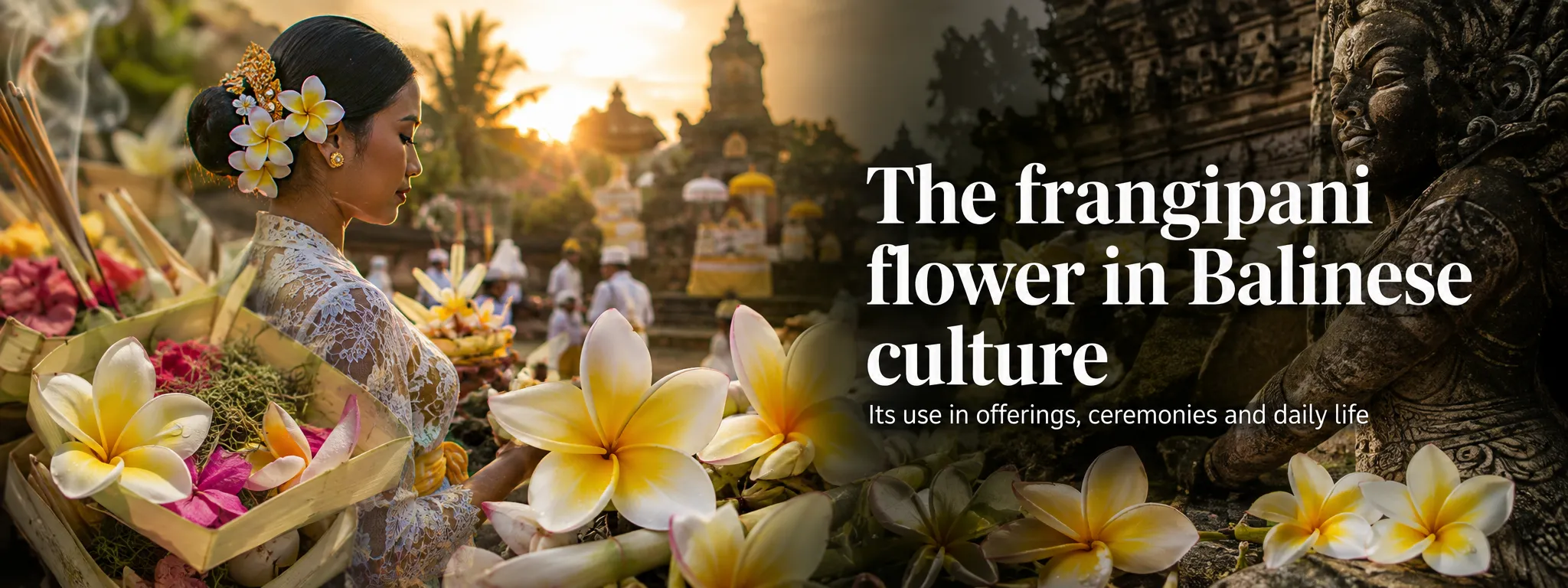
Fresh flowers are a common element of Balinese Hindu offerings, including the small daily canang sari baskets seen outside homes, shops and temples. Jepun is one of several flowers that may be used because it is abundant, fragrant and easy to gather.
Do not reduce every colour or flower placement to a single universal code. Offerings vary by ritual, family, temple and available materials. The important point is that flowers are not merely decoration: they are part of an act of devotion.
Offerings are assembled from what is locally meaningful and available, so jepun may appear beside other flowers, leaves, food and incense. Watching a family or temple community prepare them makes the flower’s role clearer: it is one material in a wider devotional practice, not a standalone icon with one fixed dictionary definition.
03 Why temple courtyards are full of frangipani trees
Frangipani trees suit Bali’s climate and architecture beautifully. Their branching forms create dappled shade without turning a courtyard into a dense canopy, while fallen flowers provide a steady supply for offerings and decoration.
That practical usefulness sits comfortably beside the flower’s sacred associations. A mature jepun tree beside old stone can look as if it has always been there, which is one reason the combination has become such a powerful visual shorthand for Bali.
04 From family compounds to hotels
You will also see jepun in family compounds and modern landscaping. Hotels and spas use the flower heavily because visitors already associate it with tropical calm, so the same plant can move between religious, domestic and commercial settings.
Context matters. A flower tucked behind someone’s ear at a dance performance is not the same thing as a flower placed in a shrine. Bali’s visual culture is full of shared materials whose meaning changes with place and purpose.
05 White-and-yellow is only one version
The classic Bali postcard flower is creamy white with a yellow centre, but frangipani comes in pinks, reds, yellows and blended tones as well. Different cultivars vary in petal shape, fragrance and tree form.
Colour can carry ritual associations in Balinese Hindu practice, but visitors should be cautious about online charts that claim one fixed meaning for every flower in every ceremony. Religious symbolism is more contextual than a souvenir infographic suggests.
06 Flowers in hair and performance
Frangipani frequently appears in hair styling, dance costumes and ceremonial dress. Sometimes it is part of formal performance presentation; sometimes it is simply a beautiful fresh flower worn casually.
If you are invited to wear one, there is nothing inherently disrespectful about it. The issue is where the flower came from and how you behave with it. Picking directly from a temple shrine or dismantling an offering for a photo is a very different matter.
07 A simple etiquette rule: sacred first, souvenir second
Do not pluck flowers from offerings, shrines or clearly maintained temple arrangements. Do not step on offerings to reach a photogenic tree. Fallen flowers on ordinary ground may look tempting, but in sacred spaces it is still better to leave things where they are.
If you want a frangipani for a photo or room, ask your accommodation or buy flowers from a market. Respect is easier than trying to decode every religious boundary after you have already crossed it.
08 The scent is part of Bali’s sensory memory
Frangipani fragrance is strongest at particular times and varies by cultivar. Combined with incense, damp stone and tropical evening air, it becomes part of the sensory memory many travellers carry away from temples and gardens.
That is worth noticing because Bali is often experienced visually first. Stop looking through the camera for a moment and the smell of jepun can tell you just as clearly where you are.
In the dry season, fallen jepun can collect beneath almost leafless branches; after rain, glossy new leaves change the whole tree. That seasonal shift is another reason the plant never looks exactly the same from trip to trip.
09 How to photograph frangipani without cliché
The obvious shot is a perfect flower on a stone statue. There is nothing wrong with that, but frangipani is more interesting when photographed in context: a tree shading a family compound, petals scattered after rain, flowers being prepared for offerings or branches framing temple architecture.
Always ask before photographing people preparing religious items at close range. The best cultural photographs come from observation and permission, not rearranging someone else’s ritual objects.
10 What one flower reveals about Bali
Jepun shows how Bali absorbs outside influences and makes them feel completely local. A plant that did not originate on the island now appears inseparable from its temples, offerings and tourism imagery.
That does not make the symbolism fake. Culture is built through use, memory and repetition. Once you start noticing frangipani in daily life rather than only in hotel logos, it becomes a small but useful doorway into how religion, domestic space and beauty overlap in Bali.
For visitors, that makes frangipani a useful lesson in avoiding the idea that authentic culture must be ancient and untouched. Plants, foods, materials and artistic forms move between places. What matters is how communities adopt them, use them and attach meaning over time.